Cumnoria
- Lived
- 152 to 149 million years ago, Late Jurassic
- Diet
- Herbivore
- Group
- Ornithopods
- Found in
- United Kingdom
- Named by
- Seeley 1888
Where its fossils were found
The evidence
Today

150 million years ago
Habitat
It lived on land in Late Jurassic England, beside seas where the Kimmeridge Clay accumulated. Dacentrurus and Juratyrant also lived in this region.
Field notes
About Cumnoria
What it was like
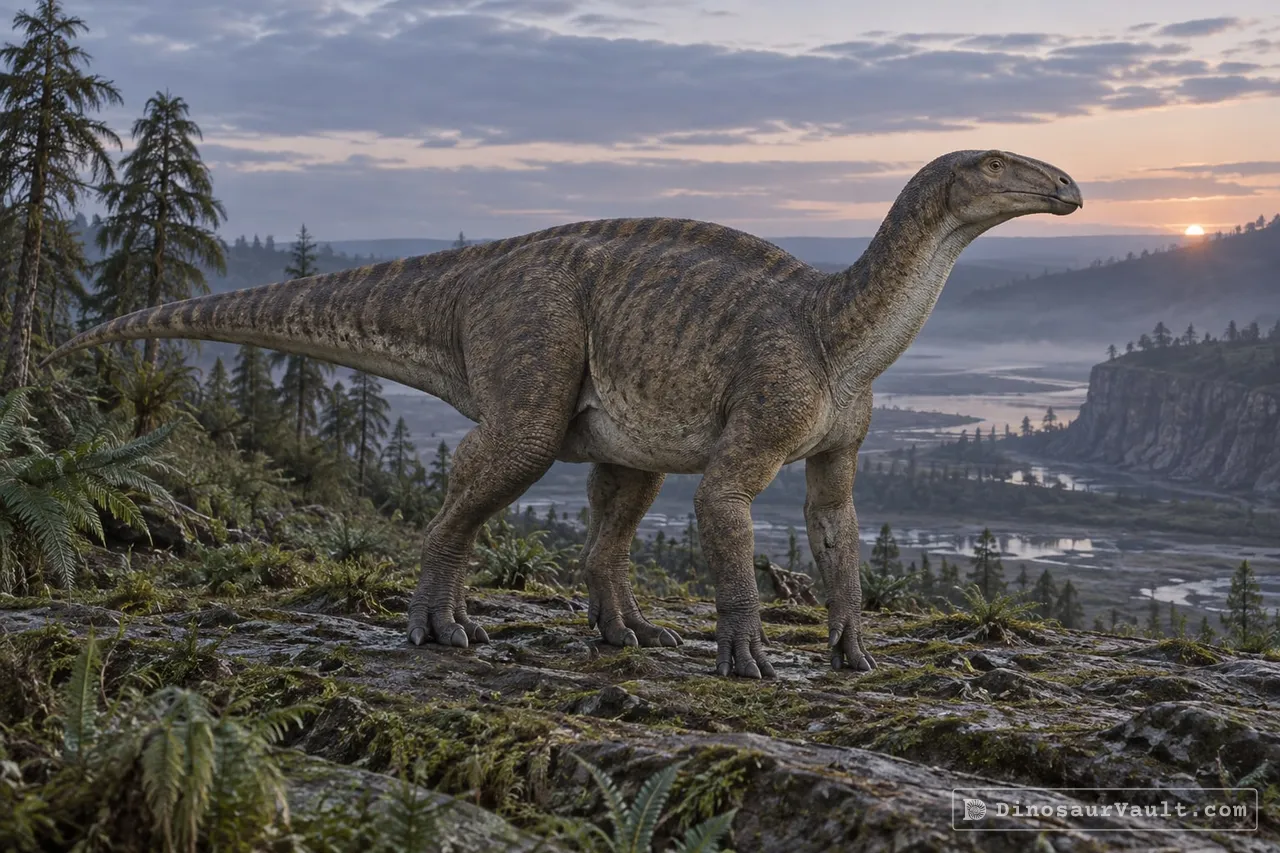
Cumnoria was a plant eater related to Iguanodon, known from a partial skeleton and skull. It walked on two legs but probably could drop onto all fours.
Its world
It lived in the Late Jurassic, in what is now England. It comes from the Kimmeridge Clay, rocks laid down in the sea. The stegosaur Dacentrurus and the tyrannosaur relative Juratyrant have also been found in rocks of this age in England.
How it was found
Seeley named Cumnoria in 1888. For many years it was placed in Camptosaurus. Later studies disagree, but the latest full redescription keeps Cumnoria as a separate genus.
Field gallery
More views of Cumnoria
Scenes reconstructed from the available fossil evidence.
1 of 3
Lived alongside
Found in the same rock formations


A rock formation can hold fossils laid down millions of years apart, so not every animal here met Cumnoria.
The evidence
The science behind Cumnoria
Which parts of the picture come from its own bones, and which come from its relatives.
From its own fossils
- A partial skull and skeleton of one relatively lightly built plant eater.
- The latest redescription found two features of the shoulder girdle that it treats as unique to Cumnoria, separating it from Camptosaurus.
- The upper jaw bone has a shelf above the tooth row.
Borrowed from relatives
- The front of the head, the neck, hands and feet are restored by comparison with Camptosaurus.
- The ribcage and tail are restored by comparison with the later iguanodontian Eolambia.
Still unknown
- The exact shape of its shoulder blades, coracoids and hips, which are damaged or broken in the skeleton.
- The size and proportions of a fully grown adult.
- Its skin colors and patterns.
Discovery timeline
- 1888Named itSeeley
- 2011Family treeMCDONALD
- 2012Family treeMcDonald
- 2022Full descriptionMaidment et al.
- 2026Family treeRotatori et al.
Key papers
The research behind what we know of Cumnoria
Named it
Gave Cumnoria its own genus name for the plant-eating dinosaur from the Kimmeridge Clay.
On Cumnoria, an iguanodont genus founded upon the Iguanodon prestwichi, Hulke. Report of the British Association for the Advancement of Science 57: 698
No link available
Family tree
Reviewed the species assigned to Camptosaurus and returned the English species to its own genus, Cumnoria.
The taxonomy of species assigned to Camptosaurus (Dinosauria: Ornithopoda). Zootaxa 2783
Read the paper : The taxonomy of species assigned to Camptosaurus (Dinosauria: Ornithopoda) (opens in a new tab)Family tree
Compared early iguanodontians and supported dividing animals formerly grouped together under Camptosaurus and Iguanodon into separate genera.
Phylogeny of Basal Iguanodonts (Dinosauria: Ornithischia): An Update. PLoS ONE 7: e36745
Read the paper : Phylogeny of Basal Iguanodonts (Dinosauria: Ornithischia): An Update (opens in a new tab)Full description
Redescribed the skeleton, found two shoulder features unique to Cumnoria, and placed it as an early iguanodontian outside the group that includes Camptosaurus.
OSTEOLOGY AND RELATIONSHIPS OF CUMNORIA PRESTWICHII (ORNITHISCHIA: ORNITHOPODA) FROM THE LATE JURASSIC OF OXFORDSHIRE, UK. Monographs of the Palaeontographical Society 176: 1-55
Read the paper : OSTEOLOGY AND RELATIONSHIPS OF CUMNORIA PRESTWICHII (ORNITHISCHIA: ORNITHOPODA) FROM THE LATE JURASSIC OF OXFORDSHIRE, UK (opens in a new tab)Family tree
A large family-tree study of iguanodontians also placed Cumnoria just outside the group that includes Camptosaurus and Iguanodon.
The early origin of Iguanodontia: new insights into the macroevolution, diversity and biogeography of the clade. Palaeontology 69
Read the paper : The early origin of Iguanodontia: new insights into the macroevolution, diversity and biogeography of the clade (opens in a new tab)
Close relatives
Other members of Styracosterna


Sources: Wikidata