Soriatitan
"Soria titan"
Type species Soriatitan golmayensis
- Lived
- 133 to 121 million years ago, Early Cretaceous
- Diet
- Herbivore
- Group
- Sauropods, Brachiosauridae
- Found in
- Spain
- Named by
- Royo-Torres et al. 2017
Where its fossils were found
The evidence
Today

125 million years ago
Habitat
Rivers, lakes and muddy floodplains covered this part of Spain. Polacanthus and Magnamanus are also known from the Golmayo Formation.
Field notes
About Soriatitan
What it was like
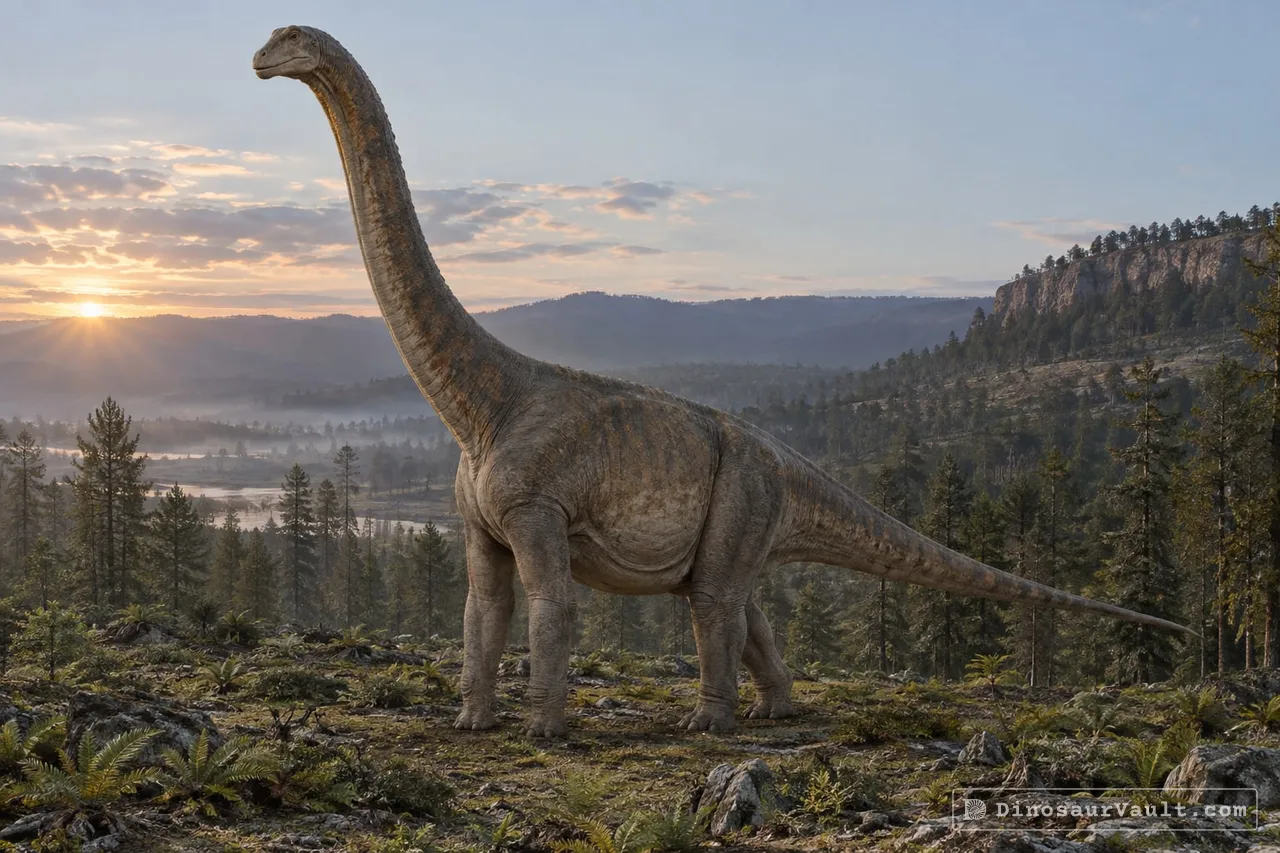
Soriatitan was a long-necked plant eater, often placed among the brachiosaurids. It is known from part of the skeleton and a single tooth. Its exact place in the sauropod family tree changes between studies.
Its world
It lived in the Early Cretaceous, in what is now Spain. It comes from the Golmayo Formation, where the armored Polacanthus and the plant eater Magnamanus have also been found. Its describers considered it one of the last brachiosaurids known from Europe.
How it was found
Royo-Torres and colleagues named Soriatitan in 2017. The type species is Soriatitan golmayensis.
Field gallery
More views of Soriatitan
Scenes reconstructed from the available fossil evidence.
Lived alongside
Found in the same rock formations


A rock formation can hold fossils laid down millions of years apart, so not every animal here met Soriatitan.
The evidence
The science behind Soriatitan
Which parts of the picture come from its own bones, and which come from its relatives.
From its own fossils
- The partial skeleton includes a single partly spoon-shaped tooth, back vertebrae and ribs, part of the hip vertebrae, tail vertebrae, an upper arm, both forearm bones, parts of the hip bones and part of a thigh bone.
- Some tail vertebrae have upper spines that lean forward, as in Cedarosaurus and Venenosaurus.
- Its upper arm bone has a straight outer edge from the head down the shaft, a feature shared with Cedarosaurus.
Borrowed from relatives
- The missing skull and front of the neck are restored by comparison with Abydosaurus, a brachiosaurid with a complete skull.
- The body, lower legs, feet and tail follow Cedarosaurus, with Mnyamawamtuka for parts of the neck and feet, and the hands follow Brachiosaurus and Camarasaurus.
Still unknown
- The shape of its skull and the length of its neck.
- Its exact place in the family tree. It falls among brachiosaurids in some analyses, but one study found its position changes when different species are included.
- How it grew and whether it lived in groups.
Discovery timeline
- 2010Close relativeChure et al.
- 2013Close relativeMannion et al.
- 2017Named itRoyo-Torres et al.
- 2017Close relativeMannion, Allain & Moine
Key papers
The research behind what we know of Soriatitan
Close relative
Described the complete skull and neck vertebrae of Abydosaurus, a brachiosaurid from North America.
First complete sauropod dinosaur skull from the Cretaceous of the Americas and the evolution of sauropod dentition. Naturwissenschaften 97: 379-391
Read the paper : First complete sauropod dinosaur skull from the Cretaceous of the Americas and the evolution of sauropod dentition (opens in a new tab)Close relative
Redescribed Lusotitan and compared brachiosaurid anatomy, providing a framework for interpreting fragmentary relatives such as Soriatitan.
Osteology of the Late Jurassic Portuguese sauropod dinosaurLusotitan atalaiensis(Macronaria) and the evolutionary history of basal titanosauriforms. Zoological Journal of the Linnean Society 168: 98-206
Read the paper : Osteology of the Late Jurassic Portuguese sauropod dinosaurLusotitan atalaiensis(Macronaria) and the evolutionary history of basal titanosauriforms (opens in a new tab)Named it
Described the partial skeleton and placed Soriatitan among brachiosaurids, linking its anatomy to relatives in North America.
A new Brachiosauridae Sauropod dinosaur from the lower Cretaceous of Europe (Soria Province, Spain). Cretaceous Research 80: 38-55
Read the paper : A new Brachiosauridae Sauropod dinosaur from the lower Cretaceous of Europe (Soria Province, Spain) (opens in a new tab)Close relative
Named Vouivria and revised brachiosaurid relationships, providing another European comparison for Soriatitan.
The earliest known titanosauriform sauropod dinosaur and the evolution of Brachiosauridae. PeerJ 5: e3217
Read the paper : The earliest known titanosauriform sauropod dinosaur and the evolution of Brachiosauridae (opens in a new tab)
Close relatives
Other members of Brachiosauridae


Sources: Wikidata