Riabininohadros
"Riabinin's hadrosaur"
Type species Riabininohadros weberae
- Lived
- 72 to 66 million years ago, Late Cretaceous
- Diet
- Herbivore
- Group
- Ornithopods
- Found in
- Ukraine
- Named by
- Ulansky 2015
Where its fossils were found
The evidence
Today

70 million years ago
Habitat
It lived on land in what is now Ukraine near the end of the Late Cretaceous.
Field notes
About Riabininohadros
What it was like
Riabininohadros was a plant eater related to the duck-billed dinosaurs, known from bones of the legs and hips.
Its world
It lived about 72 to 66 million years ago, at the end of the Late Cretaceous, in what is now Ukraine.
How it was found
Its bones were first described as a species of another genus. Ulansky gave them their own genus in 2015.
Field gallery
More views of Riabininohadros
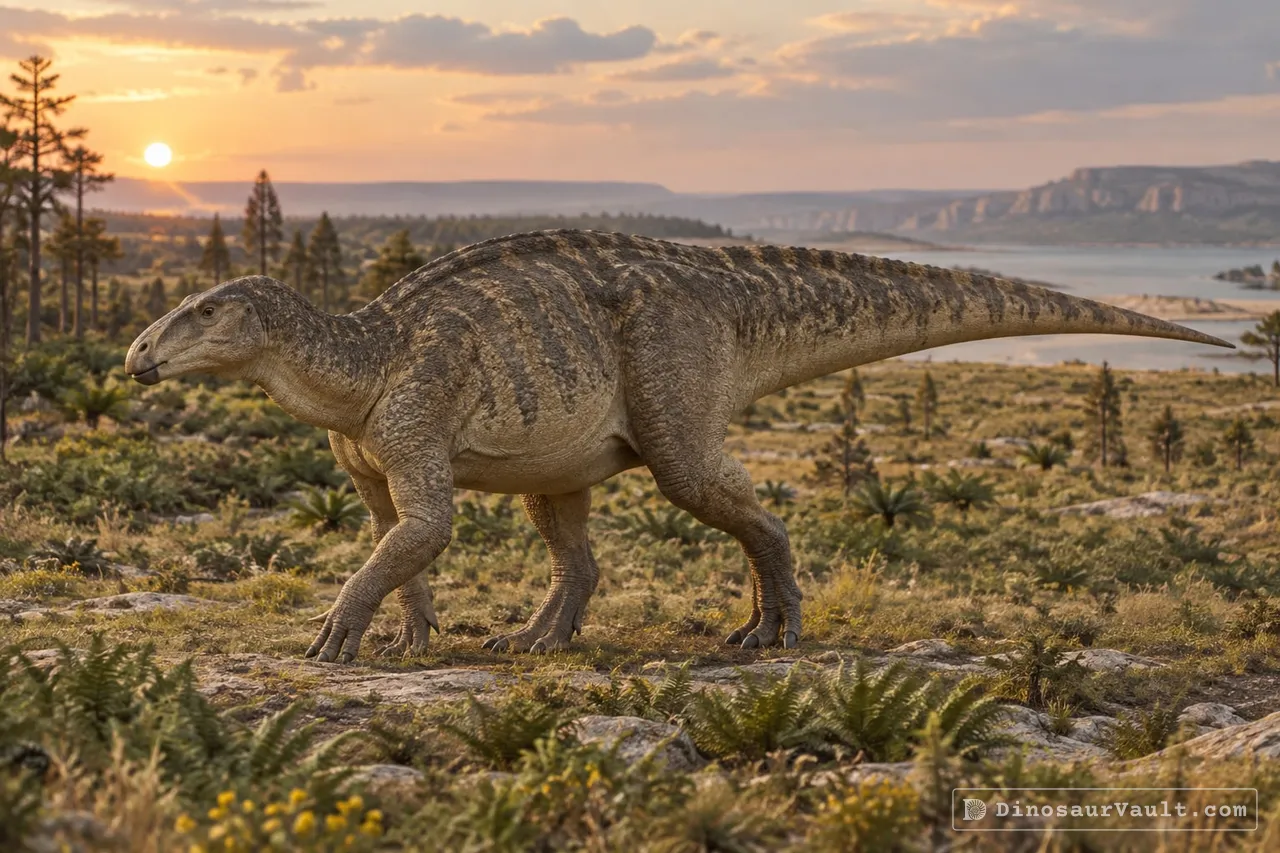
Scenes reconstructed from the available fossil evidence.
1 of 2
The evidence
The science behind Riabininohadros
Which parts of the picture come from its own bones, and which come from its relatives.
From its own fossils
- The type material includes thigh, shin, ankle and foot bones.
- Its thigh bone has an unusual knee joint, with a groove that opens to the side.
- The middle foot bone is long and slender, while the preserved base bone of the second toe is short and stout.
Borrowed from relatives
- The missing head and trunk are restored by comparison with better-known plant-eating ornithopods such as Iguanodon.
Still unknown
- The shape of its skull.
- Experts have disagreed over whether the fragmentary remains are enough to define a separate genus, and its closest relatives are not settled.
- Its color and skin pattern.
Discovery timeline
- 2015Named itUlansky
- 2019RedescriptionAverianov & Lopatin
- 2020RedescriptionLopatin & Averianov
Key papers
The research behind what we know of Riabininohadros
Named it
Proposed Riabininohadros as a genus for the old species; a later paper made the name available under zoological naming rules.
Riabininohadros, novyy rod dlya gadrozavra iz maastrikhta Kryma Rossiya []. Dinologia.
No link available
Redescription
Restudied the leg bones, corrected earlier identifications of the knee and ankle pieces, and placed Riabininohadros outside the duckbill group.
Dinosaur Fossils from the Upper Cretaceous of Crimea. Paleontological Journal 53: 398-410
Read the paper : Dinosaur Fossils from the Upper Cretaceous of Crimea (opens in a new tab)Redescription
Formally established the genus name under zoological naming rules after the earlier publication failed to meet them.
Riabininohadros, a New Genus for the Ornithischian Dinosaur Orthomerus weberae (Ornithopoda, Iguanodontia) from the Late Cretaceous of Crimea. Paleontological Journal 54: 320-322
Read the paper : Riabininohadros, a New Genus for the Ornithischian Dinosaur Orthomerus weberae (Ornithopoda, Iguanodontia) from the Late Cretaceous of Crimea (opens in a new tab)
Close relatives
Other members of Styracosterna


Sources: Wikidata