Machairoceratops
"bent sword horned face"
Type species Machairoceratops cronusi
- Lived
- 84 to 72 million years ago, Late Cretaceous
- Diet
- Herbivore
- Group
- Ceratopsians, Ceratopsidae
- Found in
- United States
- Named by
- Lund et al. 2016
Where its fossils were found
The evidence
Today

80 million years ago
Habitat
Rivers crossed a low floodplain, with some channels influenced by tides. Other dinosaurs from the Wahweap Formation include Diabloceratops, Lythronax and Adelolophus.
Field notes
About Machairoceratops
What it was like
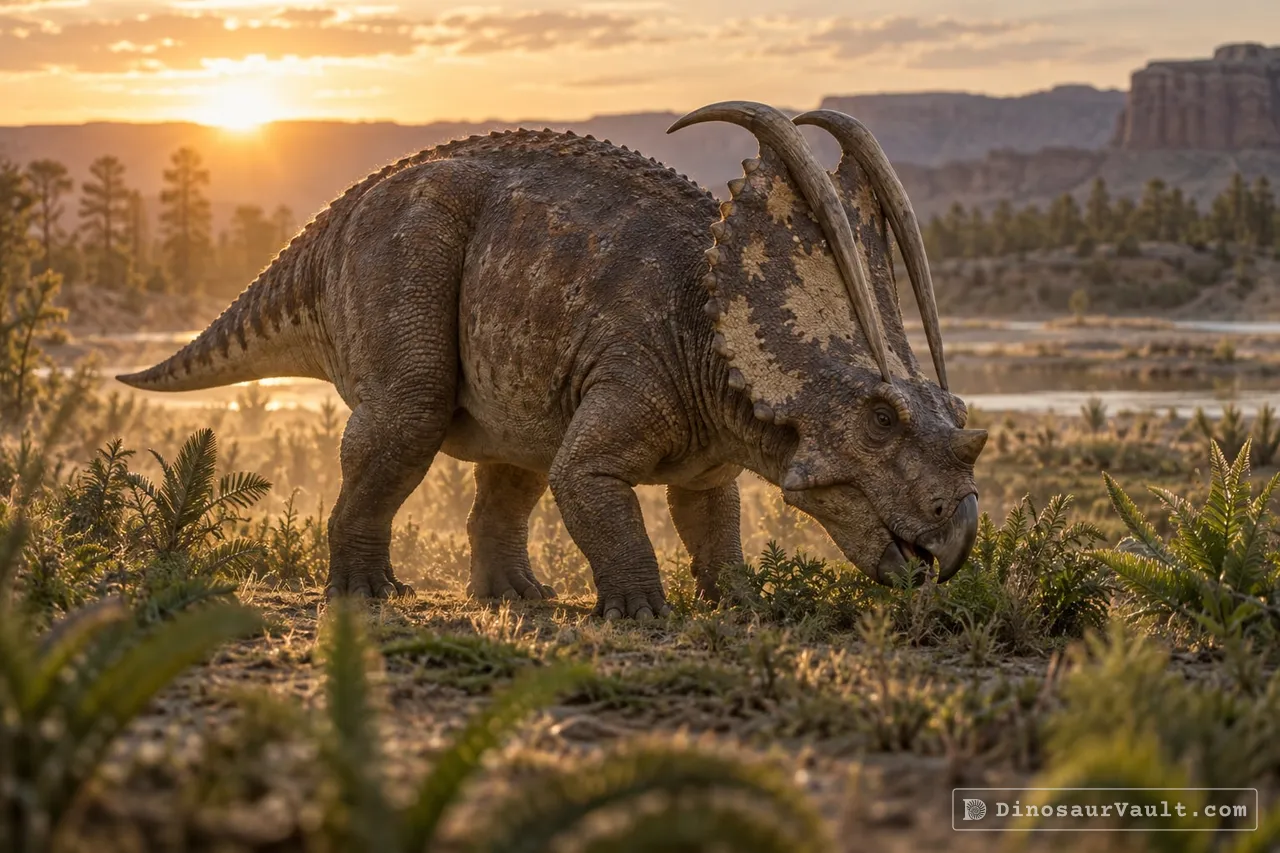
Machairoceratops was a horned dinosaur with two long, curved spikes at the top of its frill that bent forward and down, like sword blades. Its nose horn is not known.
Its world
It lived in the Late Cretaceous in what is now southern Utah, in the United States. Its fossil comes from the Wahweap Formation, where it shared the land with the horned Diabloceratops, the tyrannosaur Lythronax and the duck-billed Adelolophus.
How it was found
Lund and colleagues named Machairoceratops in 2016, from a single skull.
Field gallery
More views of Machairoceratops
Scenes reconstructed from the available fossil evidence.
Lived alongside
Found in the same rock formations


A rock formation can hold fossils laid down millions of years apart, so not every animal here met Machairoceratops.
The evidence
The science behind Machairoceratops
Which parts of the picture come from its own bones, and which come from its relatives.
From its own fossils
- A partial skull preserves long brow horns, cheek and frill bones, and much of the braincase.
- The triangular frill carries a pair of long spikes that curve forward and have a groove along their rear surface.
Borrowed from relatives
- The missing body is restored using other centrosaurines, such as Centrosaurus: a heavy trunk supported by four sturdy legs.
- Diabloceratops provides a close comparison for the triangular frill and its long spikes.
Still unknown
- The shape of its nose horn.
- Whether the known animal was fully grown.
- Its skin color and the outer covering of its horns.
Discovery timeline
- 2011Its worldJinnah & Roberts
- 2013Same rocksLoewen et al.
- 2016Named itLund et al.
Key papers
The research behind what we know of Machairoceratops
Its world
Traced changing rivers, floodplains and tidal channels through the Wahweap Formation, describing the landscapes that buried its dinosaurs.
Facies Associations, Paleoenvironment, and Base-Level Changes in the Upper Cretaceous Wahweap Formation, Utah, U.S.A. Journal of Sedimentary Research 81: 266-283
Read the paper : Facies Associations, Paleoenvironment, and Base-Level Changes in the Upper Cretaceous Wahweap Formation, Utah, U.S.A. (opens in a new tab)Same rocks
Named Lythronax from the Wahweap Formation and linked tyrannosaur evolution to changing seas that divided their habitats.
Tyrant Dinosaur Evolution Tracks the Rise and Fall of Late Cretaceous Oceans. PLoS ONE 8: e79420
Read the paper : Tyrant Dinosaur Evolution Tracks the Rise and Fall of Late Cretaceous Oceans (opens in a new tab)Named it
Described the partial skull and its curved frill spikes, placing Machairoceratops among the early branches of the centrosaurine family tree.
A New Centrosaurine Ceratopsid, Machairoceratops cronusi gen et sp. nov., from the Upper Sand Member of the Wahweap Formation (Middle Campanian), Southern Utah. PLOS ONE 11: e0154403
Read the paper : A New Centrosaurine Ceratopsid, Machairoceratops cronusi gen et sp. nov., from the Upper Sand Member of the Wahweap Formation (Middle Campanian), Southern Utah (opens in a new tab)
Close relatives
Other members of Ceratopsidae


Sources: Wikidata