Adelolophus
"unknown crest"
Type species Adelolophus hutchisoni
- Lived
- 84 to 72 million years ago, Late Cretaceous
- Diet
- Herbivore
- Group
- Ornithopods, Hadrosauridae
- Found in
- United States
- Named by
- Gates et al. 2014
Where its fossils were found
The evidence
Today

80 million years ago
Habitat
It lived on river floodplains in what is now Utah. Other dinosaurs from the Wahweap Formation include Lythronax, Diabloceratops and Machairoceratops.
Field notes
About Adelolophus
What it was like
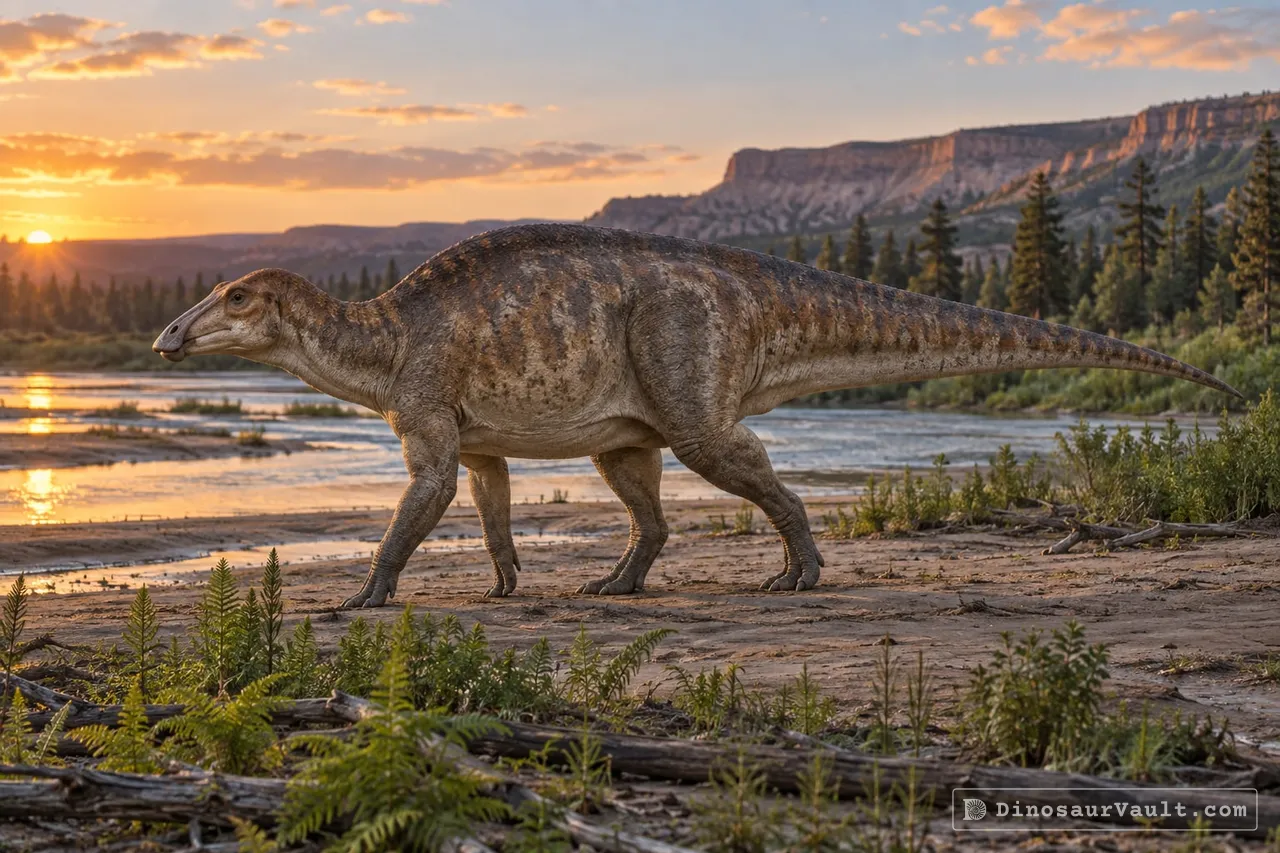
Adelolophus was a duck-billed dinosaur from the branch of hadrosaurs that carried hollow crests. It is known only from a broken upper jaw bone, so the shape of its crest is unknown, which is where its name comes from.
Its world
It lived in the Late Cretaceous in what is now Utah, in the United States. Its fossil comes from the Wahweap Formation, where it shared the land with the tyrannosaur Lythronax and the horned Diabloceratops and Machairoceratops.
How it was found
Gates and colleagues named Adelolophus in 2014, from a single find. It is one of the oldest crested hadrosaurs from North America.
Field gallery
More views of Adelolophus
Scenes reconstructed from the available fossil evidence.
Lived alongside
Found in the same rock formations


A rock formation can hold fossils laid down millions of years apart, so not every animal here met Adelolophus.
The evidence
The science behind Adelolophus
Which parts of the picture come from its own bones, and which come from its relatives.
From its own fossils
- A broken upper jaw bone is the only described fossil of Adelolophus.
- The jaw has a tall, narrow upper portion and a raised ridge along its inner surface.
Borrowed from relatives
- Parasaurolophus provides a comparison for the missing connection between the upper jaw and cheek.
- Hadrosaurs such as Edmontosaurus provide comparisons for restoring the beak, body and feet.
Still unknown
- The shape and size of its crest.
- Its complete body proportions and skin covering.
- Its color and how its head changed as it grew.
Discovery timeline
- 2014Named itGates et al.
- 2017Close relativeXing, Mallon & Currie
- 2026Close relativeSereno et al.
Key papers
The research behind what we know of Adelolophus
Named it
Named Adelolophus from a partial upper jaw with distinctive ridges and placed it among the crested hadrosaurs.
New hadrosaurid (Dinosauria, Ornithopoda) specimens from the lower-middle Campanian Wahweap Formation of southern Utah. Hadrosaurs.
No link available
Close relative
Described Edmontosaurus skull anatomy in detail, providing a broader hadrosaur comparison for the missing beak of Adelolophus.
Supplementary cranial description of the types of Edmontosaurus regalis (Ornithischia: Hadrosauridae), with comments on the phylogenetics and biogeography of Hadrosaurinae. PLOS ONE 12: e0175253
Read the paper : Supplementary cranial description of the types of Edmontosaurus regalis (Ornithischia: Hadrosauridae), with comments on the phylogenetics and biogeography of Hadrosaurinae (opens in a new tab)Close relative
Described hoof coverings in Edmontosaurus, a comparison for restoring feet in hadrosaurs whose own feet are missing.
Duck-billed dinosaur fleshy midline and hooves reveal terrestrial clay-template “mummification”. Science 391
Read the paper : Duck-billed dinosaur fleshy midline and hooves reveal terrestrial clay-template “mummification” (opens in a new tab)
Close relatives
Other members of Hadrosauridae


Sources: Wikidata