Nqwebasaurus
"Nqweba lizard"
- Lived
- 143 to 133 million years ago, Early Cretaceous
- Diet
- Omnivore
- Length
- about 1 m (3 ft)
- Group
- Theropods
- Found in
- South Africa
- Named by
- de Klerk et al. 2000
Size comparison
To scale

Scale in metersOutline: typical theropod shape
Where its fossils were found
The evidence
Today

140 million years ago
Habitat
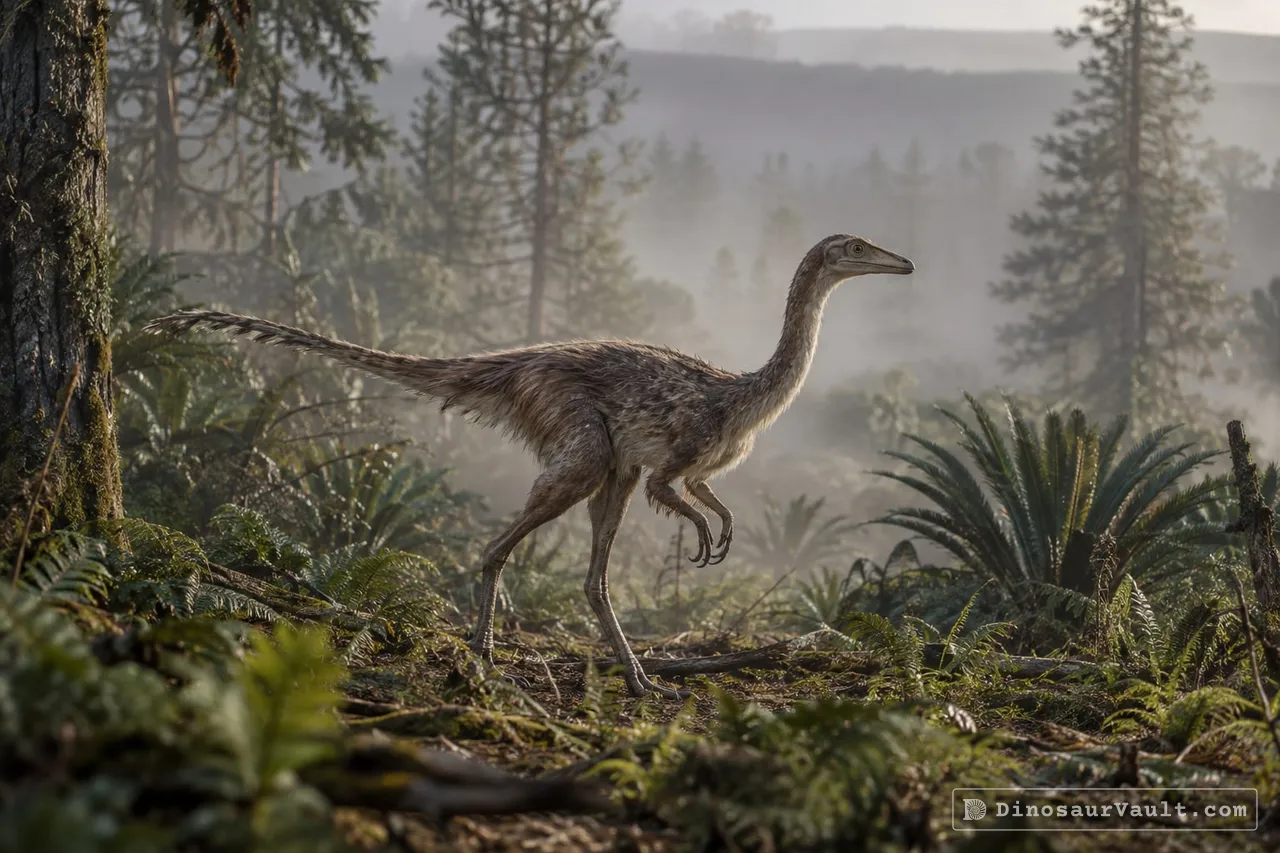
Rivers crossed a landscape with conifers, cycads and ferns in the Kirkwood Formation. Paranthodon and Iyuku were among its neighbors.
Field notes
About Nqwebasaurus
What it was like
Nqwebasaurus was a small, early ostrich-like dinosaur, about 1 meter (3 feet) long. It had long legs and a long hand with a large claw. Small stones found in its belly may have helped it grind plant food.
Its world
It lived in the Early Cretaceous in what is now South Africa. Its bones come from the Kirkwood Formation, where the stegosaur Paranthodon also lived.
How it was found
De Klerk and colleagues named it in 2000.
Field gallery
More views of Nqwebasaurus
Scenes reconstructed from the available fossil evidence.
1 of 3
Lived alongside
Found in the same rock formations


A rock formation can hold fossils laid down millions of years apart, so not every animal here met Nqwebasaurus.
The evidence
The science behind Nqwebasaurus
Which parts of the picture come from its own bones, and which come from its relatives.
From its own fossils
- One well-preserved partial skeleton includes the neck, arms, legs and long, slender feet. Most of the back, hips and tail are missing.
- The long hand has a grasping thumb whose claw is more strongly curved than the other hand claws. The short toe claws are nearly flat underneath.
- Further preparation revealed small, cone-shaped upper teeth without serrated edges. Stomach stones were preserved in its belly.
Borrowed from relatives
- The missing front of the snout and lower jaw, the back, hips and base of the tail are restored by comparison with the early ornithomimosaur Shenzhousaurus.
Still unknown
- The shape of its snout tip and the front of its lower jaw.
- The balance of plants and other food in its diet.
- Its skin covering and color.
Discovery timeline
- 2000Named itDe Klerk et al.
- 2003Close relativeJI et al.
- 2012Full descriptionChoiniere, Forster & de Klerk
- 2015Inside the bonesWatanabe et al.
- 2023Family treeHattori et al.
Key papers
The research behind what we know of Nqwebasaurus
Named it
Described a small theropod with grasping hands, slender feet and stomach stones.
A new coelurosaurian dinosaur from the Early Cretaceous of South Africa. Journal of Vertebrate Paleontology 20: 324-332
Read the paper : A new coelurosaurian dinosaur from the Early Cretaceous of South Africa (opens in a new tab)Close relative
Named Shenzhousaurus, an early ostrich-like dinosaur from China known from a skeleton with a crushed skull, backbone and hips.
An Early Ostrich Dinosaur and Implications for Ornithomimosaur Phylogeny. American Museum Novitates 3420: 1
Read the paper : An Early Ostrich Dinosaur and Implications for Ornithomimosaur Phylogeny (opens in a new tab)Full description
Newly exposed teeth and skull bones supported placing Nqwebasaurus among the earliest branches of the ostrich-like dinosaurs.
New information on Nqwebasaurus thwazi, a coelurosaurian theropod from the Early Cretaceous Kirkwood Formation in South Africa. Journal of African Earth Sciences 71-72: 1-17
Read the paper : New information on Nqwebasaurus thwazi, a coelurosaurian theropod from the Early Cretaceous Kirkwood Formation in South Africa (opens in a new tab)Inside the bones
Reexamined Nqwebasaurus neck vertebrae and identified a recess suggesting that air sacs extended into their upper arches.
Vertebral Pneumaticity in the Ornithomimosaur Archaeornithomimus (Dinosauria: Theropoda) Revealed by Computed Tomography Imaging and Reappraisal of Axial Pneumaticity in Ornithomimosauria. PLOS ONE 10: e0145168
Read the paper : Vertebral Pneumaticity in the Ornithomimosaur Archaeornithomimus (Dinosauria: Theropoda) Revealed by Computed Tomography Imaging and Reappraisal of Axial Pneumaticity in Ornithomimosauria (opens in a new tab)Family tree
Named the early ornithomimosaur Tyrannomimus from Japan and discussed Nqwebasaurus as another early member of the group.
New theropod dinosaur from the Lower Cretaceous of Japan provides critical implications for the early evolution of ornithomimosaurs. Scientific Reports 13
Read the paper : New theropod dinosaur from the Lower Cretaceous of Japan provides critical implications for the early evolution of ornithomimosaurs (opens in a new tab)
Close relatives
Other members of Ornithomimosauria


Sources: Wikidata