Itapeuasaurus
"Itapeua lizard"
- Lived
- 101 to 94 million years ago, Late Cretaceous
- Diet
- Herbivore
- Group
- Sauropods, Rebbachisauridae
- Found in
- Brazil
- Named by
- Lindoso et al. 2019
Where its fossils were found
The evidence
Today

95 million years ago
Habitat
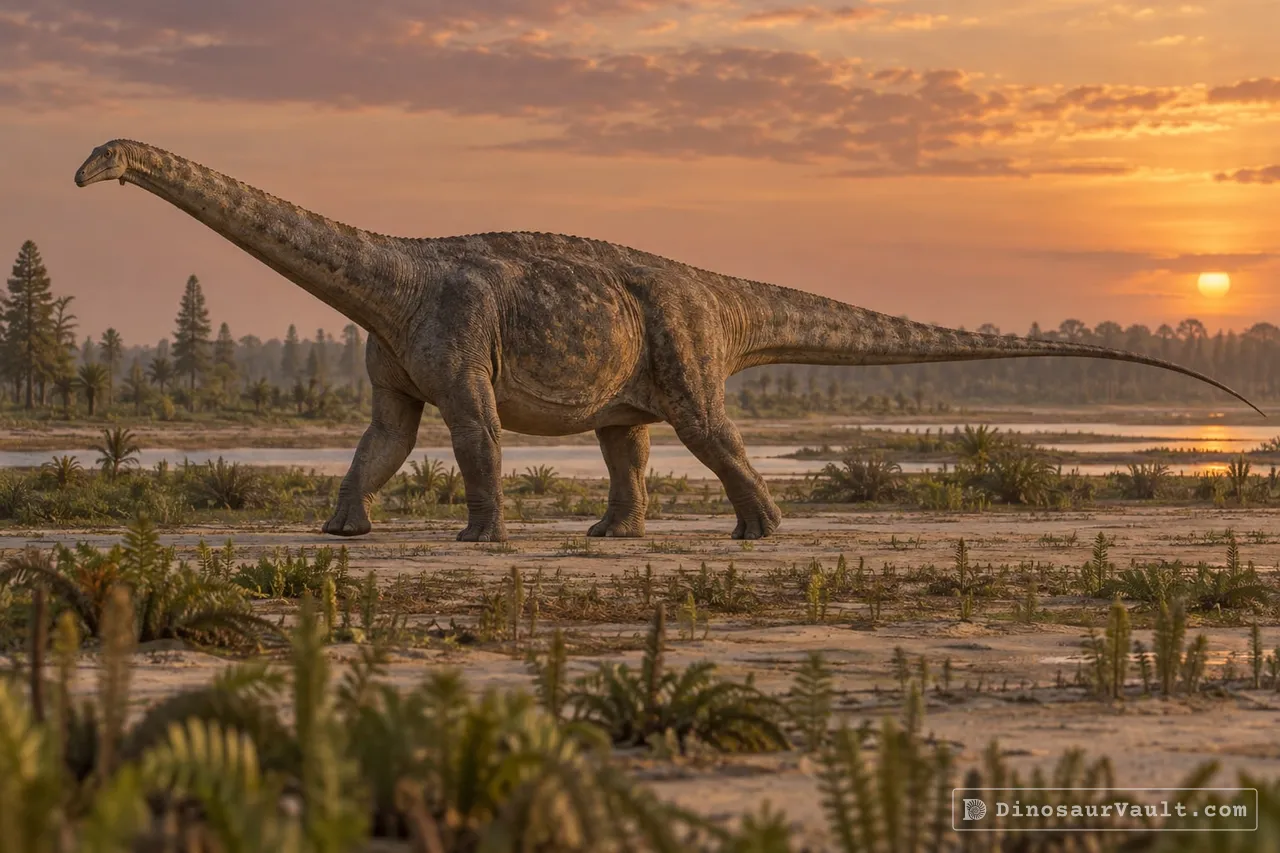
The coastal landscape of northern Brazil had humid forests amid drier country, with conifers, ferns and horsetails. Oxalaia and Carcharodontosaurus are also recorded from the Alcântara Formation.
Field notes
About Itapeuasaurus
What it was like
Itapeuasaurus was a rebbachisaurid, a long-necked plant eater related to Nigersaurus. It is known from a partial skeleton with bones of the back and tail.
Its world
It lived in the Late Cretaceous in what is now northern Brazil. Its bones come from the Alcântara Formation, a coastal land shared with the spinosaur Oxalaia.
How it was found
Lindoso and colleagues named it in 2019. It is named after a beach near where it was found.
Field gallery
More views of Itapeuasaurus
Scenes reconstructed from the available fossil evidence.
1 of 3
Lived alongside
Found in the same rock formations


A rock formation can hold fossils laid down millions of years apart, so not every animal here met Itapeuasaurus.
The evidence
The science behind Itapeuasaurus
Which parts of the picture come from its own bones, and which come from its relatives.
From its own fossils
- The type specimen is part of a back vertebra and several tail vertebrae from the front and middle of the tail. The top of a vertebral spine, another tail vertebra, bones from beneath the tail and a partial hip bone were also assigned to it.
- Deep hollows in a back vertebra are divided by thin, slanting walls of bone.
- The side projections of the front tail vertebrae have unusually thin upper and lower branches.
Borrowed from relatives
- The missing skull and neck are restored after Lavocatisaurus, a rebbachisaurid known from much of its skull and neck.
Still unknown
- The shape of its skull and teeth, and the full length of its neck and tail.
- Its skin texture and color.
- Its exact place among rebbachisaurids. One analysis puts it near the base of Rebbachisaurinae under one weighting method but not under another, and a recent review places it outside Khebbashia.
Discovery timeline
- 2007Close relativeSereno et al.
- 2014Its worldMedeiros et al.
- 2019Named itLindoso et al.
- 2025Family treeMannion & Moore
Key papers
The research behind what we know of Itapeuasaurus
Close relative
Described the lightweight skull and specialized teeth of Nigersaurus, a better-preserved member of the same sauropod family as Itapeuasaurus.
Structural Extremes in a Cretaceous Dinosaur. PLoS ONE 2: e1230
Read the paper : Structural Extremes in a Cretaceous Dinosaur (opens in a new tab)Its world
Reviewed plants and animals from the Alcântara Formation and reconstructed humid forests surrounded by drier landscapes.
The Cretaceous (Cenomanian) continental record of the Laje do Coringa flagstone (Alcântara Formation), northeastern South America. Journal of South American Earth Sciences 53: 50-58
Read the paper : The Cretaceous (Cenomanian) continental record of the Laje do Coringa flagstone (Alcântara Formation), northeastern South America (opens in a new tab)Named it
Named Itapeuasaurus from back and tail bones, identifying distinctive hollows and ridges in its vertebrae.
A new rebbachisaurid (Sauropoda: Diplodocoidea) from the middle Cretaceous of northern Brazil. Cretaceous Research 104: 104191
Read the paper : A new rebbachisaurid (Sauropoda: Diplodocoidea) from the middle Cretaceous of northern Brazil (opens in a new tab)Family tree
A revised family tree of diplodocoids that included Itapeuasaurus placed it early in Rebbachisaurinae under one weighting method.
Critical reappraisal of a putative dicraeosaurid sauropod dinosaur from the Middle Jurassic of Gondwana and a revised view of diplodocoid evolutionary relationships and biogeography. Journal of Systematic Palaeontology 23
Read the paper : Critical reappraisal of a putative dicraeosaurid sauropod dinosaur from the Middle Jurassic of Gondwana and a revised view of diplodocoid evolutionary relationships and biogeography (opens in a new tab)
Close relatives
Other members of Rebbachisauridae


Sources: Wikidata