Oxalaia
- Lived
- 101 to 94 million years ago, Late Cretaceous
- Diet
- Carnivore
- Group
- Theropods, Spinosauridae
- Found in
- Brazil
- Named by
- Kellner et al. 2011
Where its fossils were found
The evidence
Today

95 million years ago
Habitat
Its fossils come from coastal and estuary deposits in Brazil, with conifers, ferns and horsetails. Animals recorded from the broader region include Carcharodontosaurus and Itapeuasaurus.
Field notes
About Oxalaia
What it was like
Oxalaia was a large, fish-eating theropod with a long, narrow snout lined with straight teeth, built for gripping slippery prey much like a crocodile's jaws. As a spinosaurid, it was likely a strong swimmer or wader that hunted in rivers and along coastlines, and may also have taken other prey such as small dinosaurs when the chance arose. It is known as one of the largest predatory dinosaurs so far found in Brazil.
Its world
Oxalaia lived in what is now Brazil during the Late Cretaceous, between about 101 and 94 million years ago. Its remains, from a single find, come from the Alcântara Formation. It shared its world with the predator Carcharodontosaurus and the sauropod Itapeuasaurus.
How it was found
Kellner and colleagues named Oxalaia in 2011, based on two partial skull bones. It belongs to Spinosauridae, the family of fish-eating theropods that also includes Spinosaurus, Baryonyx, and Suchomimus. Because so little of its skeleton is known, some researchers have suggested Oxalaia may be the same animal as Spinosaurus, though others consider it a distinct genus.
Field gallery
More views of Oxalaia
Scenes reconstructed from the available fossil evidence.
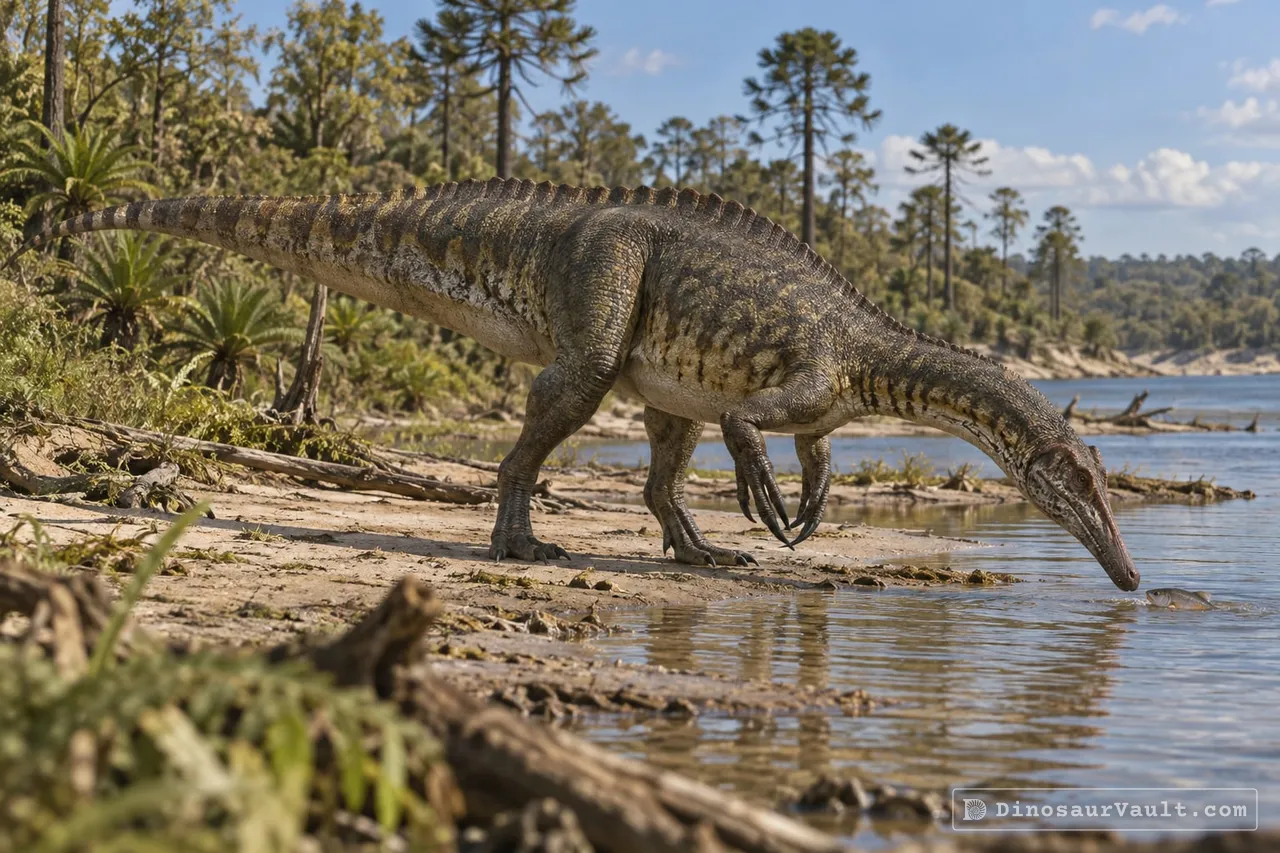
1 of 4
Lived alongside
Found in the same rock formations


A rock formation can hold fossils laid down millions of years apart, so not every animal here met Oxalaia.
The evidence
The science behind Oxalaia
Which parts of the picture come from its own bones, and which come from its relatives.
From its own fossils
- The preserved snout tip widens into a rounded rosette around the front teeth.
- Its snout holds conical teeth, and a separate fragment of the upper jaw was assigned to the same species.
Borrowed from relatives
- The long, narrow jaws are completed by comparison with Spinosaurus and other spinosaurids.
- Any full-body restoration borrows its backbone, limbs and tail from relatives such as Spinosaurus.
Still unknown
- Its adult size and the proportions of its limbs and body.
- Whether it had a tall sail or a deep swimming tail.
- Whether it was a distinct genus or a close match for Spinosaurus.
Discovery timeline
- 2009Same rocksKELLNER et al.
- 2011Named itKellner et al.
- 2014Its worldMedeiros et al.
Key papers
The research behind what we know of Oxalaia
Same rocks
Described a crocodile relative from the same fossil locality and showed that the deposit mixed remains reworked from older sediments.
A new crocodyliform from the Alcântara Formation (Cenomanian), Cajual Island, Brazil. Zootaxa 2030
Read the paper : A new crocodyliform from the Alcântara Formation (Cenomanian), Cajual Island, Brazil (opens in a new tab)Named it
Named Oxalaia from a widened snout tip and a referred fragment of the upper jaw from Brazil.
A new dinosaur (Theropoda, Spinosauridae) from the Cretaceous (Cenomanian) Alcântara Formation, Cajual Island, Brazil. Anais da Academia Brasileira de Ciências 83: 99-108
Read the paper : A new dinosaur (Theropoda, Spinosauridae) from the Cretaceous (Cenomanian) Alcântara Formation, Cajual Island, Brazil (opens in a new tab)Its world
Reviewed the coastal fossil deposits that yielded Oxalaia, including their dinosaurs, other vertebrates and plants.
The Cretaceous (Cenomanian) continental record of the Laje do Coringa flagstone (Alcântara Formation), northeastern South America. Journal of South American Earth Sciences 53: 50-58
Read the paper : The Cretaceous (Cenomanian) continental record of the Laje do Coringa flagstone (Alcântara Formation), northeastern South America (opens in a new tab)
Close relatives
Other members of Spinosauridae


Sources: Wikidata