Irritator
IH-rih-TAY-tor
"one who irritates"
- Lived
- 120 to 113 million years ago, Early Cretaceous
- Diet
- Carnivore
- Length
- about 6.5 m (21 ft)
- Group
- Theropods, Spinosauridae
- Found in
- Brazil
- Named by
- Martill et al. 1996
Size comparison
To scale


Scale in meters
Where its fossils were found
The evidence
Today

115 million years ago
Habitat
Coastal lagoons and nearby river channels in the Romualdo Formation of Brazil. Santanaraptor and Mirischia were among the small theropods of this region.
Field notes
About Irritator
What it was like
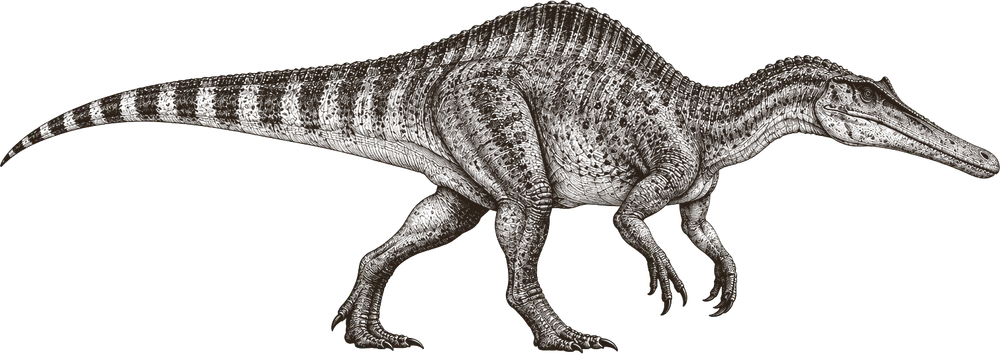
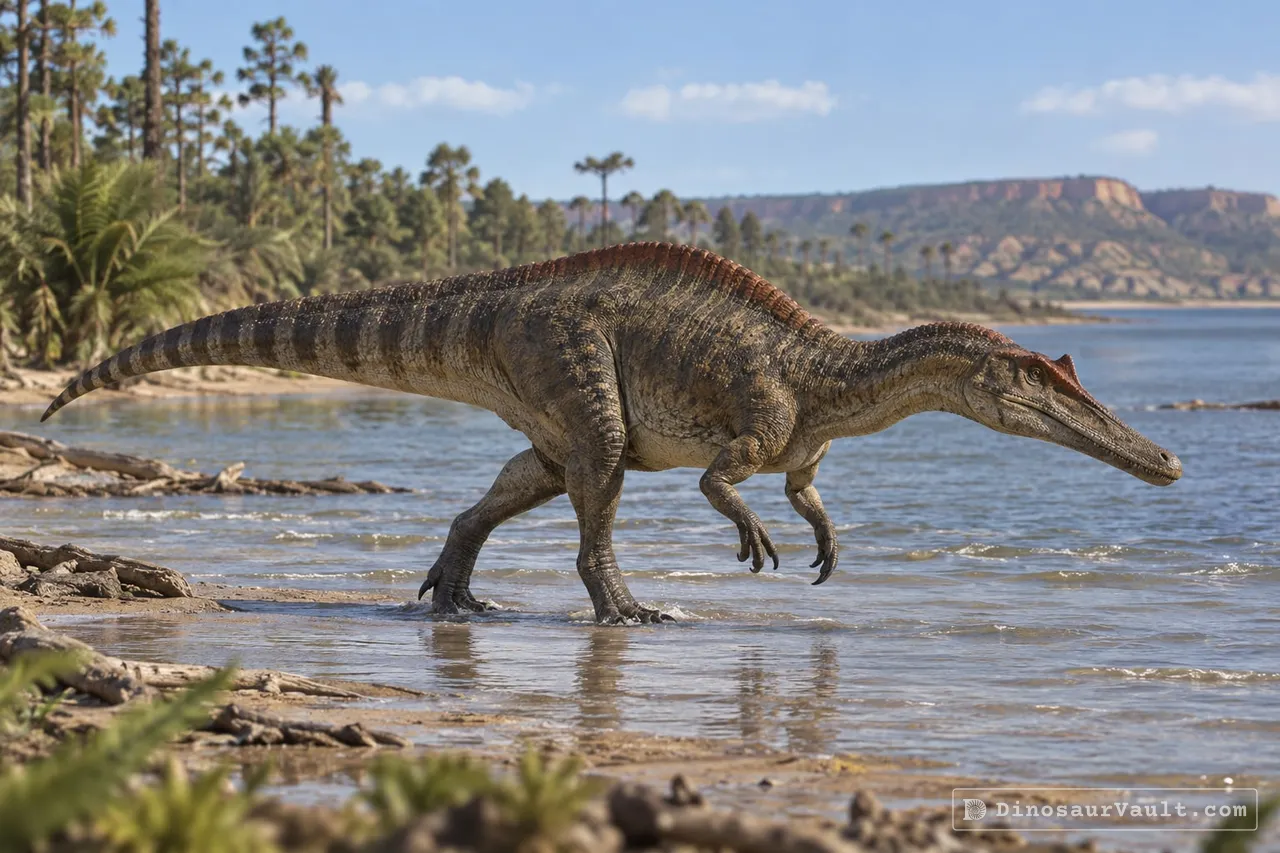
Irritator had a long, narrow, crocodile-like snout lined with straight, unserrated teeth built for gripping slippery prey. A low, bony crest ran along the top of its head, and it likely carried a sail of skin along its back like other spinosaurids. It grew to roughly 6.5 meters (21 feet) long, making it one of the smaller members of its family.
Its nostrils sat well back from the tip of the snout, an adaptation that may have let it breathe even with its jaws partly submerged. Paleontologists think Irritator hunted fish and other small prey near water, and one fossil shows it had eaten a pterosaur.
Its world
Irritator lived from about 120 to 113 million years ago, in the Early Cretaceous, in what is now Brazil. Its skull comes from the Romualdo Formation.
It shared its coastal habitat with smaller theropods such as Santanaraptor, Mirischia, and Aratasaurus, along with turtles, crocodile relatives, and many species of pterosaurs and fish.
How it was found
Martill and colleagues named Irritator in 1996, from a skull that had been damaged and reshaped before scientists could study it properly, which is how the genus got its name. Only one confirmed fossil find is known. Some paleontologists think the similar spinosaurid Angaturama, named from a snout tip found nearby, may be the same animal as Irritator, though this remains debated.
Field gallery
More views of Irritator
Scenes reconstructed from the available fossil evidence.
1 of 7
Lived alongside
Found in the same rock formations


A rock formation can hold fossils laid down millions of years apart, so not every animal here met Irritator.
The evidence
The science behind Irritator
Which parts of the picture come from its own bones, and which come from its relatives.
From its own fossils
- A nearly complete skull preserves long, narrow jaws with straight teeth lacking serrated cutting edges.
- The nostrils sit well behind the snout tip, and a low crest runs along the top of the skull.
- Scans of the skull show joints that may have let the lower jaws spread apart as the mouth opened.
Borrowed from relatives
- The arms, legs and tail are restored from other spinosaurids, including Baryonyx and Suchomimus.
- The enlarged first-finger claws follow its relatives; lips and mostly scaly skin are inferred from other theropods.
Still unknown
- The proportions of its body, the height of its back and the shape of its tail.
- Its color and the extent of any skin or feather covering.
- Whether Angaturama represents the same animal.
Often drawn wrong
- A tall horn on the head exaggerates the low crest preserved in its skull.
- Its palms should face inward rather than flat toward the ground.
Discovery timeline
- 1996Named itMARTILL et al.
- 2002Full descriptionSues et al.
- 2017Family treeSales & Schultz
- 2020SkullSchade, Rauhut & Evers
- 2023How it fedSchade et al.
Key papers
The research behind what we know of Irritator
Named it
Named Irritator from a skull whose snout had been altered before scientists studied it.
A new crested maniraptoran dinosaur from the Santana Formation (Lower Cretaceous) of Brazil. Journal of the Geological Society 153: 5-8
Read the paper : A new crested maniraptoran dinosaur from the Santana Formation (Lower Cretaceous) of Brazil (opens in a new tab)Full description
Restudied the prepared skull and confirmed that Irritator belonged to the spinosaur family.
Irritator challengeri, a spinosaurid (Dinosauria: Theropoda) from the Lower Cretaceous of Brazil. Journal of Vertebrate Paleontology 22: 535-547
Read the paper : Irritator challengeri, a spinosaurid (Dinosauria: Theropoda) from the Lower Cretaceous of Brazil (opens in a new tab)Family tree
Compared Brazilian spinosaur skulls and challenged the idea that the known Irritator and Angaturama skull pieces came from the same individual.
Spinosaur taxonomy and evolution of craniodental features: Evidence from Brazil. PLOS ONE 12: e0187070
Read the paper : Spinosaur taxonomy and evolution of craniodental features: Evidence from Brazil (opens in a new tab)Skull
Reconstructed the brain cavity and inner ear, proposing sensory adaptations that may have helped Irritator catch fish.
Neuroanatomy of the spinosaurid Irritator challengeri (Dinosauria: Theropoda) indicates potential adaptations for piscivory. Scientific Reports 10
Read the paper : Neuroanatomy of the spinosaurid Irritator challengeri (Dinosauria: Theropoda) indicates potential adaptations for piscivory (opens in a new tab)How it fed
Skull scans suggest rapid jaw closure and lower jaws that could spread apart, helping Irritator swallow small prey.
A reappraisal of the cranial and mandibular osteology of the spinosaurid Irritator challengeri (Dinosauria: Theropoda). Palaeontologia Electronica
Read the paper : A reappraisal of the cranial and mandibular osteology of the spinosaurid Irritator challengeri (Dinosauria: Theropoda) (opens in a new tab)
Close relatives
Other members of Spinosauridae


Sources: Wikidata