Ichthyovenator
ICK-thee-oh-veh-NAY-tor
"fish hunter"
- Lived
- 121 to 113 million years ago, Early Cretaceous
- Diet
- Carnivore
- Group
- Theropods, Spinosauridae
- Found in
- Laos
- Named by
- Allain et al. 2012
Where its fossils were found
The evidence
Today

115 million years ago
Habitat
It lived in a landscape of rivers and floodplains in Laos. Other dinosaurs recorded in these rocks include the long-necked Tangvayosaurus and the plant eater Mandschurosaurus.
Field notes
About Ichthyovenator
What it was like
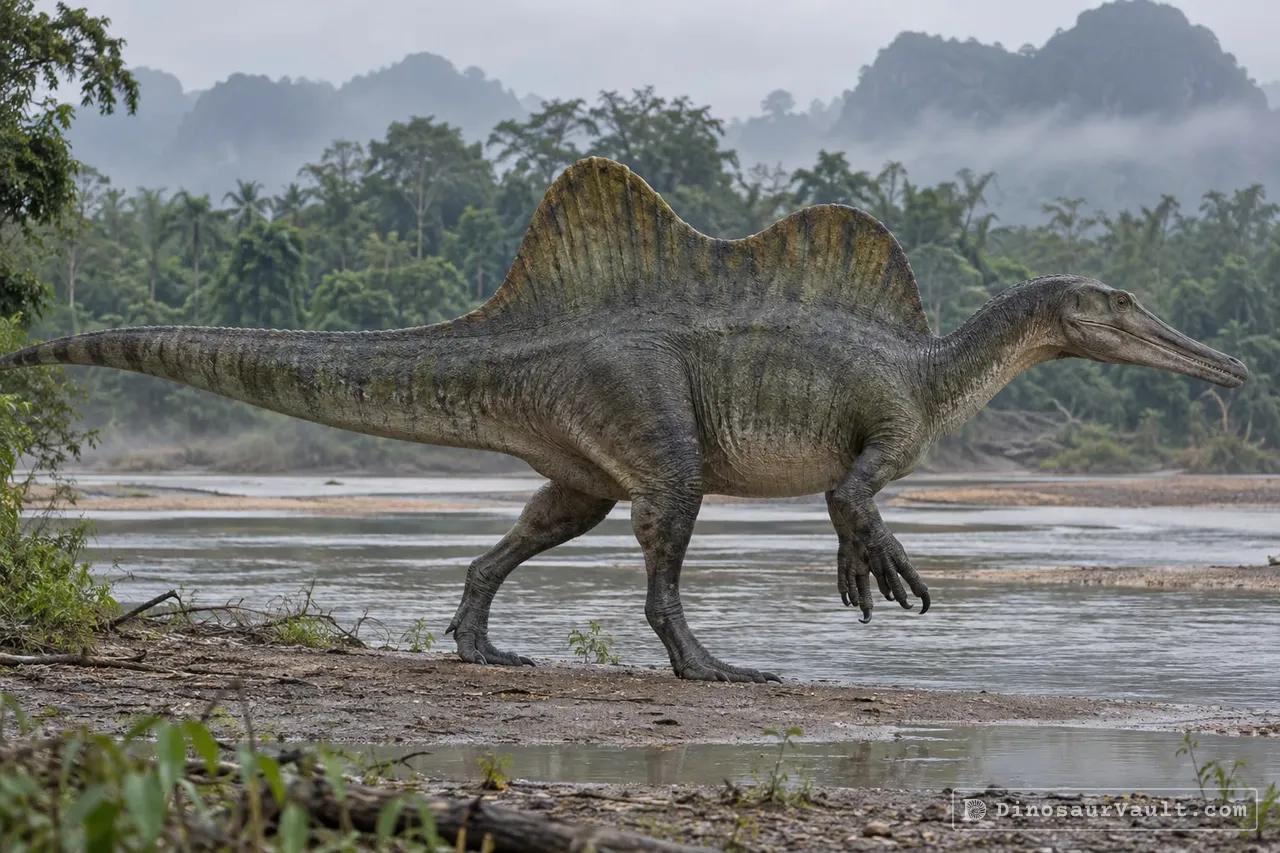
Ichthyovenator was a spinosaurid, a relative of Spinosaurus and Baryonyx. It had a sail on its back, and the sail dipped in the middle over the hips, making it look like two sails in a row.
Like its relatives it probably had a long, narrow snout and caught fish.
Its world
It lived about 121 to 113 million years ago, in the Early Cretaceous, in what is now Laos. Its fossils come from the Grès supérieurs Formation, where the long-necked Tangvayosaurus also lived.
How it was found
Allain and colleagues named Ichthyovenator in 2012, from one partial skeleton. More bones from the same animal were collected later.
Field gallery
More views of Ichthyovenator
Scenes reconstructed from the available fossil evidence.
1 of 2
Lived alongside
Found in the same rock formations

A rock formation can hold fossils laid down millions of years apart, so not every animal here met Ichthyovenator.
The evidence
The science behind Ichthyovenator
Which parts of the picture come from its own bones, and which come from its relatives.
From its own fossils
- A partly connected skeleton preserves hip bones, a rib, and parts of the backbone and base of the tail.
- Tall bony spines rise above the back and hips, with a dip over the front of the hips that gives the sail a wavy outline.
Borrowed from relatives
- The long, low snout and strong arms are restored by comparison with Baryonyx.
- The legs and far end of the tail follow a more general spinosaur body plan than the specialized one in Spinosaurus.
Still unknown
- The front edge of the sail and its full outline in life.
- The shape of its own skull and limbs.
- Its color and the purpose of its sail.
Often drawn wrong
- A single smooth sail crest misses the dip over its hips.
- Short hind legs and a deep paddle tail copy specialized features of Spinosaurus.
Discovery timeline
- 2012Named itAllain et al.
- 2013Close relativeCuff & Rayfield
- 2022Family treeMateus & Estraviz-López
Key papers
The research behind what we know of Ichthyovenator
Named it
Named Ichthyovenator from a partial skeleton in Laos and described the distinctive dip in its sail over the hips.
The first definitive Asian spinosaurid (Dinosauria: Theropoda) from the early cretaceous of Laos. Naturwissenschaften 99: 369-377
Read the paper : The first definitive Asian spinosaurid (Dinosauria: Theropoda) from the early cretaceous of Laos (opens in a new tab)Close relative
Compared the mechanics of spinosaur and crocodilian snouts, helping explain the long jaws inferred for Ichthyovenator from relatives.
Feeding Mechanics in Spinosaurid Theropods and Extant Crocodilians. PLoS ONE 8: e65295
Read the paper : Feeding Mechanics in Spinosaurid Theropods and Extant Crocodilians (opens in a new tab)Family tree
Named Iberospinus and compared its bones with Ichthyovenator and other spinosaurs to investigate relationships within the family.
A new theropod dinosaur from the early cretaceous (Barremian) of Cabo Espichel, Portugal: Implications for spinosaurid evolution. PLOS ONE 17: e0262614
Read the paper : A new theropod dinosaur from the early cretaceous (Barremian) of Cabo Espichel, Portugal: Implications for spinosaurid evolution (opens in a new tab)
Close relatives
Other members of Spinosauridae


Sources: Wikidata