Mirischia
"wonderful hip"
Type species Mirischia asymmetrica
- Lived
- 120 to 113 million years ago, Early Cretaceous
- Diet
- Carnivore
- Group
- Theropods
- Found in
- Brazil
- Named by
- Naish et al. 2004
Where its fossils were found
The evidence
Today

115 million years ago
Habitat
Coastal land in what is now Brazil lay beside waters rich in fish. Irritator and Santanaraptor also lived in the Romualdo Formation.
Field notes
About Mirischia
What it was like
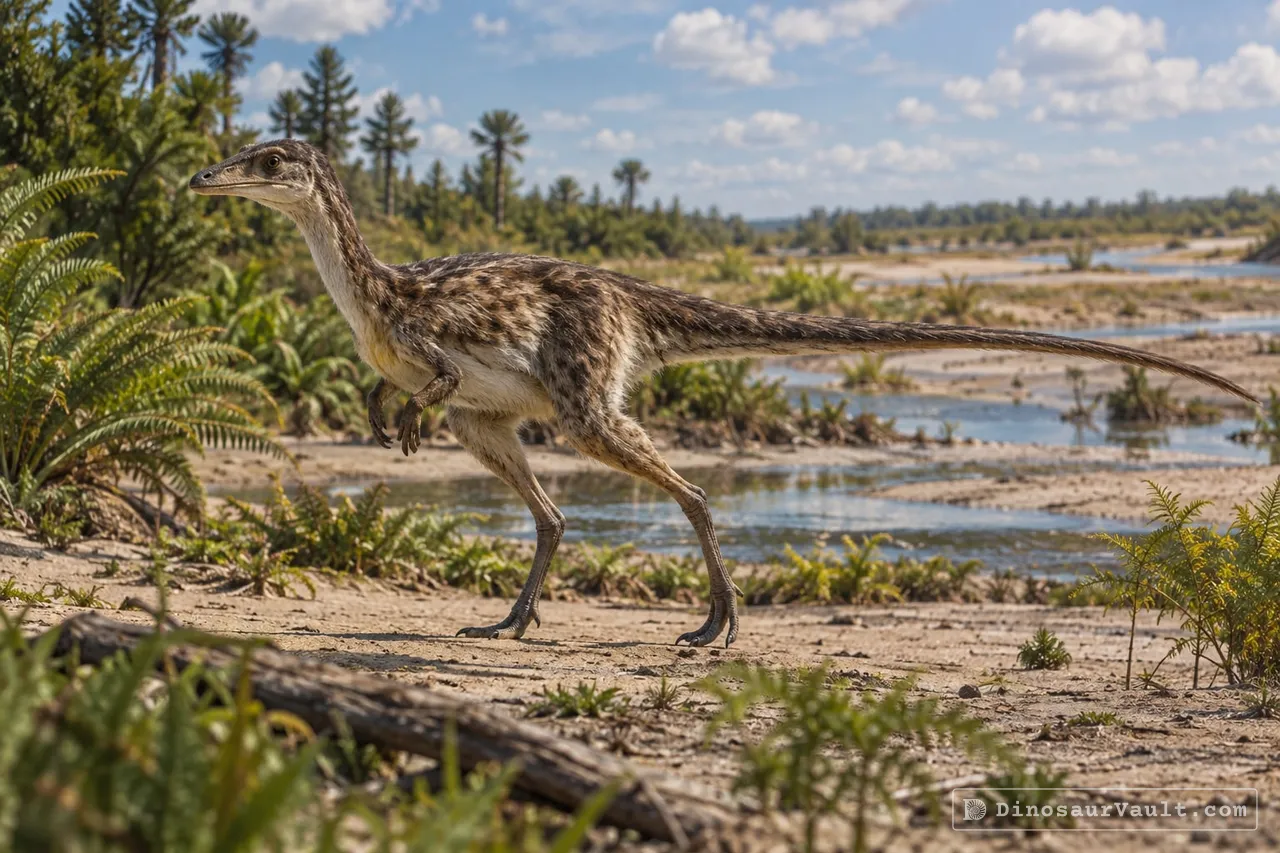
Mirischia was a small two-legged predator known from part of the hips, legs and backbone. Its hip bones differ from left to right. Some scientists think a space near the hip held an air sac, like those of birds.
Its world
It lived in the Early Cretaceous in what is now northeastern Brazil. Its bones come from the Romualdo Formation, a coastal land shared with the spinosaur Irritator and the small predator Santanaraptor.
How it was found
Naish and colleagues named it in 2004 from one find. The type species is Mirischia asymmetrica.
Field gallery
More views of Mirischia
Scenes reconstructed from the available fossil evidence.
1 of 3
Lived alongside
Found in the same rock formations


A rock formation can hold fossils laid down millions of years apart, so not every animal here met Mirischia.
The evidence
The science behind Mirischia
Which parts of the picture come from its own bones, and which come from its relatives.
From its own fossils
- An articulated partial skeleton preserves the trunk, hips and upper parts of the hind legs.
- Its torso and pelvis were narrow, with substantial thigh bones.
Borrowed from relatives
- Compsognathus provides a comparison for the missing head, limbs and tail.
- Feather-like filaments in Dilong suggest that Mirischia may also have had a feather covering.
Still unknown
- Its complete skull, hands and feet.
- Its skin covering and color.
- Its exact place among the early coelurosaurs.
Discovery timeline
- 2004Named itNaish, Martill & Frey
- 2004Close relativeXu et al.
- 2025Full descriptionDelcourt et al.
Key papers
The research behind what we know of Mirischia
Named it
Described a small predator from an articulated trunk and hips, including differences between the left and right hip bones.
Ecology, Systematics and Biogeographical Relationships of Dinosaurs, Including a New Theropod, from the Santana Formation (?Albian, Early Cretaceous) of Brazil. Historical Biology 16: 57-70
Read the paper : Ecology, Systematics and Biogeographical Relationships of Dinosaurs, Including a New Theropod, from the Santana Formation (?Albian, Early Cretaceous) of Brazil (opens in a new tab)Close relative
Described Dilong with feather-like filaments, a comparison for the possible covering of other early coelurosaurs such as Mirischia.
Basal tyrannosauroids from China and evidence for protofeathers in tyrannosauroids. Nature 431: 680-684
Read the paper : Basal tyrannosauroids from China and evidence for protofeathers in tyrannosauroids (opens in a new tab)Full description
Compared Mirischia and Santanaraptor, confirmed differences between them and proposed a shared early branch of the coelurosaur family tree.
The coelurosaur theropods of the Romualdo formation, early Cretaceous (Aptian) of Brazil: Santanaraptor placidus meets Mirischia asymmetrica. The Anatomical Record 309: 2752-2789
Read the paper : The coelurosaur theropods of the Romualdo formation, early Cretaceous (Aptian) of Brazil: Santanaraptor placidus meets Mirischia asymmetrica (opens in a new tab)
Sources: Wikidata