Angaturama
- Lived
- 120 to 113 million years ago, Early Cretaceous
- Diet
- Carnivore
- Group
- Theropods, Spinosauridae
- Found in
- Brazil
- Named by
- Kellner and Campos 1996
Where its fossils were found
The evidence
Today

115 million years ago
Habitat
It comes from the coastal world of the Romualdo Formation in northeastern Brazil. Santanaraptor, Mirischia and Aratasaurus are also recorded from these rocks.
Field notes
About Angaturama
What it was like
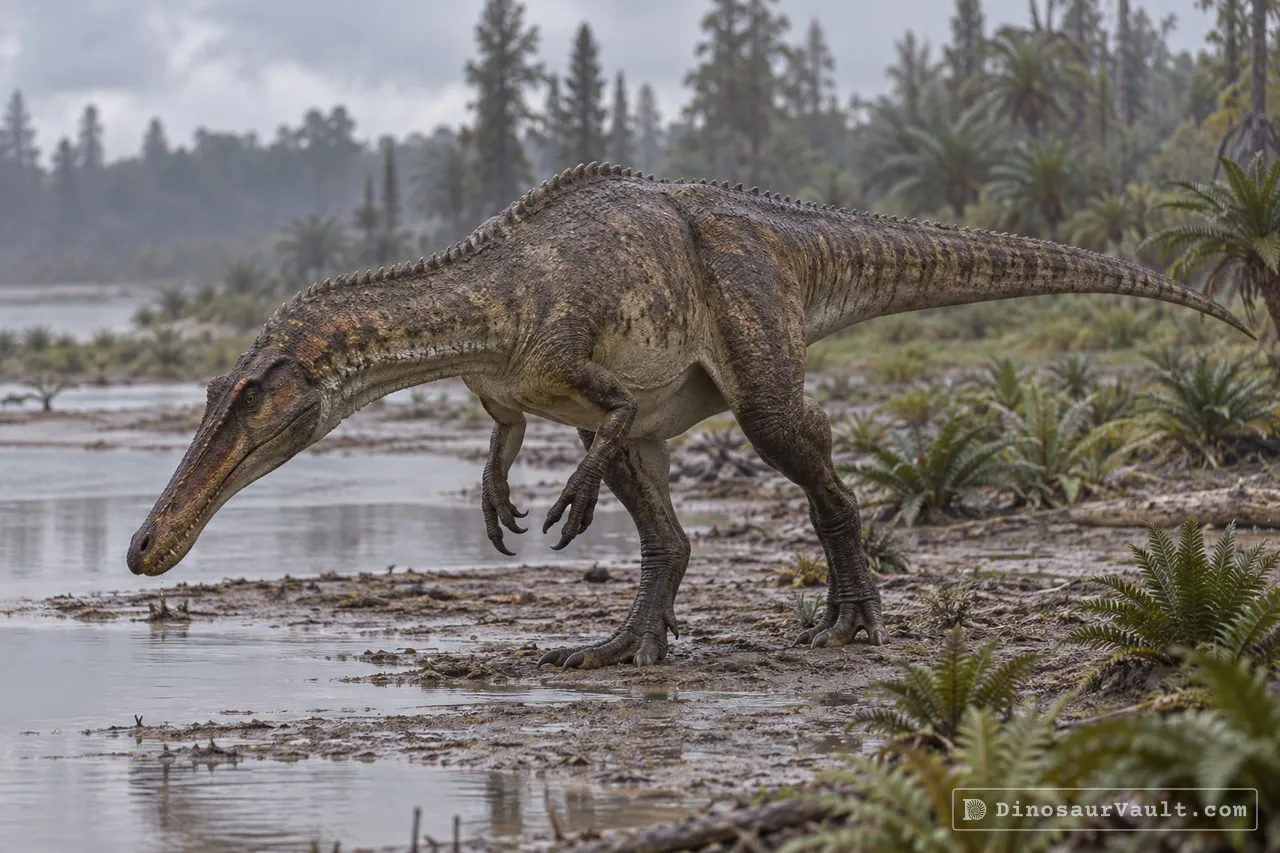
Angaturama was a spinosaur, a predator with a long, narrow snout. It is known from the tip of a snout. Many scientists think it may be the same animal as Irritator, found in the same rocks.
Its world
It lived in the Early Cretaceous in what is now northeastern Brazil. Its fossil comes from the Romualdo Formation, a coastal land shared with the small predators Santanaraptor and Mirischia.
How it was found
Kellner and Campos named Angaturama in 1996. Its name comes from a local language.
Field gallery
More views of Angaturama
Scenes reconstructed from the available fossil evidence.
1 of 3
Lived alongside
Found in the same rock formations


A rock formation can hold fossils laid down millions of years apart, so not every animal here met Angaturama.
The evidence
The science behind Angaturama
Which parts of the picture come from its own bones, and which come from its relatives.
From its own fossils
- The only named specimen is the front of the upper jaw, with parts of its teeth.
- A narrow bony crest runs along the top of the snout nearly to its tip, ending in a rounded bump at the front.
- The teeth have smooth cutting edges rather than sawlike serrations.
Borrowed from relatives
- The missing rear of the skull is restored by comparison with Irritator.
- The limbs and trunk are inferred from other spinosaurids such as Baryonyx and Suchomimus.
Still unknown
- Whether Angaturama and Irritator are the same species, or even parts of one skull. Experts disagree, and a newer study of Irritator's tooth sockets weakened the main argument that the two specimens came from different animals.
- The height of its back and the shape of its tail.
- Its skin color and the full shape of its crest, whose tip is broken off.
Discovery timeline
- 1996Named itKellner & Campos
- 1998Close relativeSereno et al.
- 2017RedescriptionSales & Schultz
- 2023Close relativeSchade et al.
Key papers
The research behind what we know of Angaturama
Named it
Named Angaturama from a narrow snout with a prominent crest and recognized its relationship to other spinosaurids.
First Early Cretaceous theropod dinosaur from Brazil with comments on Spinosauridae. Neues Jahrbuch für Geologie und Paläontologie - Abhandlungen 199: 151-166
Read the paper : First Early Cretaceous theropod dinosaur from Brazil with comments on Spinosauridae (opens in a new tab)Close relative
Named Suchomimus, a long-snouted spinosaurid known from much of the skeleton, including its neck, hips and stout forearms.
A Long-Snouted Predatory Dinosaur from Africa and the Evolution of Spinosaurids. Science 282: 1298-1302
Read the paper : A Long-Snouted Predatory Dinosaur from Africa and the Evolution of Spinosaurids (opens in a new tab)Redescription
Reexamined the crest and teeth, and argued from overlapping jaw parts that the Angaturama and Irritator specimens did not come from one individual.
Spinosaur taxonomy and evolution of craniodental features: Evidence from Brazil. PLOS ONE 12: e0187070
Read the paper : Spinosaur taxonomy and evolution of craniodental features: Evidence from Brazil (opens in a new tab)Close relative
CT scans reconstructed the skull and jaws of Irritator and found its tooth positions too uncertain to show whether its jaw overlaps Angaturama's snout.
A reappraisal of the cranial and mandibular osteology of the spinosaurid Irritator challengeri (Dinosauria: Theropoda). Palaeontologia Electronica
Read the paper : A reappraisal of the cranial and mandibular osteology of the spinosaurid Irritator challengeri (Dinosauria: Theropoda) (opens in a new tab)
Close relatives
Other members of Spinosauridae


Sources: Wikidata