Aratasaurus
- Lived
- 113 to 110 million years ago, Early Cretaceous
- Diet
- Carnivore
- Group
- Theropods
- Found in
- Brazil
- Named by
- Sayão et al. 2020
Where its fossils were found
The evidence
Today

110 million years ago
Habitat
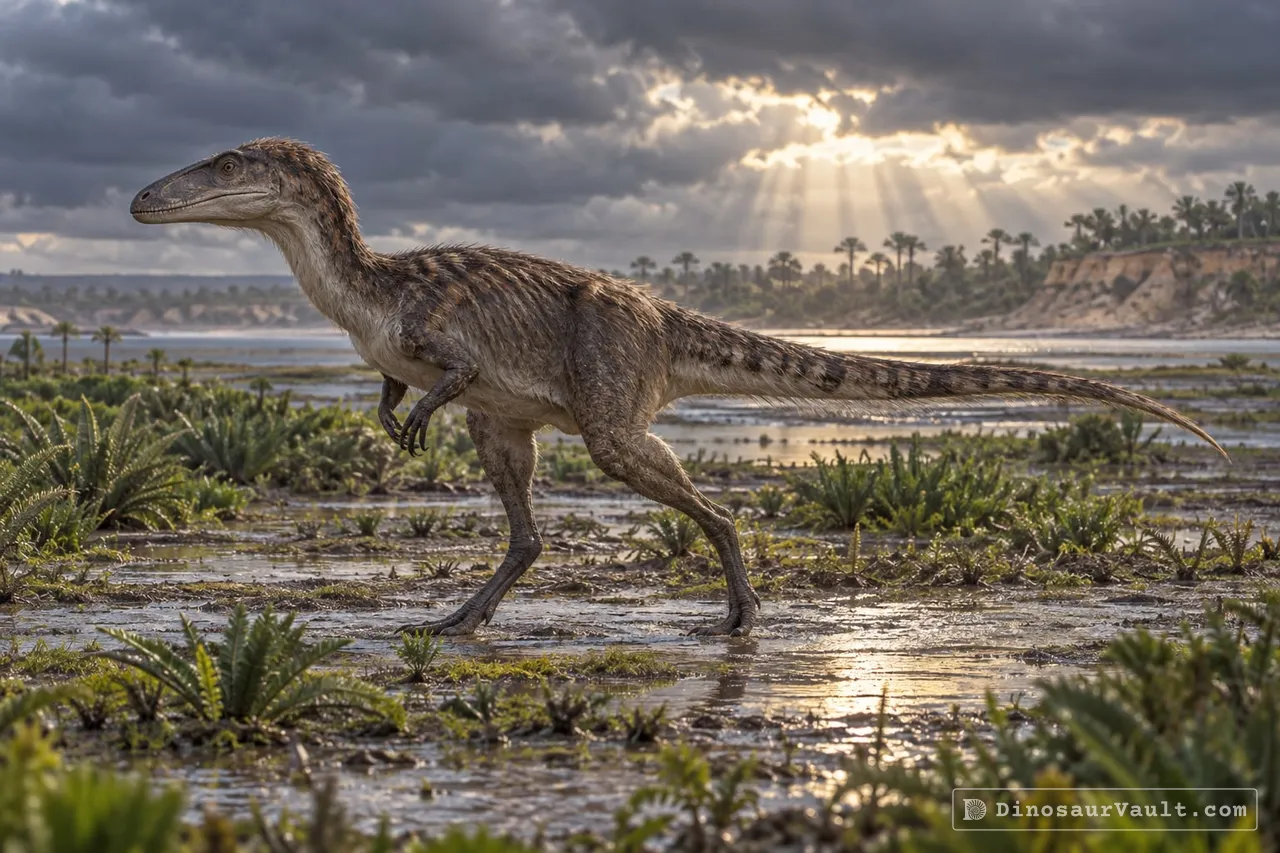
It probably lived on land near a lagoon, in a region with dry conditions and vegetation including conifers and cycads. Other dinosaurs from the Romualdo Formation include Irritator, Santanaraptor and Mirischia.
Field notes
About Aratasaurus
What it was like
Aratasaurus was a small coelurosaur, a two-legged meat eater. It is known from a single hind leg.
Its world
It lived in the Early Cretaceous, in what is now Brazil. It comes from the Romualdo Formation, where it shared the land with the spinosaur Irritator and the small theropod Santanaraptor.
How it was found
Sayão and colleagues named Aratasaurus in 2020. Its fossil was among the few from its museum to survive a great fire.
Field gallery
More views of Aratasaurus
Scenes reconstructed from the available fossil evidence.
1 of 3
Lived alongside
Found in the same rock formations


A rock formation can hold fossils laid down millions of years apart, so not every animal here met Aratasaurus.
The evidence
The science behind Aratasaurus
Which parts of the picture come from its own bones, and which come from its relatives.
From its own fossils
- A partial right hind leg preserves parts of the thigh and shin, along with foot bones, toes and claws.
- Its slender foot has outer weight-bearing toes of similar length, giving it a nearly symmetrical outline.
Borrowed from relatives
- The missing head, arms and trunk are restored by comparison with early coelurosaurs such as Zuolong.
Still unknown
- The shape of its skull and teeth.
- Its full adult size.
- Its color and body covering.
Discovery timeline
- 2004Same rocksNaish, Martill & Frey
- 2010Close relativeChoiniere et al.
- 2020Named itSayão et al.
Key papers
The research behind what we know of Aratasaurus
Same rocks
Named Mirischia and examined the meat-eating dinosaurs and dry shoreline habitats of the rocks now called the Romualdo Formation.
Ecology, Systematics and Biogeographical Relationships of Dinosaurs, Including a New Theropod, from the Santana Formation (?Albian, Early Cretaceous) of Brazil. Historical Biology 16: 57-70
Read the paper : Ecology, Systematics and Biogeographical Relationships of Dinosaurs, Including a New Theropod, from the Santana Formation (?Albian, Early Cretaceous) of Brazil (opens in a new tab)Close relative
Described skull and body bones of Zuolong, an early coelurosaur used for comparisons with Aratasaurus.
A basal coelurosaur (Dinosauria: Theropoda) from the Late Jurassic (Oxfordian) of the Shishugou Formation in Wucaiwan, People's Republic of China. Journal of Vertebrate Paleontology 30: 1773-1796
Read the paper : A basal coelurosaur (Dinosauria: Theropoda) from the Late Jurassic (Oxfordian) of the Shishugou Formation in Wucaiwan, People's Republic of China (opens in a new tab)Named it
Named Aratasaurus from a hind leg, identified a close relationship with Zuolong and found that the animal was still growing.
The first theropod dinosaur (Coelurosauria, Theropoda) from the base of the Romualdo Formation (Albian), Araripe Basin, Northeast Brazil. Scientific Reports 10
Read the paper : The first theropod dinosaur (Coelurosauria, Theropoda) from the base of the Romualdo Formation (Albian), Araripe Basin, Northeast Brazil (opens in a new tab)
Close relatives
Other members of Coelurosauria


Sources: Wikidata