Fylax
"keeper"
Type species Fylax thyrakolasus
- Lived
- 72 to 66 million years ago, Late Cretaceous
- Diet
- Herbivore
- Group
- Ornithopods
- Found in
- Spain
- Named by
- Prieto-Márquez and Carrera Farias 2021
Where its fossils were found
The evidence
Today

70 million years ago
Habitat
It lived in a river landscape in what is now Spain. Rhabdodon is also recorded from the Figuerola Formation.
Field notes
About Fylax
What it was like
Fylax was a relative of the duckbills known from a nearly complete lower jaw. It had long rows of teeth for grinding plants.
Its world
It lived about 72 to 66 million years ago, near the end of the Cretaceous, in what is now Spain. It comes from the Figuerola Formation, where Rhabdodon has also been found.
How it was found
Prieto-Márquez and Carrera Farias named Fylax in 2021. The type species is Fylax thyrakolasus.
Field gallery
More views of Fylax
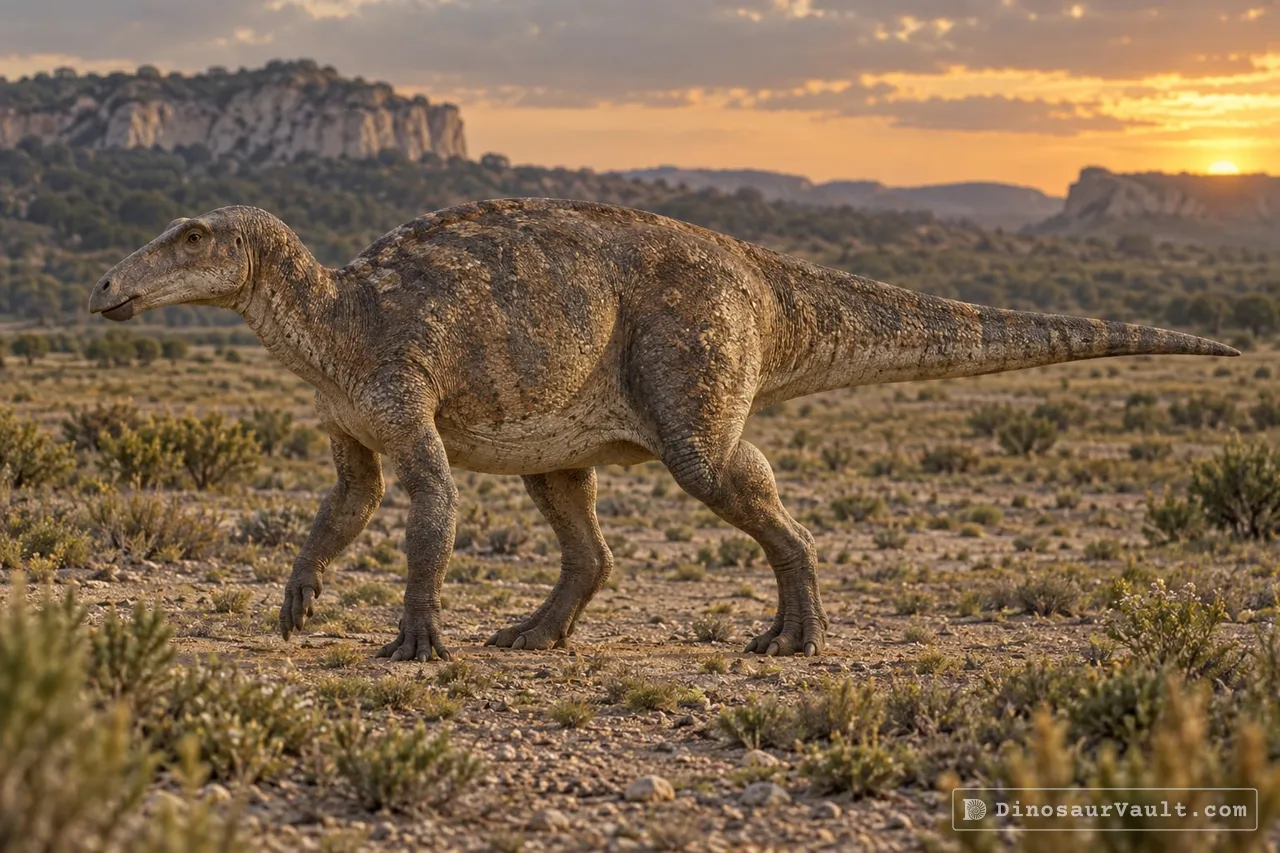
Scenes reconstructed from the available fossil evidence.
Lived alongside
Found in the same rock formations

A rock formation can hold fossils laid down millions of years apart, so not every animal here met Fylax.
The evidence
The science behind Fylax
Which parts of the picture come from its own bones, and which come from its relatives.
From its own fossils
- The type specimen is a left lower jaw with tightly packed teeth; its front teeth and the part joining the opposite jaw are missing.
- The jaw has a broad projection for attaching chewing muscles and a steep, flat tooth-wear surface.
- The preserved front of the lower jaw bends downward.
Borrowed from relatives
- Restorations take the missing head roof, neck, limbs and tail from Eolambia, an early relative of the duckbills; its own skull is a tentative composite, and the Fylax jaw is not taken from it.
Still unknown
- The shape of the rest of its skull and body, and how large it grew.
- Its skin covering and color.
- Its closest relatives; the original proposed pairing with Tethyshadros was based only on jaw characters.
Discovery timeline
- 2012Family treeMcDonald et al.
- 2021Named itPrieto-Marquez & Carrera Farias
- 2021Family treeChiarenza et al.
Key papers
The research behind what we know of Fylax
Family tree
Described the bones of Eolambia, an early duckbill relative, from adults and young, with a tentative composite skull.
Osteology of the Basal Hadrosauroid Eolambia caroljonesa (Dinosauria: Ornithopoda) from the Cedar Mountain Formation of Utah. PLoS ONE 7: e45712
Read the paper : Osteology of the Basal Hadrosauroid Eolambia caroljonesa (Dinosauria: Ornithopoda) from the Cedar Mountain Formation of Utah (opens in a new tab)Named it
Named Fylax from a lower jaw and placed it close to Tethyshadros, outside the true duckbills.
The late-surviving early diverging Ibero-Armorican ‘duck-billed’ dinosaur Fylax and the role of the Late Cretaceous European Archipelago in hadrosauroid biogeography. Acta Palaeontologica Polonica 66
Read the paper : The late-surviving early diverging Ibero-Armorican ‘duck-billed’ dinosaur Fylax and the role of the Late Cretaceous European Archipelago in hadrosauroid biogeography (opens in a new tab)Family tree
Showed the original Tethyshadros skeleton was still growing and described a larger animal; the Fylax naming paper compared its jaw with Tethyshadros.
An Italian dinosaur Lagerstätte reveals the tempo and mode of hadrosauriform body size evolution. Scientific Reports 11
Read the paper : An Italian dinosaur Lagerstätte reveals the tempo and mode of hadrosauriform body size evolution (opens in a new tab)
Close relatives
Other members of Hadrosauroidea


Sources: Wikidata