Foskeia
Type species Foskeia pelendonum
- Lived
- 126 to 120 million years ago, Early Cretaceous
- Diet
- Herbivore
- Group
- Ornithopods
- Found in
- Spain
- Named by
- Dieudonné et al. 2026
Where its fossils were found
The evidence
Today

125 million years ago
Habitat
Braided rivers crossed well-drained floodplains in the Castrillo de la Reina Formation. Europatitan and Demandasaurus were large plant eaters from the same rocks.
Field notes
About Foskeia
What it was like
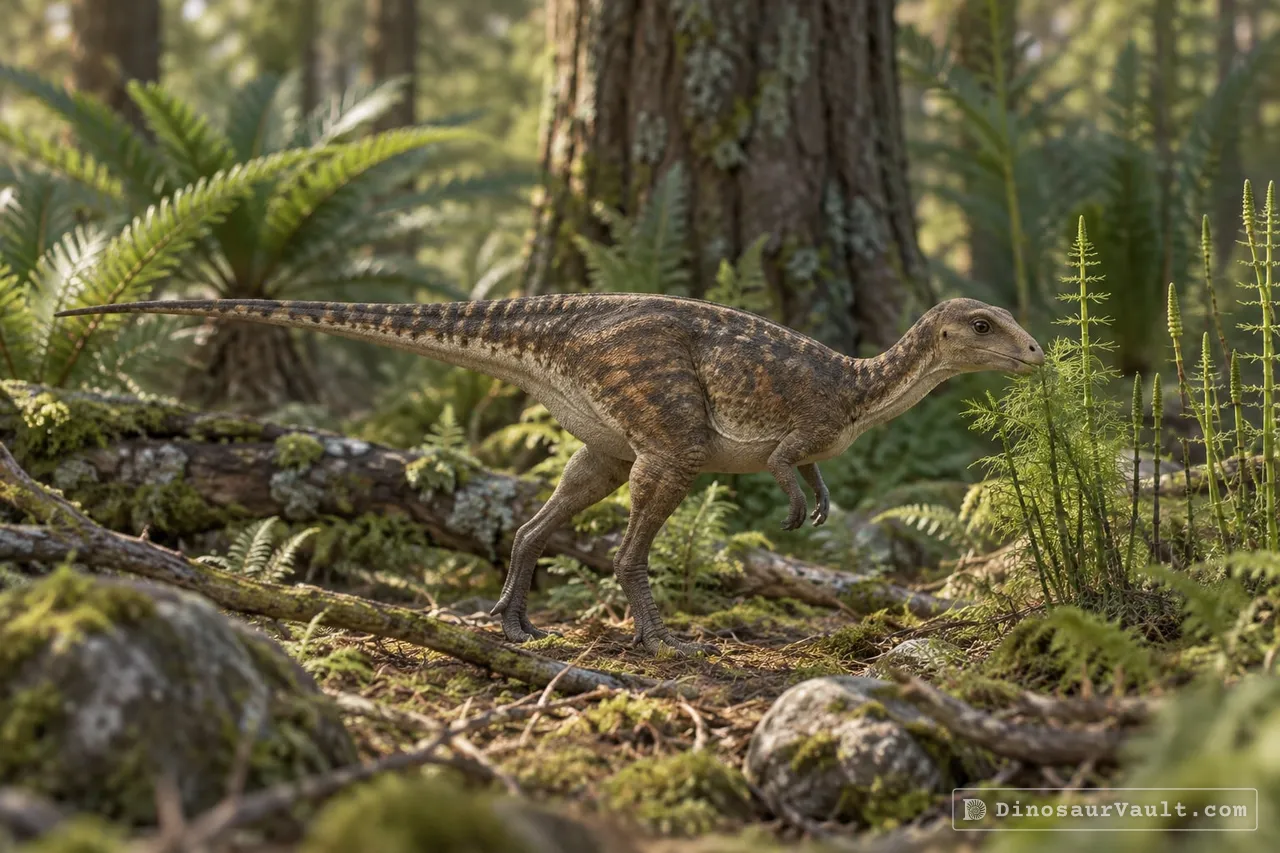
Foskeia was a very small plant eater that walked on two legs. It belonged to the rhabdodontomorphs, a group better known from larger animals. Its fossils include several animals of different ages.
Its world
It lived in the Early Cretaceous, in what is now Spain. It comes from the Castrillo de la Reina Formation, where it shared the land with the sauropod Europatitan and the rebbachisaurid Demandasaurus.
How it was found
Dieudonné and colleagues named Foskeia in 2026. The type species is Foskeia pelendonum.
Field gallery
More views of Foskeia
Scenes reconstructed from the available fossil evidence.
Lived alongside
Found in the same rock formations


A rock formation can hold fossils laid down millions of years apart, so not every animal here met Foskeia.
The evidence
The science behind Foskeia
Which parts of the picture come from its own bones, and which come from its relatives.
From its own fossils
- Many broken bones represent small animals at different stages of growth.
- Skull bones show fused bones at the front of the upper jaw and forward-leaning front teeth.
- The lower jaw has a slender first tooth and a raised jaw joint.
Borrowed from relatives
- Comparisons with Rhabdodon, Zalmoxes and Mochlodon help fill gaps in its skeleton.
Still unknown
- Its skin covering and color.
- Which plants it ate.
- Whether it cared for its young.
Discovery timeline
- 2016Full descriptionDieudonné et al.
- 2023Growing upDieudonné, Fernández-Baldor & Stein
- 2026Named itDieudonné et al.
Key papers
The research behind what we know of Foskeia
Full description
Described the bones before the animal had a formal name, recognized different growth stages and linked it with rhabdodontomorph plant eaters.
An Unexpected Early Rhabdodontid from Europe (Lower Cretaceous of Salas de los Infantes, Burgos Province, Spain) and a Re-Examination of Basal Iguanodontian Relationships. PLOS ONE 11: e0156251
Read the paper : An Unexpected Early Rhabdodontid from Europe (Lower Cretaceous of Salas de los Infantes, Burgos Province, Spain) and a Re-Examination of Basal Iguanodontian Relationships (opens in a new tab)Growing up
Examined thin slices of differently sized thigh and shin bones to study growth and changes in how the animal supported its weight.
Histogenesis and growth dynamics of the tiny Vegagete rhabdodontomorph hindlimb (Ornithischia, Ornithopoda): Paleoecological and evolutionary implications. Cretaceous Research 141: 105342
Read the paper : Histogenesis and growth dynamics of the tiny Vegagete rhabdodontomorph hindlimb (Ornithischia, Ornithopoda): Paleoecological and evolutionary implications (opens in a new tab)Named it
Newly identified skull bones gave this tiny plant eater its name and revealed unusual features of its jaws and teeth.
Foskeia pelendonum , a new rhabdodontomorph from the Lower Cretaceous of Salas de los Infantes (Burgos Province, Spain), and a new phylogeny of ornithischian dinosaurs. Papers in Palaeontology 12
Read the paper : Foskeia pelendonum , a new rhabdodontomorph from the Lower Cretaceous of Salas de los Infantes (Burgos Province, Spain), and a new phylogeny of ornithischian dinosaurs (opens in a new tab)
Sources: Wikidata