Europatitan
"European titan"
Type species Europatitan eastwoodi
- Lived
- 126 to 120 million years ago, Early Cretaceous
- Diet
- Herbivore
- Group
- Sauropods
- Found in
- Spain
- Named by
- Torcida Fernández-Baldor et al. 2017
Where its fossils were found
The evidence
Today

125 million years ago
Habitat
Its bones were buried beside a river channel on a floodplain in Spain. Demandasaurus and Foskeia also lived in the landscape preserved by the Castrillo de la Reina Formation.
Field notes
About Europatitan
What it was like
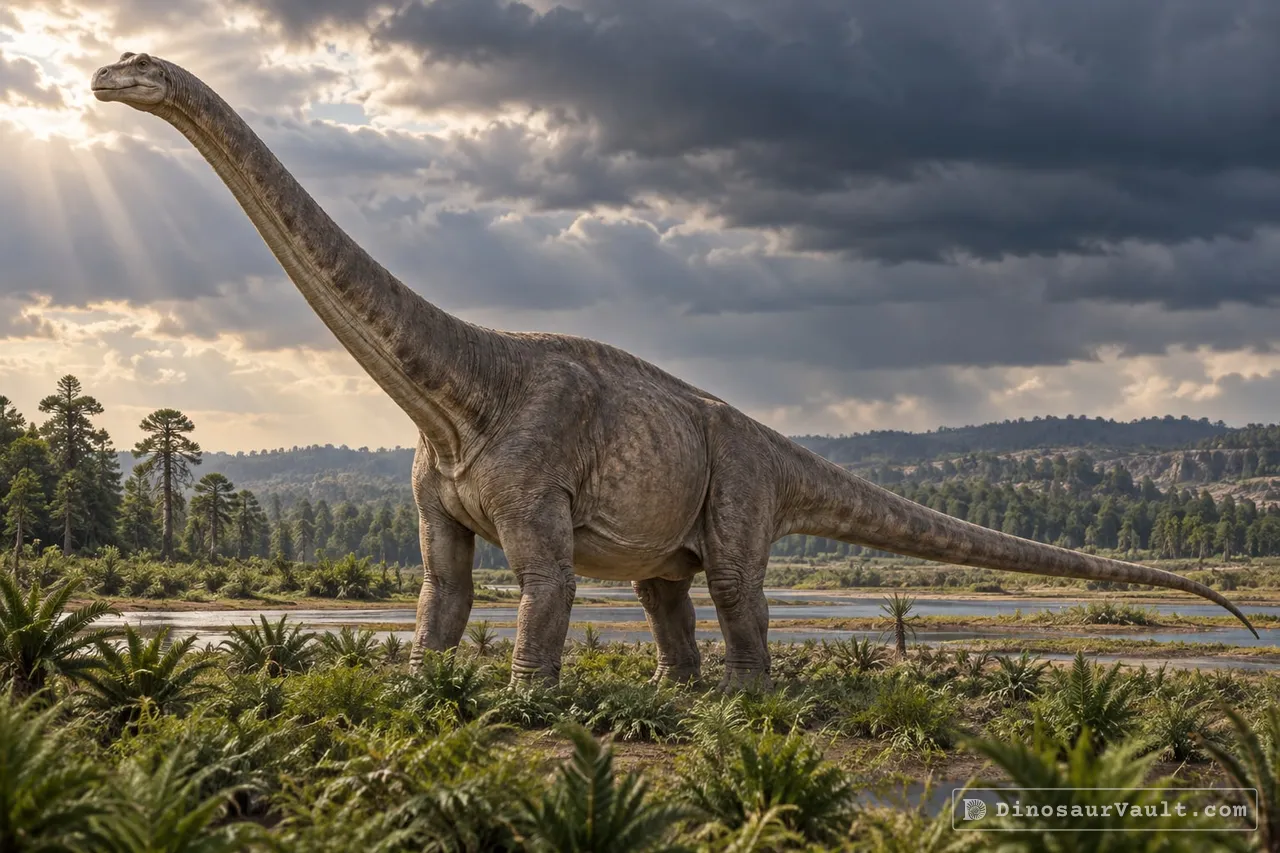
Europatitan was a large sauropod, a long-necked plant eater, and a relative of the titanosaurs. It is known from a scattered partial skeleton, including neck bones with deep hollows. No skull or complete limbs were found.
Its world
It lived in the Early Cretaceous, in what is now Spain. It comes from the Castrillo de la Reina Formation, where it shared the land with the rebbachisaurid Demandasaurus and the small plant eater Foskeia.
How it was found
Torcida Fernández-Baldor and colleagues named Europatitan in 2017. The type species is Europatitan eastwoodi, after a film actor who once worked in the area.
Field gallery
More views of Europatitan
Scenes reconstructed from the available fossil evidence.
Lived alongside
Found in the same rock formations


A rock formation can hold fossils laid down millions of years apart, so not every animal here met Europatitan.
The evidence
The science behind Europatitan
Which parts of the picture come from its own bones, and which come from its relatives.
From its own fossils
- The type specimen is one partial skeleton found scattered at a single site: a tooth, neck vertebrae, a back vertebra, tail vertebrae, ribs, chevrons, both shoulder blades, a coracoid, the upper ends of two hand bones, a pubis and ischia.
- Its neck vertebrae are very long and low, so it probably had a long neck. They and the back vertebra contain hollows and thin bony partitions associated with air sacs.
- Its one tooth is spoon-shaped rather than pencil-like, and tooth marks on some bones show that meat eaters fed on its carcass.
Borrowed from relatives
- The missing head, legs and body are restored after Euhelopus, another early somphospondylan.
- The missing finger bones follow Apatosaurus, and the unknown feet follow Camarasaurus.
Still unknown
- Its full size and the lengths of its limbs.
- The shape of its skull and its skin color.
- Its exact place among early titanosaur relatives. The naming paper's analyses gave several weakly supported answers, and a later study kept it among the early somphospondylans.
Discovery timeline
- 2011Same rocksFernández-Baldor et al.
- 2017Named itTorcida Fernández-Baldor et al.
- 2019Family treeMannion et al.
- 2023Family treeMocho et al.
Key papers
The research behind what we know of Europatitan
Same rocks
Described Demandasaurus, a different kind of sauropod from the same formation, and linked it to relatives in Africa.
Demandasaurus darwini, a New Rebbachisaurid Sauropod from the Early Cretaceous of the Iberian Peninsula. Acta Palaeontologica Polonica 56: 535-552
Read the paper : Demandasaurus darwini, a New Rebbachisaurid Sauropod from the Early Cretaceous of the Iberian Peninsula (opens in a new tab)Named it
Described Europatitan's partial skeleton and placed it among early relatives of titanosaurs, with distinctive hollows and ridges in its backbone.
Europatitan eastwoodi, a new sauropod from the lower Cretaceous of Iberia in the initial radiation of somphospondylans in Laurasia. PeerJ 5: e3409
Read the paper : Europatitan eastwoodi, a new sauropod from the lower Cretaceous of Iberia in the initial radiation of somphospondylans in Laurasia (opens in a new tab)Family tree
A family-tree study of northern titanosaur relatives that included Europatitan kept it among the early somphospondylans.
New information on the Cretaceous sauropod dinosaurs of Zhejiang Province, China: impact on Laurasian titanosauriform phylogeny and biogeography. Royal Society Open Science 6: 191057
Read the paper : New information on the Cretaceous sauropod dinosaurs of Zhejiang Province, China: impact on Laurasian titanosauriform phylogeny and biogeography (opens in a new tab)Family tree
Compared Europatitan with Garumbatitan and other early titanosaur relatives, testing their positions in the sauropod family tree.
New sauropod dinosaur from the Lower Cretaceous of Morella (Spain) provides new insights on the evolutionary history of Iberian somphospondylan titanosauriforms. Zoological Journal of the Linnean Society 201: 214-268
Read the paper : New sauropod dinosaur from the Lower Cretaceous of Morella (Spain) provides new insights on the evolutionary history of Iberian somphospondylan titanosauriforms (opens in a new tab)
Close relatives
Other members of Somphospondyli


Sources: Wikidata