Delapparentia
- Lived
- 126 to 121 million years ago, Early Cretaceous
- Diet
- Herbivore
- Group
- Ornithopods
- Found in
- Spain
- Named by
- Ruiz-Omeñaca 2011
Where its fossils were found
The evidence
Today

125 million years ago
Habitat
It lived on a floodplain crossed by rivers in what is now Spain. Other dinosaurs from the Camarillas Formation include Gideonmantellia and Camarillasaurus.
Field notes
About Delapparentia
What it was like
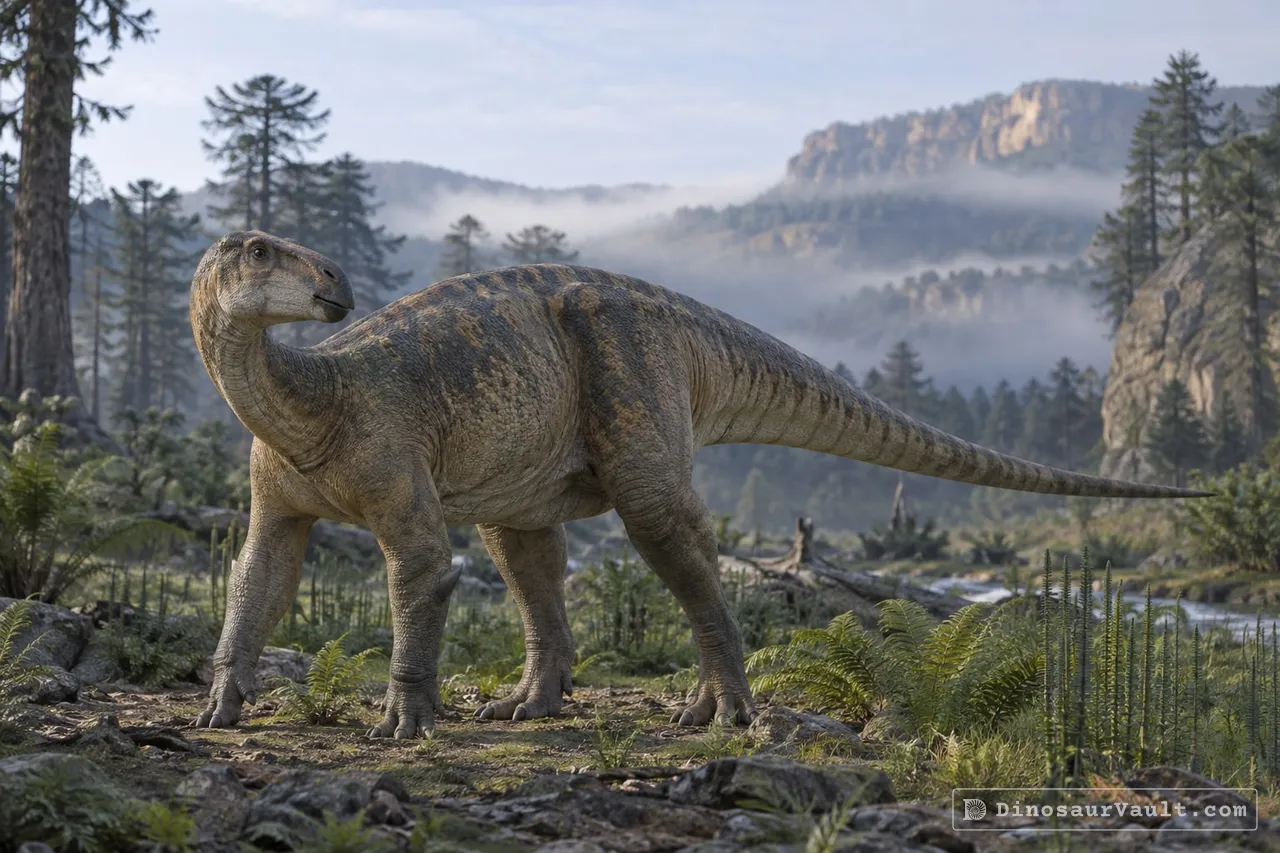
Delapparentia was a large plant eater related to Iguanodon. It is known from a partial skeleton. Some scientists think it may be a large Iguanodon instead.
Its world
It lived in the Early Cretaceous in what is now Spain. Its bones come from the Camarillas Formation, where the predator Camarillasaurus and the small plant eater Gideonmantellia also lived.
How it was found
Ruiz-Omeñaca named it in 2011. The name honors a French paleontologist who first described the bones.
Field gallery
More views of Delapparentia
Scenes reconstructed from the available fossil evidence.
Lived alongside
Found in the same rock formations


A rock formation can hold fossils laid down millions of years apart, so not every animal here met Delapparentia.
The evidence
The science behind Delapparentia
Which parts of the picture come from its own bones, and which come from its relatives.
From its own fossils
- A partial skeleton includes neck, back and tail vertebrae, ribs, hip bones and part of a shoulder blade.
- A neck vertebra carries an unusually tall blade of bone above the spinal canal.
- Some ribs and tail vertebrae are fused, suggesting the animal was a mature adult.
Borrowed from relatives
- The missing skull and limbs are restored by comparison with iguanodonts such as Iguanodon and Barilium.
Still unknown
- Whether Delapparentia is a separate genus or belongs to Iguanodon.
- The shape of its skull.
- Its skin covering and color.
Discovery timeline
- 2011Named itRuiz-Omeñaca
- 2015New findGasca et al.
- 2017Family treeVerdú et al.
Key papers
The research behind what we know of Delapparentia
Named it
Named Delapparentia after restudying a partial skeleton previously assigned to Iguanodon.
Delapparentia turolensis nov. gen et sp., un nuevo dinosaurio iguanodontoideo (Ornithischia: Ornithopoda) en el Cretácico Inferior de Galve. Estudios Geológicos 67: 83-110
Read the paper : Delapparentia turolensis nov. gen et sp., un nuevo dinosaurio iguanodontoideo (Ornithischia: Ornithopoda) en el Cretácico Inferior de Galve (opens in a new tab)New find
Described additional neck and shoulder bones, revised the identifying features, and compared its hips with Barilium.
New material and phylogenetic position of the basal iguanodont dinosaur Delapparentia turolensis from the Barremian (Early Cretaceous) of Spain. Journal of Iberian Geology 41
Read the paper : New material and phylogenetic position of the basal iguanodont dinosaur Delapparentia turolensis from the Barremian (Early Cretaceous) of Spain (opens in a new tab)Family tree
Found wide variation among Iguanodon skeletons and argued that the known Delapparentia bones fit within that genus.
Individual variation in the postcranial skeleton of the Early Cretaceous Iguanodon bernissartensis (Dinosauria: Ornithopoda). Cretaceous Research 74: 65-86
Read the paper : Individual variation in the postcranial skeleton of the Early Cretaceous Iguanodon bernissartensis (Dinosauria: Ornithopoda) (opens in a new tab)
Close relatives
Other members of Styracosterna


Sources: Wikidata