Gideonmantellia
"for Gideon Mantell"
- Lived
- 126 to 121 million years ago, Early Cretaceous
- Diet
- Herbivore
- Group
- Ornithopods, Hypsilophodontidae
- Found in
- Spain
- Named by
- Ruiz-Omeñaca et al. 2012
Where its fossils were found
The evidence
Today

125 million years ago
Habitat
Rivers crossed the land that is now Spain, leaving the red clay of the Camarillas Formation. Iguanodon, Delapparentia and Camarillasaurus are also recorded from these rocks.
Field notes
About Gideonmantellia
What it was like
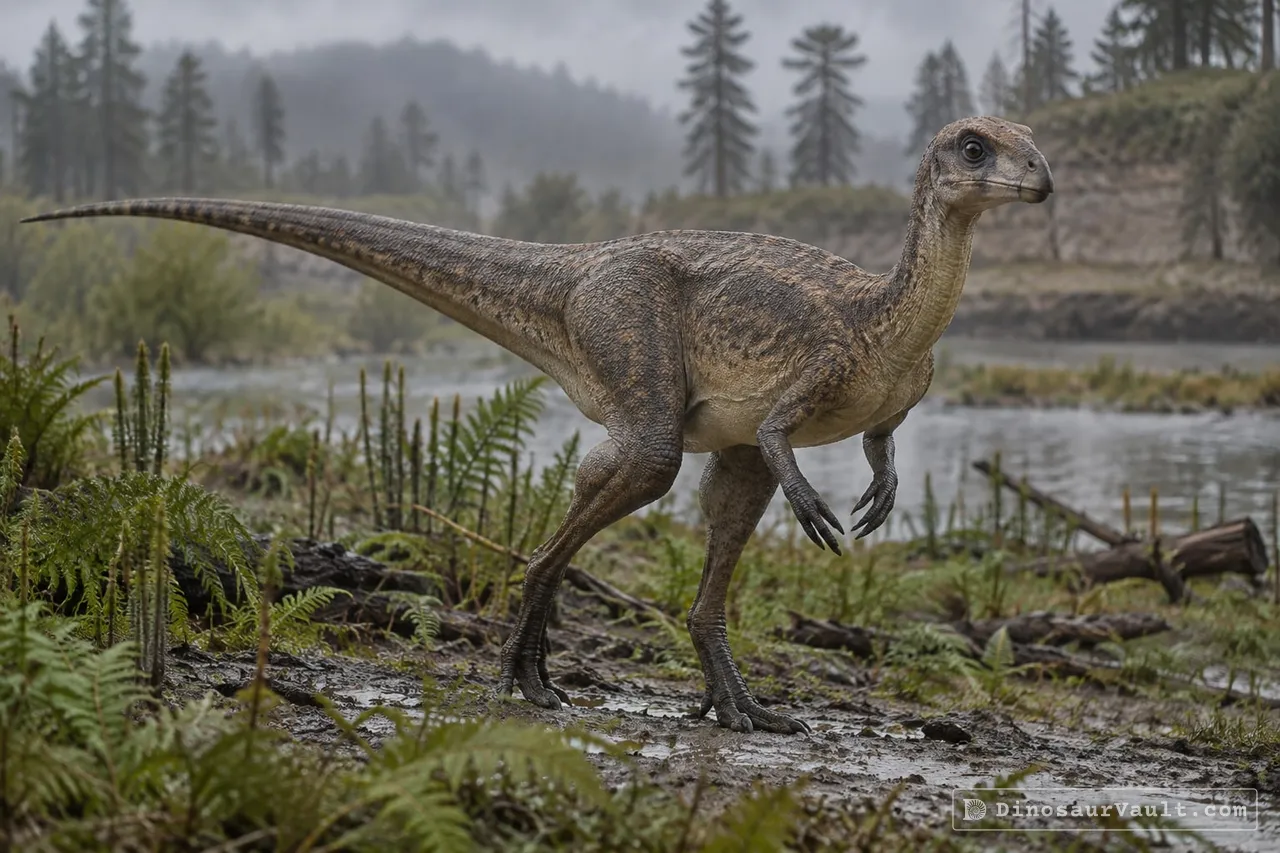
Gideonmantellia was a small, two-legged plant eater known from a partial skeleton, mainly the hips, backbone and legs.
Its world
It lived in the Early Cretaceous in what is now Spain. Its bones come from the Camarillas Formation, where Iguanodon and the predator Camarillasaurus also lived.
How it was found
Ruiz-Omeñaca and colleagues named it in 2012. The name honors an English doctor who was one of the first people to study dinosaurs.
Field gallery
More views of Gideonmantellia
Scenes reconstructed from the available fossil evidence.
1 of 3
Lived alongside
Found in the same rock formations


A rock formation can hold fossils laid down millions of years apart, so not every animal here met Gideonmantellia.
The evidence
The science behind Gideonmantellia
Which parts of the picture come from its own bones, and which come from its relatives.
From its own fossils
- A partial skeleton preserves the backbone, part of the hips and the hind legs, including foot bones. No head, neck or arms were found with it.
- A rod-shaped hip bone has a twisted, expanded tip, and the first bone beneath the tail has a right-angle bend.
- The shinbone is longer than the thighbone, and the toe claws are long and moderately curved.
Borrowed from relatives
- The missing head is restored after Hypsilophodon, a small plant eater whose skull is well known.
- The neck, arms and hands follow Fona, another small early plant eater whose front limbs are preserved.
Still unknown
- Its adult size and skull shape.
- Whether its two shinbones, which differ in shape, come from one animal or two. The describers left both possibilities open.
- Its closest relatives. One later study grouped it with Hypsilophodon, and another found the same pairing with weak support.
Discovery timeline
- 2012Named itRuiz-Omeñaca et al.
- 2016Family treeDieudonné et al.
- 2025Same rocksRauhut, Canudo & Castanera
Key papers
The research behind what we know of Gideonmantellia
Named it
Described a small plant eater distinguished by the shapes of its hip bones and a bone beneath the tail.
A new basal ornithopod dinosaur from the Barremian of Galve, Spain. Comptes Rendus Palevol 11: 435-444
Read the paper : A new basal ornithopod dinosaur from the Barremian of Galve, Spain (opens in a new tab)Family tree
Compared the feet and hind legs of early plant eaters, including Gideonmantellia, while reassessing their relationships.
An Unexpected Early Rhabdodontid from Europe (Lower Cretaceous of Salas de los Infantes, Burgos Province, Spain) and a Re-Examination of Basal Iguanodontian Relationships. PLOS ONE 11: e0156251
Read the paper : An Unexpected Early Rhabdodontid from Europe (Lower Cretaceous of Salas de los Infantes, Burgos Province, Spain) and a Re-Examination of Basal Iguanodontian Relationships (opens in a new tab)Same rocks
Reassigned Camarillasaurus, a predator from the same formation, to the spinosaurs after restudying its bones and describing new finds.
Revision of the theropod dinosaur Camarillasaurus cirugedae from the Early Cretaceous (Barremian) of Teruel province, Spain. Palaeontologia Electronica
Read the paper : Revision of the theropod dinosaur Camarillasaurus cirugedae from the Early Cretaceous (Barremian) of Teruel province, Spain (opens in a new tab)
Close relatives
Other members of Hypsilophodontidae


Sources: Wikidata