Datai
Type species Datai yingliangis
- Lived
- 94 to 86 million years ago, Late Cretaceous
- Diet
- Herbivore
- Group
- Ankylosaurs, Ankylosauridae
- Found in
- China
- Named by
- Xing et al. 2024
Where its fossils were found
The evidence
Today

90 million years ago
Habitat
A landscape of rivers and lakes in southeastern China. The long-necked plant eater Gandititan is known from the same formation.
Field notes
About Datai
What it was like
Datai was an ankylosaur, an armored plant eater, known from skulls and partial skeletons of two animals. Its skull was covered in bony armor.
Its world
It lived in the Late Cretaceous in what is now southeastern China. Its bones come from the Zhoutian Formation, where it shared the land with the titanosaur Gandititan.
How it was found
Xing and colleagues named Datai in 2024.
Field gallery
More views of Datai
Scenes reconstructed from the available fossil evidence.
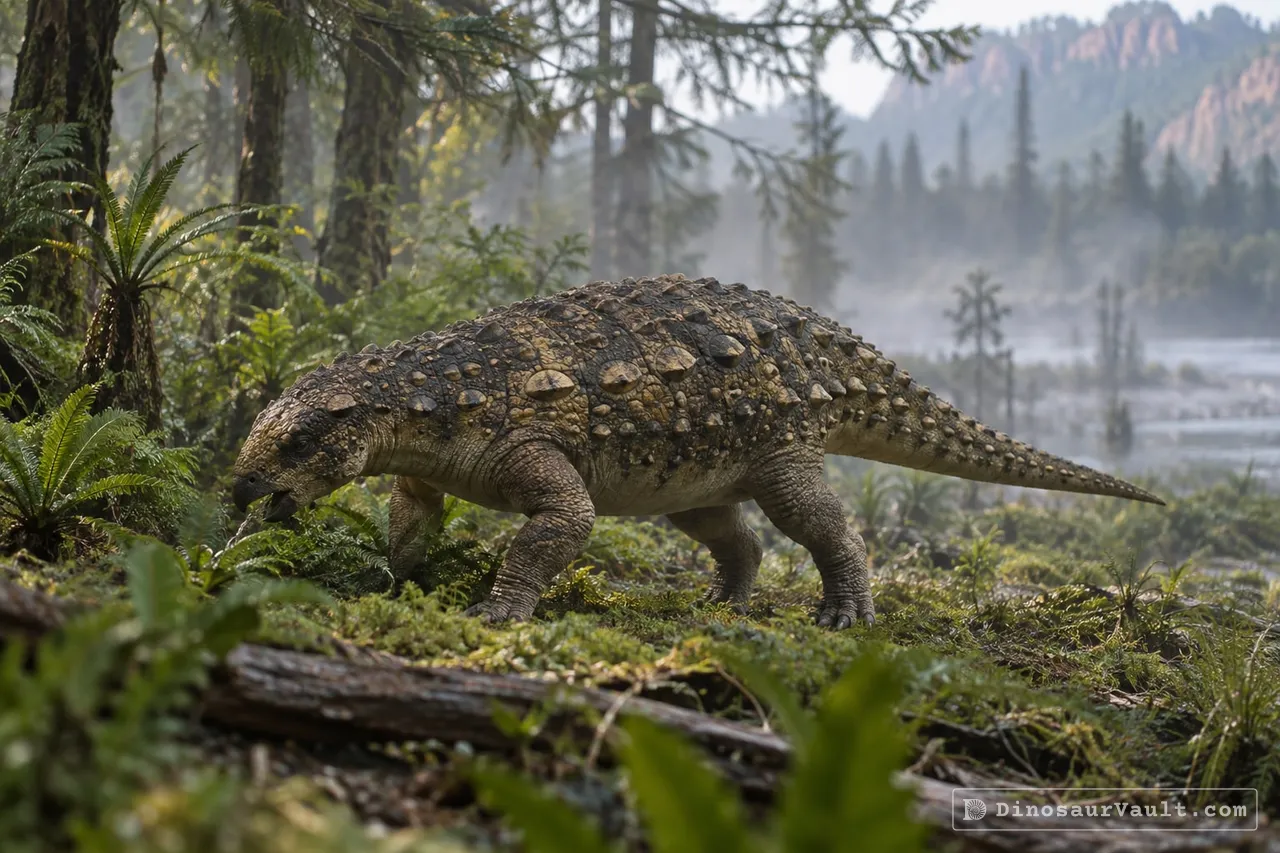
1 of 3
Lived alongside
Found in the same rock formations

A rock formation can hold fossils laid down millions of years apart, so not every animal here met Datai.
The evidence
The science behind Datai
Which parts of the picture come from its own bones, and which come from its relatives.
From its own fossils
- Skulls and partial skeletons preserve paired cheek horns and clusters of bony armor beneath the throat.
- Tail vertebrae interlock to form a stiff handle.
- Bony neck bands and many small armor scales are preserved with the skeletons.
Borrowed from relatives
- A club at the end of the tail is inferred by comparison with Jinyunpelta.
- Pinacosaurus provides a comparison for the missing parts of the limbs and the changes in armor during growth.
Still unknown
- Its full adult size and appearance.
- The complete arrangement of armor along its trunk.
- Its color.
Discovery timeline
- 2018Close relativeZheng et al.
- 2024Named itXing et al.
- 2024Same rocksHan et al.
Key papers
The research behind what we know of Datai
Close relative
Described Jinyunpelta with a complete tail club, providing a comparison for restoring the missing club knob in Datai.
The most basal ankylosaurine dinosaur from the Albian–Cenomanian of China, with implications for the evolution of the tail club. Scientific Reports 8
Read the paper : The most basal ankylosaurine dinosaur from the Albian–Cenomanian of China, with implications for the evolution of the tail club (opens in a new tab)Named it
Described immature skeletons with paired cheek horns and extensive throat armor, and compared their anatomy with other Asian ankylosaurids.
A new armored dinosaur with double cheek horns from the early Late Cretaceous of southeastern China. Vertebrate Anatomy Morphology Palaeontology 11
Read the paper : A new armored dinosaur with double cheek horns from the early Late Cretaceous of southeastern China (opens in a new tab)Same rocks
Named Gandititan from a partial skeleton, adding a long-necked plant eater to the dinosaur fauna of the same formation.
A new titanosaurian sauropod, Gandititan cavocaudatus gen. et sp. nov., from the Late Cretaceous of southern China. Journal of Systematic Palaeontology 22
Read the paper : A new titanosaurian sauropod, Gandititan cavocaudatus gen. et sp. nov., from the Late Cretaceous of southern China (opens in a new tab)
Close relatives
Other members of Ankylosauridae


Sources: Wikidata