Gandititan
Type species Gandititan cavocaudatus
- Lived
- 101 to 90 million years ago, Late Cretaceous
- Diet
- Herbivore
- Group
- Sauropods
- Found in
- China
- Named by
- Han et al. 2024
Where its fossils were found
The evidence
Today

95 million years ago
Habitat
A landscape of rivers and shallow lakes in what is now southern China. The armored Datai is also known from the Zhoutian Formation.
Field notes
About Gandititan
What it was like
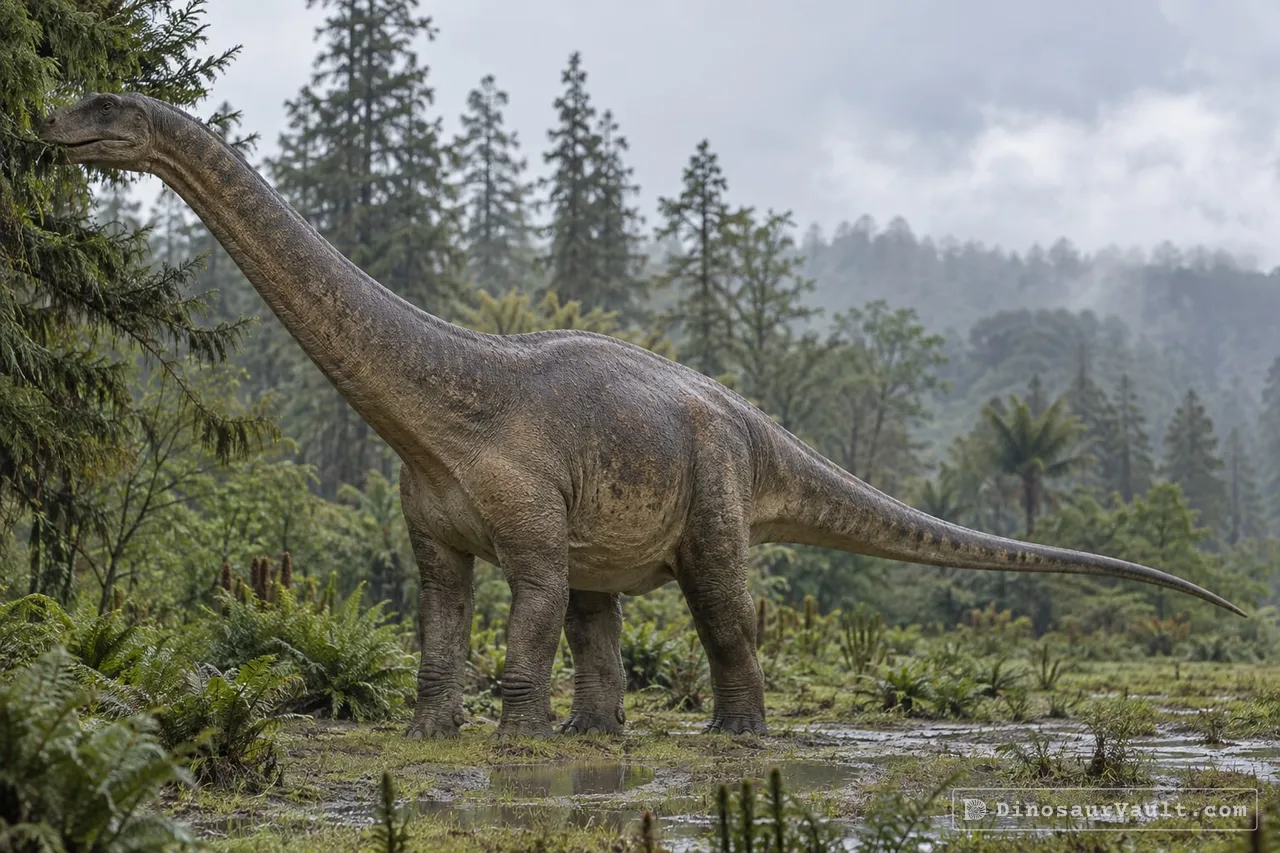
Gandititan was a titanosaur, a long-necked plant eater. It is known from a partial skeleton. A later study suggested that large openings in the bodies of its front tail vertebrae carried blood vessels, while the bony arches above them show outward signs of air spaces.
Its world
It lived in the Late Cretaceous in what is now southeastern China. Its bones come from the Zhoutian Formation.
How it was found
Han and colleagues named it in 2024. The type species is Gandititan cavocaudatus, which refers to its hollow tail.
Field gallery
More views of Gandititan
Scenes reconstructed from the available fossil evidence.
Lived alongside
Found in the same rock formations

A rock formation can hold fossils laid down millions of years apart, so not every animal here met Gandititan.
The evidence
The science behind Gandititan
Which parts of the picture come from its own bones, and which come from its relatives.
From its own fossils
- A partial skeleton preserves six neck vertebrae, parts of two back vertebrae, the fused backbone above the hips still joined to the first seventeen tail vertebrae, and part of the right side of the pelvis.
- The vertebrae near the base of the tail have forked spines and deeply hollowed sides.
- The neck vertebrae have long, narrow hollows along their sides.
Borrowed from relatives
- The missing head is restored by comparison with Tapuiasaurus, a titanosaur known from a skull.
- The rest of the neck, the body, the shoulders, the hips and the upper legs follow Mnyamawamtuka, a titanosaur from Tanzania.
Still unknown
- The shape of its skull, teeth and limbs.
- How far air spaces reached into its tail. A later study suggested that the large openings in the bodies of its front tail vertebrae held blood vessels, and that the outward signs of air sacs are on the arches above them.
- Its exact place among titanosaurs. Its naming study placed it closest to Abdarainurus, another sauropod with unusual tail vertebrae.
Discovery timeline
- 2020Close relativeAverianov & Lopatin
- 2024Named itHan et al.
- 2024Same rocksXing et al.
- 2026Inside the bonesBeeston et al.
Key papers
The research behind what we know of Gandititan
Close relative
Named Abdarainurus from tail vertebrae with an unusual combination of joint shapes, ridges and hollows.
An unusual new sauropod dinosaur from the Late Cretaceous of Mongolia. Journal of Systematic Palaeontology 18: 1009-1032
Read the paper : An unusual new sauropod dinosaur from the Late Cretaceous of Mongolia (opens in a new tab)Named it
Described a partial titanosaur skeleton with deeply hollowed tail vertebrae and placed it closest to Abdarainurus.
A new titanosaurian sauropod, Gandititan cavocaudatus gen. et sp. nov., from the Late Cretaceous of southern China. Journal of Systematic Palaeontology 22
Read the paper : A new titanosaurian sauropod, Gandititan cavocaudatus gen. et sp. nov., from the Late Cretaceous of southern China (opens in a new tab)Same rocks
Described young Datai skeletons from the Zhoutian Formation, with paired cheek horns and evidence of growth changes in their skulls.
A new armored dinosaur with double cheek horns from the early Late Cretaceous of southeastern China. Vertebrate Anatomy Morphology Palaeontology 11
Read the paper : A new armored dinosaur with double cheek horns from the early Late Cretaceous of southeastern China (opens in a new tab)Inside the bones
Studied air spaces in sauropod tail vertebrae with computed tomography and suggested that the large openings in the front tail vertebra bodies of Gandititan held blood vessels.
Computed tomography reveals multiple origins of extreme caudal vertebral pneumaticity in sauropod dinosaurs. Journal of Anatomy
Read the paper : Computed tomography reveals multiple origins of extreme caudal vertebral pneumaticity in sauropod dinosaurs (opens in a new tab)
Close relatives
Other members of Titanosauria


Sources: Wikidata