Theiophytalia
"garden of the gods"
- Lived
- 121 to 101 million years ago, Early Cretaceous
- Diet
- Herbivore
- Group
- Ornithopods
- Found in
- United States
- Named by
- Brill and Carpenter 2007
Where its fossils were found
The evidence
Today

110 million years ago
Habitat
It lived on land in Early Cretaceous Colorado. Its skull comes from the Purgatoire Formation.
Field notes
About Theiophytalia
What it was like
Theiophytalia was a plant eater related to Iguanodon, known from a skull.
Its world
It lived in the Early Cretaceous in what is now Colorado. Its skull comes from the Purgatoire Formation.
How it was found
Brill and Carpenter named it in 2007. The skull had been found long before and was first thought to belong to Camptosaurus. Its name refers to the famous park where it was found.
Field gallery
More views of Theiophytalia
Scenes reconstructed from the available fossil evidence.
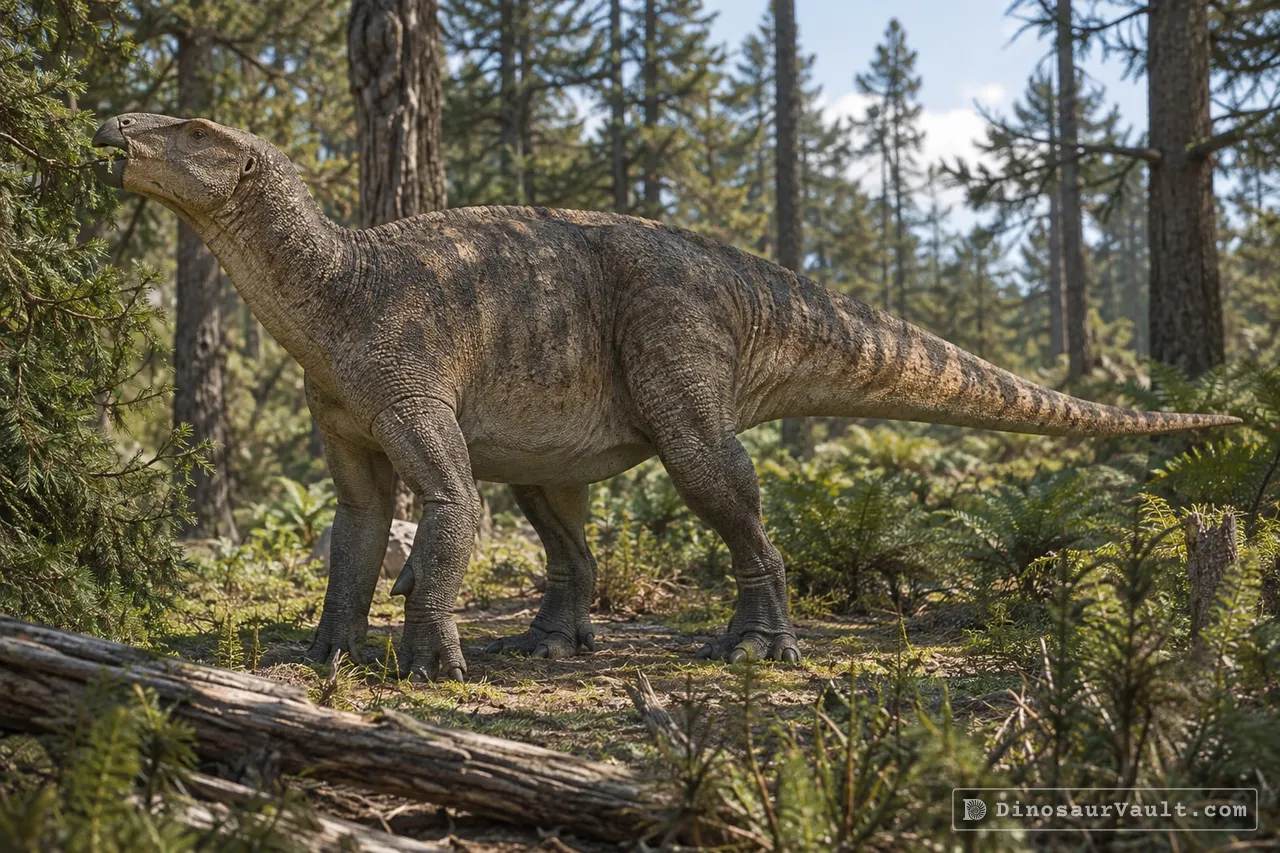
The evidence
The science behind Theiophytalia
Which parts of the picture come from its own bones, and which come from its relatives.
From its own fossils
- A partial skull preserves the snout, cheek bones and parts of the jaws. It was crushed from side to side.
- The cheek bone has a broad rear bar that forms the lower rim of the eye socket. A thin flange projects backward from it, a feature shared with Hippodraco.
- The nostril opening is oval and slanted, and each bone at the front of the upper jaw carries a single point on its biting edge.
Borrowed from relatives
- The body and limbs are restored from related iguanodontians such as Hippodraco and Iguanodon.
- Some comparisons of skull bones place it close to Hippodraco in the iguanodontian family tree.
Still unknown
- Its body, limbs and skin, and so its full size and proportions.
- Whether the trough along the top of its snout is real or partly caused by crushing.
- Its exact place among iguanodontians, and the shape of the bone at the tip of its lower jaw, which is not preserved.
Discovery timeline
- 1909SkullGilmore
- 2007Named itBrill & Carpenter
- 2010Close relativeMcDonald et al.
- 2012Family treeMcDonald
- 2015Close relativeBoyd & Pagnac
Key papers
The research behind what we know of Theiophytalia
Skull
Described this skull as Camptosaurus, including its cheek bone, nostril and rear lower jaw, and combined it with other skulls in a restoration.
Osteology of the Jurassic reptile Camptosaurus, with a revision of the species of the genus, and descriptions of two new species. Proceedings of the United States National Museum 36: 197-332
Read the paper : Osteology of the Jurassic reptile Camptosaurus, with a revision of the species of the genus, and descriptions of two new species (opens in a new tab)Named it
Reexamined a skull previously assigned to Camptosaurus and recognized a separate Early Cretaceous plant eater.
A description of a new ornithopod from the Lytle Member of the Purgatoire Formation (Lower Cretaceous) and a reassessment of the skull of Camptosaurus. Horns and Beaks: Ceratopsian and Ornithopod Dinosaurs.
No link available
Close relative
Described Hippodraco and identified skull features linking it closely to Theiophytalia.
New Basal Iguanodonts from the Cedar Mountain Formation of Utah and the Evolution of Thumb-Spiked Dinosaurs. PLoS ONE 5: e14075
Read the paper : New Basal Iguanodonts from the Cedar Mountain Formation of Utah and the Evolution of Thumb-Spiked Dinosaurs (opens in a new tab)Family tree
A broader comparison of iguanodontians again grouped Theiophytalia with Hippodraco.
Phylogeny of Basal Iguanodonts (Dinosauria: Ornithischia): An Update. PLoS ONE 7: e36745
Read the paper : Phylogeny of Basal Iguanodonts (Dinosauria: Ornithischia): An Update (opens in a new tab)Close relative
Compared Dakotadon with Theiophytalia, noting the single point on each front upper jaw bone of Theiophytalia and its sideways-crushed skull.
Insight on the anatomy, systematic relationships, and age of the Early Cretaceous ankylopollexian dinosaur Dakotadon lakotaensis. PeerJ 3: e1263
Read the paper : Insight on the anatomy, systematic relationships, and age of the Early Cretaceous ankylopollexian dinosaur Dakotadon lakotaensis (opens in a new tab)
Close relatives
Other members of Styracosterna


Sources: Wikidata