Huanansaurus
"southern China lizard"
Type species Huanansaurus ganzhouensis
- Lived
- 72 to 66 million years ago, Late Cretaceous
- Diet
- Omnivore
- Group
- Theropods, Oviraptoridae
- Found in
- China
- Named by
- Lü et al. 2015
Where its fossils were found
The evidence
Today

70 million years ago
Habitat
It lived in a river landscape in southern China. Corythoraptor and Tongtianlong also lived in this region.
Field notes
About Huanansaurus
What it was like
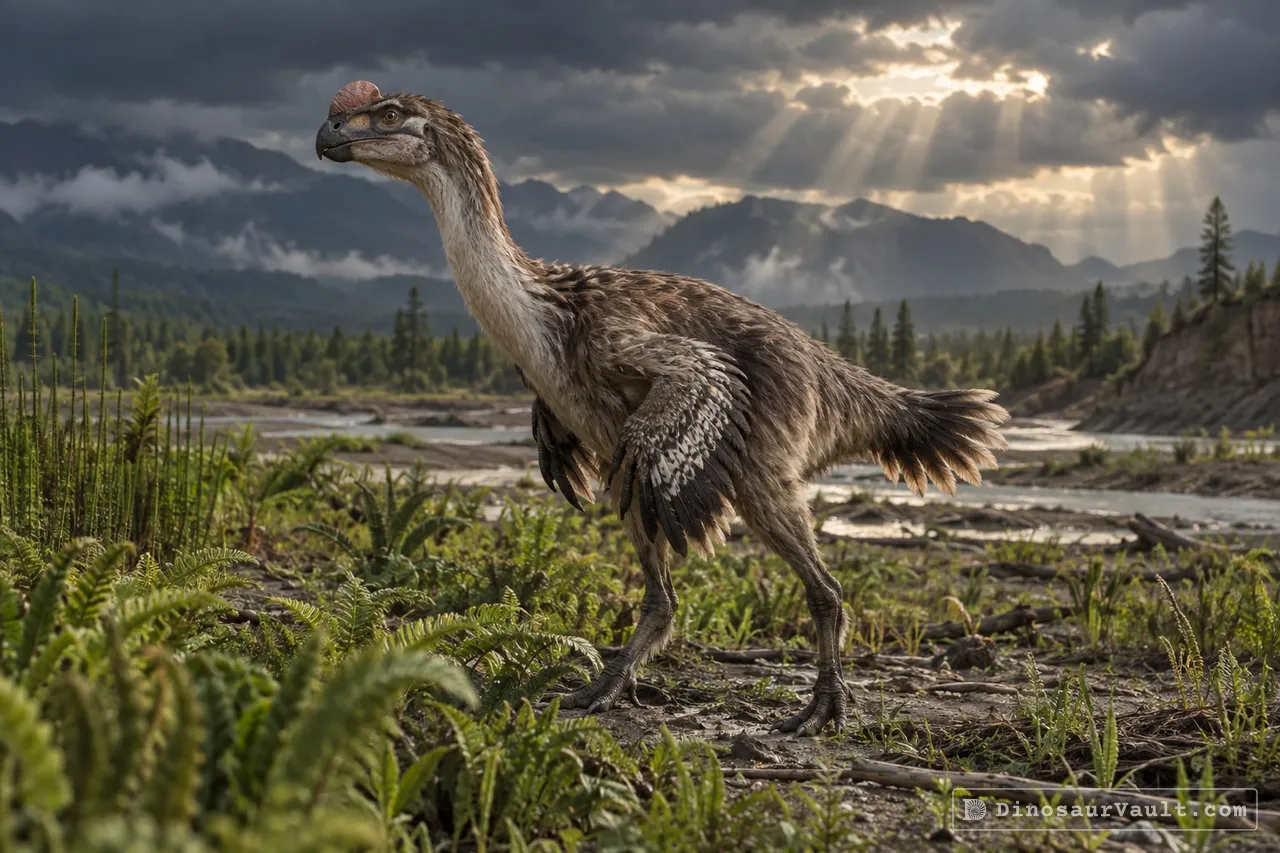
Huanansaurus was an oviraptor, a feathered, beaked dinosaur with a crest on its head and no teeth. It is known from a partial skull and skeleton.
Its world
It lived about 72 to 66 million years ago, at the end of the Late Cretaceous, in what is now southern China. It shared its world with the crested oviraptor Corythoraptor and the small oviraptor Tongtianlong.
How it was found
Lü and colleagues named Huanansaurus in 2015, from a single find. The region where it was found has produced many oviraptors, and it may have been a center of their evolution.
Field gallery
More views of Huanansaurus
Scenes reconstructed from the available fossil evidence.
1 of 3
Lived alongside
Found in the same rock formations


A rock formation can hold fossils laid down millions of years apart, so not every animal here met Huanansaurus.
The evidence
The science behind Huanansaurus
Which parts of the picture come from its own bones, and which come from its relatives.
From its own fossils
- A nearly complete skull and parts of the neck, arms and legs preserve its toothless jaws and head crest.
- The tip of its lower jaw points upward, and its hands carry curved claws.
Borrowed from relatives
- A feathered covering follows other oviraptorosaurs, including Caudipteryx.
- Missing parts of the body and tail are restored by comparison with more complete oviraptorids such as Citipati.
Still unknown
- The colors of its feathers and crest.
- Exactly what it ate.
- Whether it used its crest to attract mates or signal to other animals.
Discovery timeline
- 2015Named itLü et al.
- 2016Same rocksLü et al.
- 2017Close relativeLü et al.
Key papers
The research behind what we know of Huanansaurus
Named it
Described the skull and partial skeleton of a crested, toothless oviraptorid and found similarities to Citipati.
A New Oviraptorid Dinosaur (Dinosauria: Oviraptorosauria) from the Late Cretaceous of Southern China and Its Paleobiogeographical Implications. Scientific Reports 5
Read the paper : A New Oviraptorid Dinosaur (Dinosauria: Oviraptorosauria) from the Late Cretaceous of Southern China and Its Paleobiogeographical Implications (opens in a new tab)Same rocks
Named Tongtianlong and compared its domed skull with Huanansaurus, revealing different head shapes among the region's oviraptorids.
A Late Cretaceous diversification of Asian oviraptorid dinosaurs: evidence from a new species preserved in an unusual posture. Scientific Reports 6
Read the paper : A Late Cretaceous diversification of Asian oviraptorid dinosaurs: evidence from a new species preserved in an unusual posture (opens in a new tab)Close relative
Described Corythoraptor, an oviraptorid with a tall crest, and recovered it as a close relative of Huanansaurus.
High diversity of the Ganzhou Oviraptorid Fauna increased by a new “cassowary-like” crested species. Scientific Reports 7
Read the paper : High diversity of the Ganzhou Oviraptorid Fauna increased by a new “cassowary-like” crested species (opens in a new tab)
Close relatives
Other members of Oviraptoridae


Sources: Wikidata