Niobrarasaurus
"Niobrara lizard"
- Lived
- 90 to 84 million years ago, Late Cretaceous
- Diet
- Herbivore
- Group
- Ankylosaurs, Nodosauridae
- Found in
- United States
- Named by
- Carpenter et al. 1995
Where its fossils were found
The evidence
Today

90 million years ago
Habitat
It lived on land beside the Western Interior Seaway. The Niobrara Formation records the offshore sea, with remains of Claosaurus and flying pterosaurs.
Field notes
About Niobrarasaurus
What it was like
Niobrarasaurus was a nodosaur, an armored plant eater with bony plates on its back and no tail club.
Its world
It lived about 90 to 84 million years ago, in the Late Cretaceous, in what is now Kansas. Its bones come from the Niobrara Formation, which formed in the Western Interior Seaway far from land. Its body probably floated out to sea after death, like that of the duckbill relative Claosaurus from the same rocks.
How it was found
Carpenter and colleagues named it in 1995. There are two recorded finds.
Field gallery
More views of Niobrarasaurus
Scenes reconstructed from the available fossil evidence.
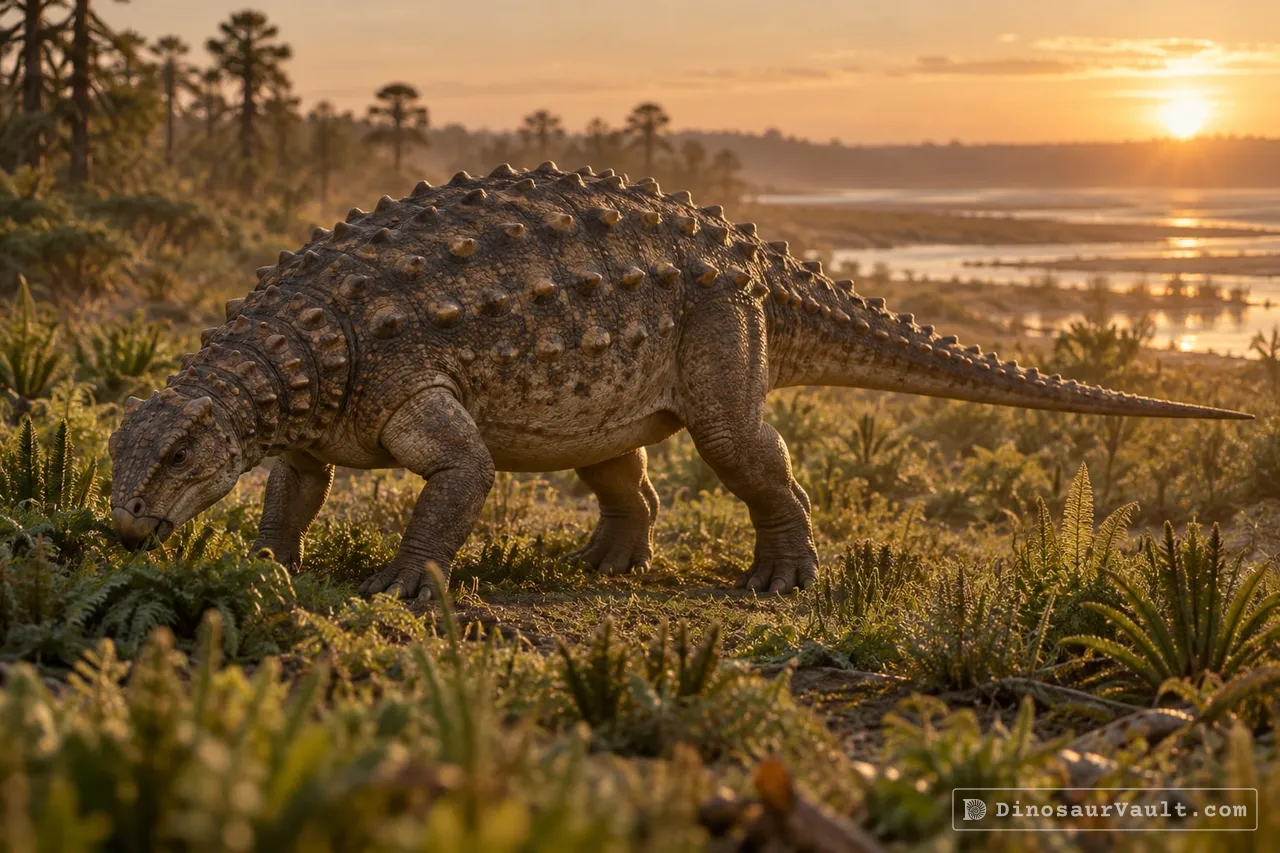
1 of 3
Lived alongside
Found in the same rock formations

A rock formation can hold fossils laid down millions of years apart, so not every animal here met Niobrarasaurus.
The evidence
The science behind Niobrarasaurus
Which parts of the picture come from its own bones, and which come from its relatives.
From its own fossils
- The type specimen is a partial skeleton preserving skull fragments, much of the tail, limb bones and bony armor.
- Its skull has a long, narrow snout, a slightly domed roof, a projecting eye rim and a triangular cheek process. A study of the skull read the snout surface as scaly skin, replacing the earlier idea of paired armor plates there.
- Separate forearm bones referred to a young Niobrarasaurus bear scratches and damaged ends, probably from a shark scavenging the carcass.
Borrowed from relatives
- The narrow skull shape is compared with Pawpawsaurus.
- Missing parts around the mouth and braincase are compared with Edmontonia.
- The missing trunk and feet are compared with Sauropelta.
Still unknown
- The full arrangement of its armor.
- Its color.
- The landscape where it lived before its body reached the sea.
Discovery timeline
- 1995Named itCarpenter, Dilkes & Weishampel
- 2005Growing upEverhart & Hamm
- 2007SkullCarpenter & Everhart
Key papers
The research behind what we know of Niobrarasaurus
Named it
Gave this armored dinosaur its own genus while reviewing the dinosaurs found in the Niobrara chalk.
The Dinosaurs of the Niobrara Chalk Formation (Upper Cretaceous, Kansas). Journal of Vertebrate Paleontology 15: 275-297
Read the paper : The Dinosaurs of the Niobrara Chalk Formation (Upper Cretaceous, Kansas) (opens in a new tab)Growing up
Assigned small forearm bones to a young Niobrarasaurus and linked their damage to shark scavenging.
A new nodosaur specimen (Dinosauria: Nodosauridae) from the Smoky Hill Chalk (Upper Cretaceous) of western Kansas. Transactions of the Kansas Academy of Science 108: 15-21
Read the paper : A new nodosaur specimen (Dinosauria: Nodosauridae) from the Smoky Hill Chalk (Upper Cretaceous) of western Kansas (opens in a new tab)Skull
Newly recognized skull pieces showed a long, narrow head resembling Pawpawsaurus more than Edmontonia.
Skull of the ankylosaur Niobrarasaurus coleu (Ankylosauria: Nodosauridae) from the Smoky Hill Chalk (Coniacian) of western Kansas. Transactions of the Kansas Academy of Science 110: 1-9
Read the paper : Skull of the ankylosaur Niobrarasaurus coleu (Ankylosauria: Nodosauridae) from the Smoky Hill Chalk (Coniacian) of western Kansas (opens in a new tab)
Close relatives
Other members of Nodosauridae


Sources: Wikidata