Austrosaurus
"southern lizard"
Type species Austrosaurus mckillopi
- Lived
- 106 to 101 million years ago, Early Cretaceous
- Diet
- Herbivore
- Length
- about 15 m (49 ft)
- Group
- Sauropods
- Found in
- Australia
- Named by
- Longman 1933
Size comparison
To scale


Scale in metersOutline: typical sauropod shape
Where its fossils were found
The evidence
Today

105 million years ago
Habitat
It lived on land beside the shallow inland sea recorded by the Allaru Mudstone, and its body probably washed out to sea. Muttaburrasaurus and Kunbarrasaurus also lived in the region.
Field notes
About Austrosaurus
What it was like
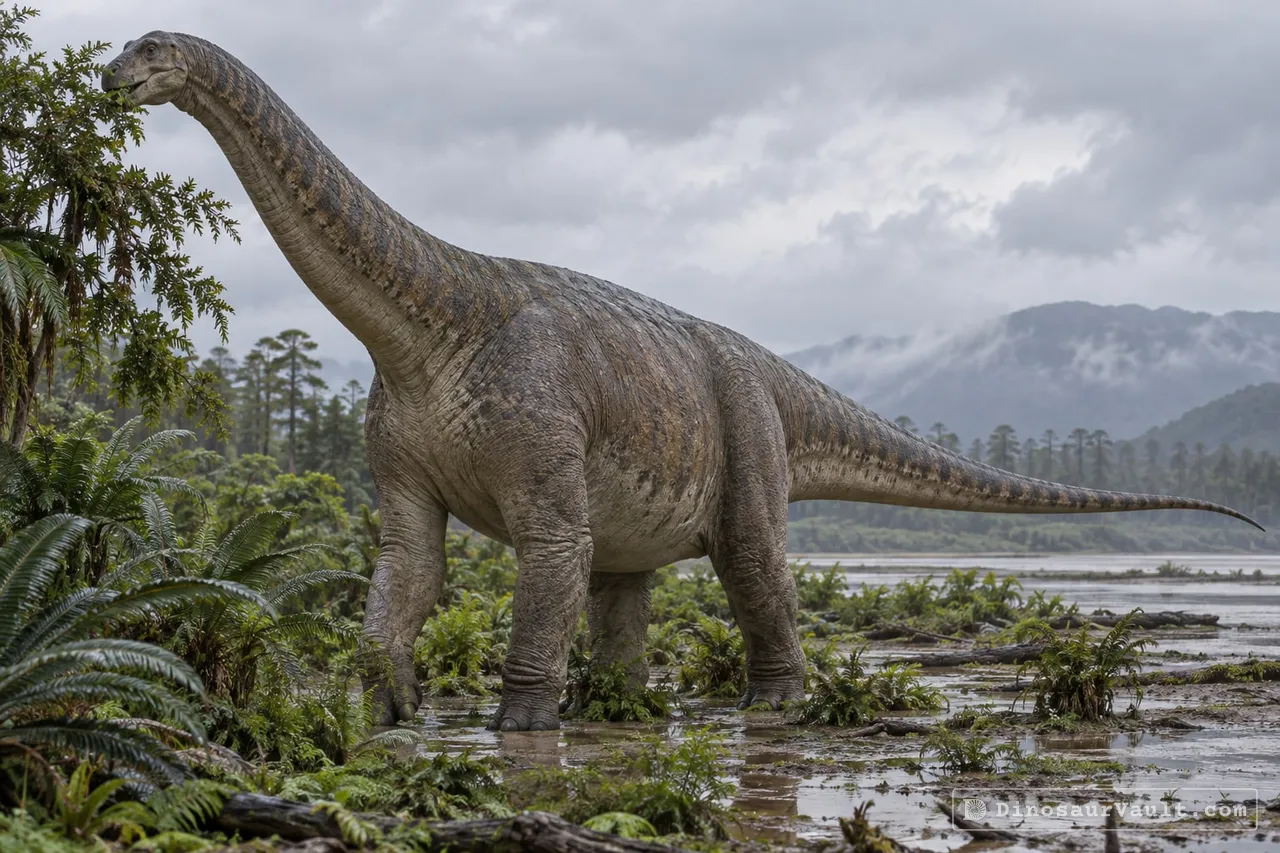
Austrosaurus was a long-necked sauropod known from backbones, ribs and some limb bones. It was one of the first sauropods found in Australia.
Its world
It lived in the Early Cretaceous in Australia. Its bones come from the Allaru Mudstone, which formed on the floor of a shallow inland sea, so its body probably washed out from land. The plant eater Muttaburrasaurus lived in the same region.
How it was found
Longman named Austrosaurus in 1933. The type species is Austrosaurus mckillopi.
Field gallery
More views of Austrosaurus
Scenes reconstructed from the available fossil evidence.
1 of 3
Lived alongside
Found in the same rock formations

A rock formation can hold fossils laid down millions of years apart, so not every animal here met Austrosaurus.
The evidence
The science behind Austrosaurus
Which parts of the picture come from its own bones, and which come from its relatives.
From its own fossils
- The original skeleton preserves the last neck vertebra, the front part of the backbone and ribs.
- Its vertebrae contain many small chambers, and its ribs have air spaces near their upper ends.
- An extra opening on the side of the first back vertebra helps distinguish it from other sauropods.
Borrowed from relatives
- More complete titanosauriforms such as Wintonotitan provide comparisons for its missing limbs and tail.
- Its small head and long neck follow the general titanosauriform body plan.
Still unknown
- The shape of its head and the proportions of its limbs and tail.
- Its exact position within the titanosauriform family tree.
- Its skin texture and color.
Discovery timeline
- 1933Named itLongman
- 2009Family treeHocknull et al.
- 2017RedescriptionPoropat et al.
Key papers
The research behind what we know of Austrosaurus
Named it
Named a sauropod from fragmentary vertebrae found in rocks containing marine fossils.
A new dinosaur from the Queensland Cretaceous. Memoirs of the Queensland Museum 10: 131-144
No link available
Family tree
Named Wintonotitan from bones previously assigned to Austrosaurus, separating the more complete skeleton from the older fragmentary animal.
New Mid-Cretaceous (Latest Albian) Dinosaurs from Winton, Queensland, Australia. PLoS ONE 4: e6190
Read the paper : New Mid-Cretaceous (Latest Albian) Dinosaurs from Winton, Queensland, Australia (opens in a new tab)Redescription
Reassembled the vertebrae with newly recovered ribs, confirmed a distinct titanosauriform and identified an extra opening in a back vertebra.
Reappraisal ofAustrosaurus mckillopiLongman, 1933 from the Allaru Mudstone of Queensland, Australia’s first named Cretaceous sauropod dinosaur. Alcheringa: An Australasian Journal of Palaeontology 41: 543-580
Read the paper : Reappraisal ofAustrosaurus mckillopiLongman, 1933 from the Allaru Mudstone of Queensland, Australia’s first named Cretaceous sauropod dinosaur (opens in a new tab)
Close relatives
Other members of Somphospondyli


Sources: Wikidata