Dasosaurus
Type species Dasosaurus tocantinensis
- Lived
- 120 to 113 million years ago, Early Cretaceous
- Diet
- Herbivore
- Group
- Sauropods
- Found in
- Brazil
- Named by
- Mayer et al. 2026
Where its fossils were found
The evidence
Today

115 million years ago
Habitat
Rivers, lakes and floodplains covered parts of its region in Brazil. Candidodon, a small crocodile relative, and the sauropod Amazonsaurus also come from the Itapecuru Formation.
Field notes
About Dasosaurus
What it was like
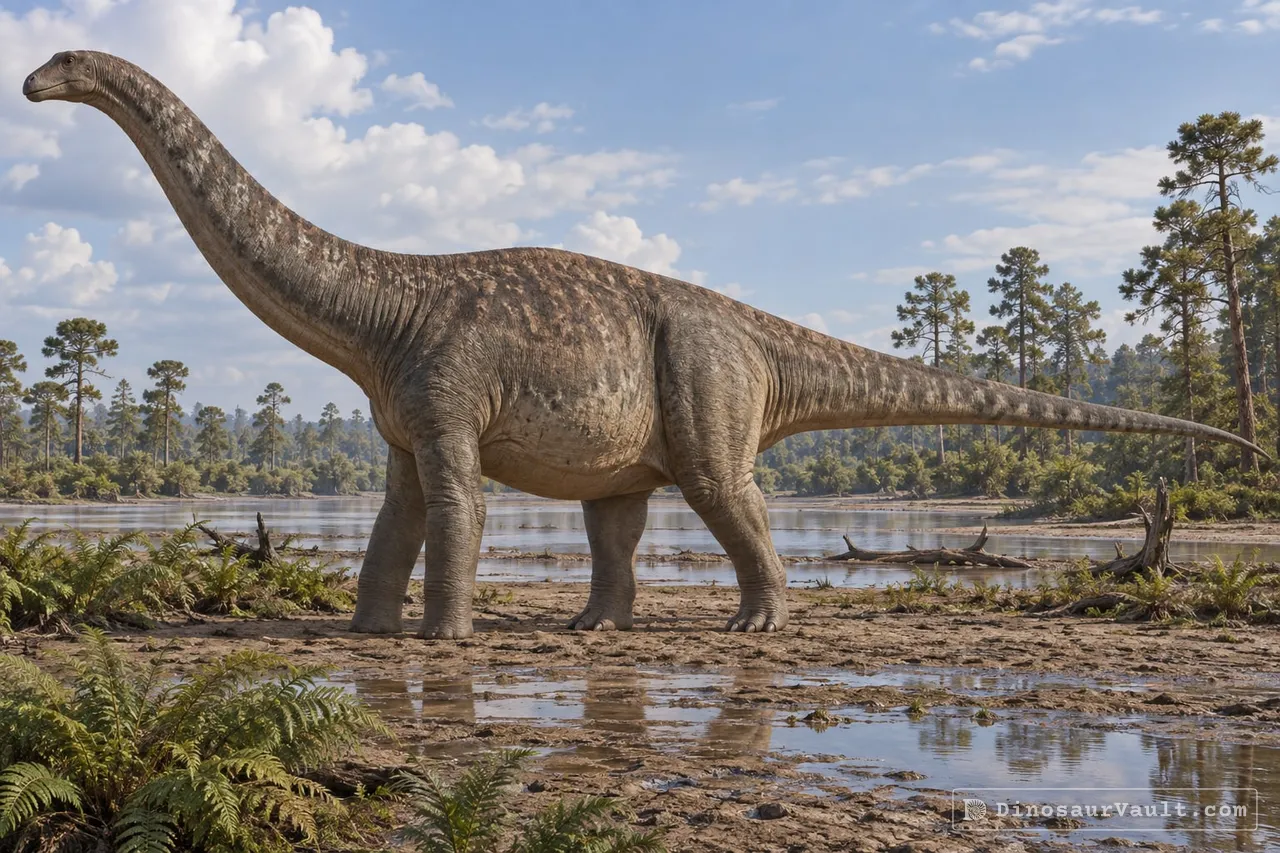
Dasosaurus was a sauropod, a long-necked plant eater, and a relative of the titanosaurs. It is known from part of one skeleton and seems to have been a fairly large animal.
Its world
It lived in the Early Cretaceous, in what is now Brazil. It comes from the Itapecuru Formation, where it shared the land with the rebbachisaurid Amazonsaurus.
How it was found
Mayer and colleagues named Dasosaurus in 2026. The type species is Dasosaurus tocantinensis.
Field gallery
More views of Dasosaurus
Scenes reconstructed from the available fossil evidence.
Lived alongside
Found in the same rock formations

A rock formation can hold fossils laid down millions of years apart, so not every animal here met Dasosaurus.
The evidence
The science behind Dasosaurus
Which parts of the picture come from its own bones, and which come from its relatives.
From its own fossils
- Part of an associated skeleton preserves tail bones, forearm bones, parts of the hands, the pelvis and hindlimbs.
- The inner hindfoot claws are strongly curved, with the innermost pair roughly similar in size and the next claw smaller.
- Microscopic bone structure shows that the known animal was mature.
Borrowed from relatives
- Euhelopus provides a comparison for the missing head and neck.
- Garumbatitan helps place its tail and limb features among related sauropods.
- Apatosaurus and other sauropods help restore the forefeet as compact supporting columns.
Still unknown
- The shape of its skull and the exact length of its neck.
- The complete arrangement of its fingers and toes.
- Its skin, color and behavior.
Often drawn wrong
- The forefeet should form compact pads rather than spread out like grasping hands.
- A row of equal hindfoot claws misses the different sizes of the preserved inner claws.
Discovery timeline
- 2003PostureBonnan
- 2013Close relativePoropat & Kear
- 2026Named itMayer et al.
Key papers
The research behind what we know of Dasosaurus
Posture
Explained how tightly grouped, upright hand bones supported sauropod weight, helping restore the incomplete forefeet of Dasosaurus.
The evolution of manus shape in sauropod dinosaurs: implications for functional morphology, forelimb orientation, and phylogeny. Journal of Vertebrate Paleontology 23: 595-613
Read the paper : The evolution of manus shape in sauropod dinosaurs: implications for functional morphology, forelimb orientation, and phylogeny (opens in a new tab)Close relative
Reassembled the skull of Euhelopus, providing a comparison for the missing head of Dasosaurus.
Photographic Atlas and Three-Dimensional Reconstruction of the Holotype Skull of Euhelopus zdanskyi with Description of Additional Cranial Elements. PLoS ONE 8: e79932
Read the paper : Photographic Atlas and Three-Dimensional Reconstruction of the Holotype Skull of Euhelopus zdanskyi with Description of Additional Cranial Elements (opens in a new tab)Named it
Described a partial sauropod skeleton, found signs of maturity in its bones and proposed a close relationship with Garumbatitan.
A new titanosauriform with European affinities in the Early Cretaceous of Brazil: insights on Somphospondyli phylogeny, histology and biogeography. Journal of Systematic Palaeontology 24
Read the paper : A new titanosauriform with European affinities in the Early Cretaceous of Brazil: insights on Somphospondyli phylogeny, histology and biogeography (opens in a new tab)
Close relatives
Other members of Somphospondyli


Sources: Wikidata