Huanghetitan
"Yellow River titan"
- Lived
- 126 to 113 million years ago, Early Cretaceous
- Diet
- Herbivore
- Group
- Sauropods
- Found in
- China
- Named by
- You et al. 2006
Where its fossils were found
The evidence
Today

120 million years ago
Habitat
It lived in inland China alongside the long-necked plant eaters Daxiatitan and Yongjinglong.
Field notes
About Huanghetitan
What it was like
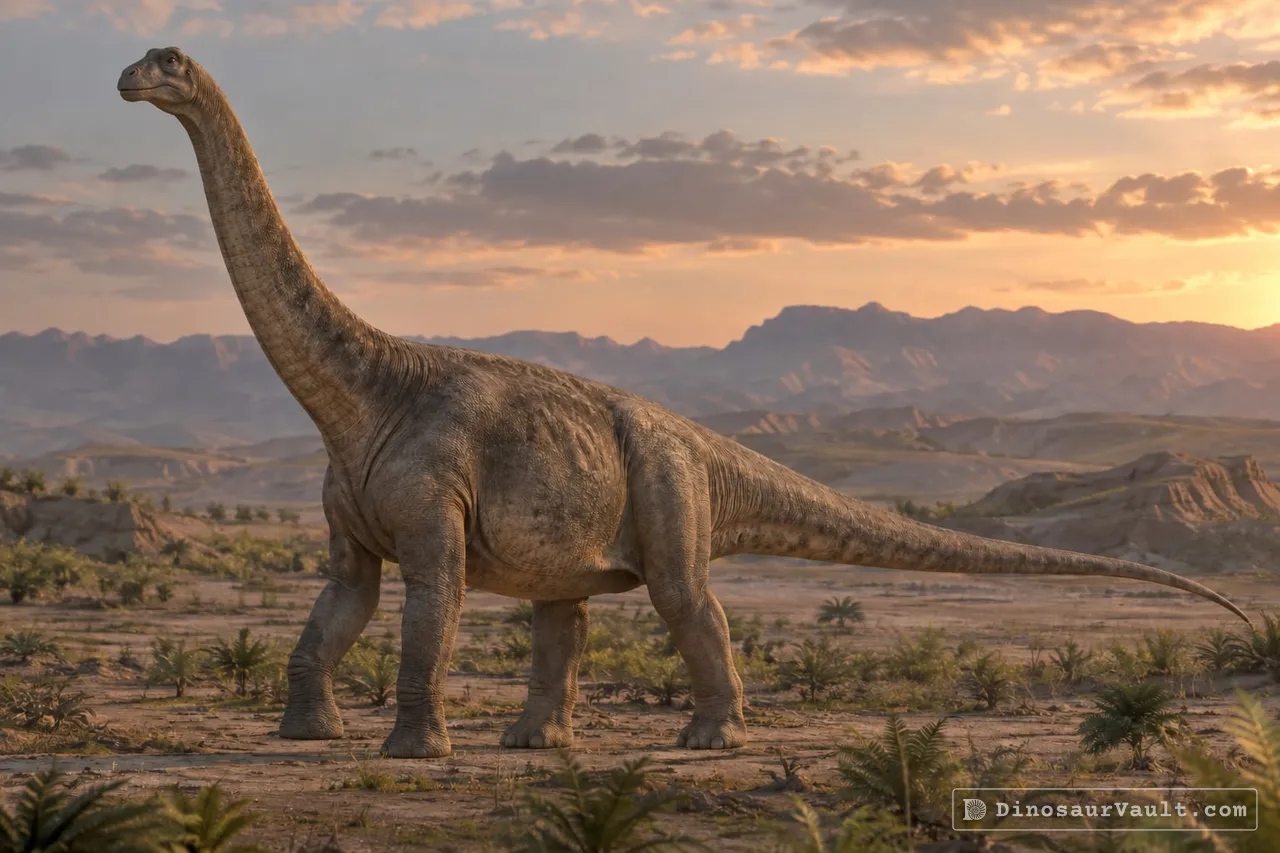
Huanghetitan was a large long-necked sauropod, an early relative of the titanosaurs. Its type species is known from hip vertebrae, tail bones, partial neck ribs and shoulder bones. A much larger skeleton was later assigned to the genus, but its classification is disputed.
Its world
It lived in the Early Cretaceous in what is now China. The large sauropod Daxiatitan lived in the same region.
How it was found
You and colleagues named it in 2006.
Field gallery
More views of Huanghetitan
Scenes reconstructed from the available fossil evidence.
1 of 3
The evidence
The science behind Huanghetitan
Which parts of the picture come from its own bones, and which come from its relatives.
From its own fossils
- The type species is known from hip vertebrae, tail bones, partial neck ribs, a bone beneath the tail and shoulder bones.
- Its shoulder blade has a broad expansion at the end nearest the shoulder joint.
- Its fused hip vertebrae have low, wide bony spines.
Borrowed from relatives
- Euhelopus provides a comparison for the missing head.
- Apatosaurus provides a comparison for the supporting front feet, and Camarasaurus for the hind feet.
Still unknown
- Its full body length and weight.
- Its skin color and markings.
- The shape and proportions of its neck, and its exact place in the sauropod family tree.
Discovery timeline
- 2006Named itYou et al.
- 2007New findJunchang et al.
- 2013Family treeMannion et al.
- 2013SkullPoropat & Kear
- 2014Same rocksLi et al.
Key papers
The research behind what we know of Huanghetitan
Named it
Named Huanghetitan from an incomplete sauropod skeleton found in China.
Huanghetitan liujiaxiaensis, a new sauropod dinosaur from the Lower Cretaceous Hekou Group of Lanzhou Basin, Gansu Province, China. Geological Review 52: 668-674
No link available
New find
Assigned a huge, deep-bodied skeleton to Huanghetitan ruyangensis, a second species whose classification was later questioned.
A New Gigantic Sauropod Dinosaur with the Deepest Known Body Cavity from the Cretaceous of Asia. Acta Geologica Sinica - English Edition 81: 167-176
Read the paper : A New Gigantic Sauropod Dinosaur with the Deepest Known Body Cavity from the Cretaceous of Asia (opens in a new tab)Family tree
Found that the species assigned to Huanghetitan fell in different parts of the family tree and proposed a separate genus for ruyangensis.
Osteology of the Late Jurassic Portuguese sauropod dinosaurLusotitan atalaiensis(Macronaria) and the evolutionary history of basal titanosauriforms. Zoological Journal of the Linnean Society 168: 98-206
Read the paper : Osteology of the Late Jurassic Portuguese sauropod dinosaurLusotitan atalaiensis(Macronaria) and the evolutionary history of basal titanosauriforms (opens in a new tab)Skull
Reconstructed the skull of Euhelopus from scans and described previously overlooked bones, providing a comparison for the missing head of Huanghetitan.
Photographic Atlas and Three-Dimensional Reconstruction of the Holotype Skull of Euhelopus zdanskyi with Description of Additional Cranial Elements. PLoS ONE 8: e79932
Read the paper : Photographic Atlas and Three-Dimensional Reconstruction of the Holotype Skull of Euhelopus zdanskyi with Description of Additional Cranial Elements (opens in a new tab)Same rocks
Named Yongjinglong from the same rocks as Huanghetitan and compared their shoulder blades.
A New Titanosaurian Sauropod from the Hekou Group (Lower Cretaceous) of the Lanzhou-Minhe Basin, Gansu Province, China. PLoS ONE 9: e85979
Read the paper : A New Titanosaurian Sauropod from the Hekou Group (Lower Cretaceous) of the Lanzhou-Minhe Basin, Gansu Province, China (opens in a new tab)
Close relatives
Other members of Somphospondyli


Sources: Wikidata