Angolatitan
"Angolan giant"
- Lived
- 90 to 86 million years ago, Late Cretaceous
- Diet
- Herbivore
- Group
- Sauropods
- Found in
- Angola
- Named by
- Mateus et al. 2011
Where its fossils were found
The evidence
Today

90 million years ago
Habitat
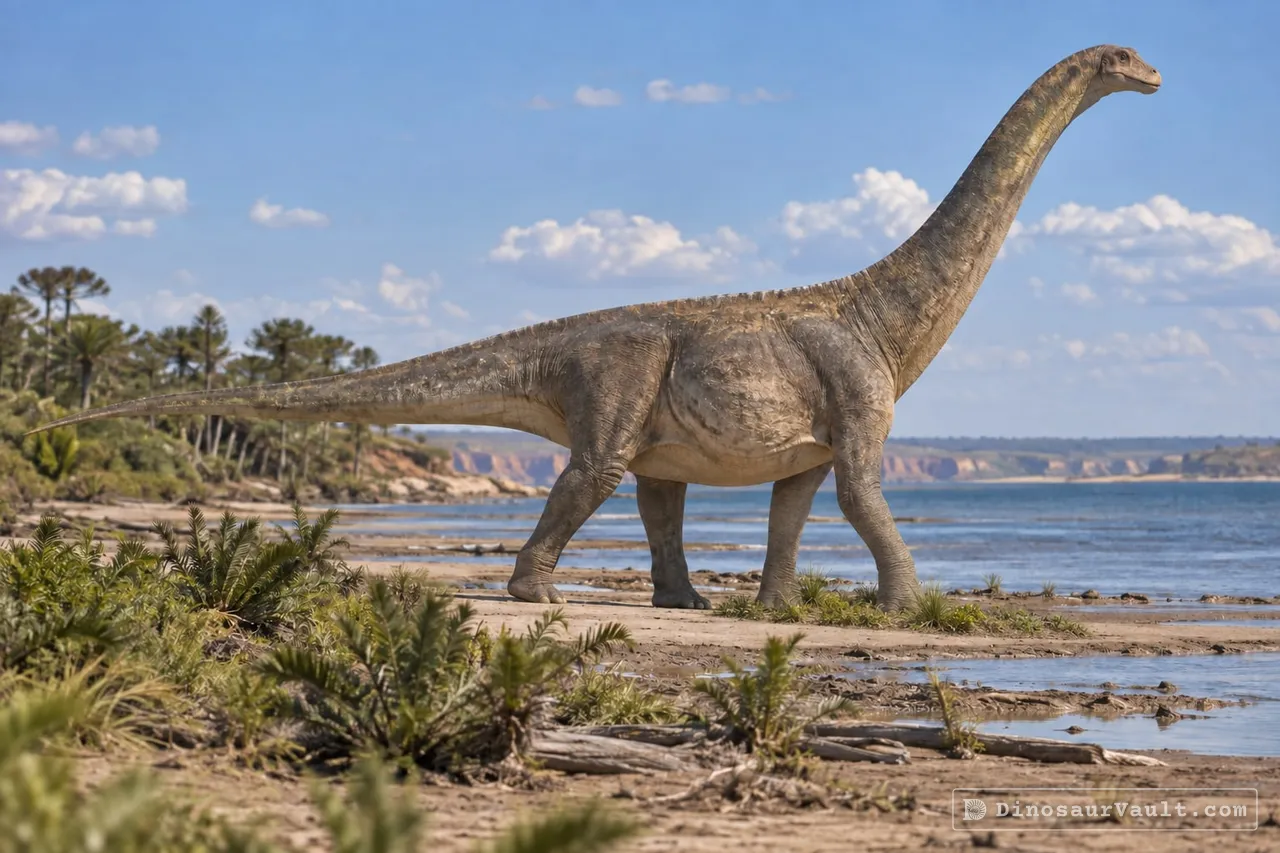
It lived along a dry coast in Angola beside the growing Atlantic. Marine turtles, mosasaurs and sharks lived in the nearby sea.
Field notes
About Angolatitan
What it was like
Angolatitan was a sauropod, a long-necked plant eater. It is known from a front leg.
Its world
It lived in the Late Cretaceous, in what is now Angola. It comes from the Itombe Formation, which formed along a coast. At that time the area was very dry.
How it was found
Mateus and colleagues named Angolatitan in 2011. It was the first dinosaur named from Angola.
Field gallery
More views of Angolatitan
Scenes reconstructed from the available fossil evidence.
The evidence
The science behind Angolatitan
Which parts of the picture come from its own bones, and which come from its relatives.
From its own fossils
- A partial right forelimb preserves the shoulder blade, upper arm, forearm and hand bones.
- Its forearm and hand bones are slender compared with those of many titanosaurs.
- The long hand bones fit closely together in a horseshoe shape. Their rounded end surfaces suggest finger bones were present.
Borrowed from relatives
- Euhelopus provides broader comparisons for the missing skull and neck.
- Apatosaurus provides a broader comparison for the missing fingers, and Camarasaurus for the missing feet.
Still unknown
- Its full body size and proportions, and the shape of its head and teeth.
- Its position inside or outside the titanosaurs; analyses disagree.
- Which plants it ate along the dry coast.
Discovery timeline
- 2009Same rocksMateus et al.
- 2011Named itMateus et al.
- 2013Family treeMannion et al.
- 2016Its worldJacobs et al.
Key papers
The research behind what we know of Angolatitan
Same rocks
Described a marine turtle from the same coastal area, tracing its relatives and their spread into the South Atlantic.
The Oldest African Eucryptodiran Turtle from the Cretaceous of Angola. Acta Palaeontologica Polonica 54: 581-588
Read the paper : The Oldest African Eucryptodiran Turtle from the Cretaceous of Angola (opens in a new tab)Named it
Described a slender forelimb and placed Angolatitan outside the titanosaurs in its family-tree analysis.
Angolatitan adamastor, a new sauropod dinosaur and the first record from Angola. Anais da Academia Brasileira de Ciências 83: 221-233
Read the paper : Angolatitan adamastor, a new sauropod dinosaur and the first record from Angola (opens in a new tab)Family tree
Placed Angolatitan outside the titanosaurs in one analysis and inside them in alternative analyses.
Osteology of the Late Jurassic Portuguese sauropod dinosaurLusotitan atalaiensis(Macronaria) and the evolutionary history of basal titanosauriforms. Zoological Journal of the Linnean Society 168: 98-206
Read the paper : Osteology of the Late Jurassic Portuguese sauropod dinosaurLusotitan atalaiensis(Macronaria) and the evolutionary history of basal titanosauriforms (opens in a new tab)Its world
Linked the changing climate and coastal fossil record of Angola to the drift of Africa and the opening of the Atlantic.
Post-Gondwana Africa and the vertebrate history of the Angolan Atlantic Coast. Memoirs of Museum Victoria 74: 343-362
Read the paper : Post-Gondwana Africa and the vertebrate history of the Angolan Atlantic Coast (opens in a new tab)
Close relatives
Other members of Somphospondyli


Sources: Wikidata