Koleken
"coming from clay and water"
Type species Koleken inakayali
- Lived
- 72 to 66 million years ago, Late Cretaceous
- Diet
- Carnivore
- Group
- Theropods, Abelisauridae
- Found in
- Argentina
- Named by
- Pol et al. 2024
Where its fossils were found
The evidence
Today

70 million years ago
Habitat
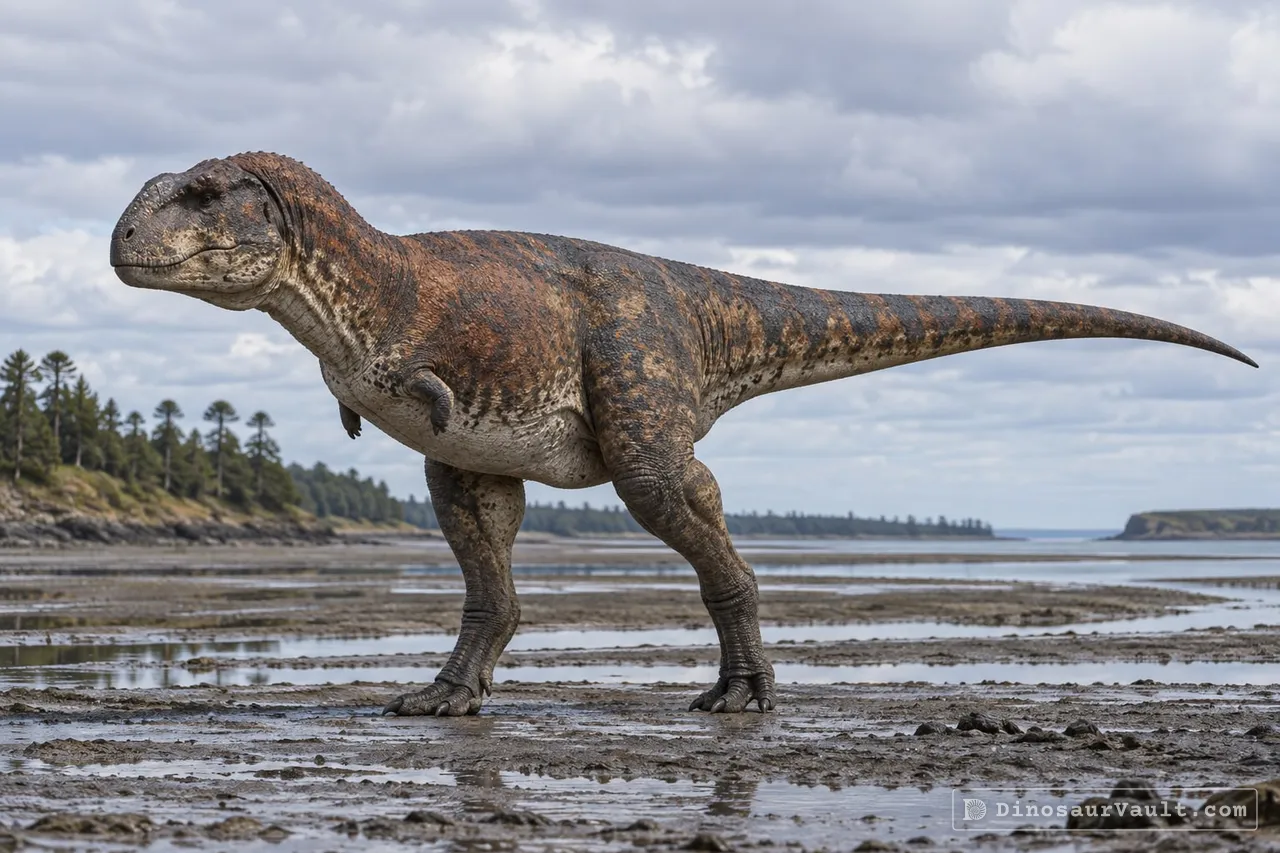
A muddy estuary where river water met the sea, in what is now Argentina. Carnotaurus and Titanomachya also occur in the La Colonia Formation.
Field notes
About Koleken
What it was like
Koleken was an abelisaur, a two-legged hunter with a short head and tiny arms. It was a close relative of Carnotaurus, but its skull had no horns.
Its skeleton is fairly complete and comes from a young animal. It helps show that several kinds of abelisaurs lived together at the end of the age of dinosaurs.
Its world
It lived about 72 to 66 million years ago, at the very end of the Late Cretaceous, in what is now Argentina. Its bones come from the La Colonia Formation, where it lived alongside Carnotaurus.
How it was found
Pol and colleagues named Koleken inakayali in 2024, from a single find.
Field gallery
More views of Koleken
Scenes reconstructed from the available fossil evidence.
Lived alongside
Found in the same rock formations


A rock formation can hold fossils laid down millions of years apart, so not every animal here met Koleken.
The evidence
The science behind Koleken
Which parts of the picture come from its own bones, and which come from its relatives.
From its own fossils
- A partial skeleton includes skull bones, much of the back, the hip region, tail bones and nearly complete hind legs.
- Its skull roof lacks the large brow horns of Carnotaurus.
- The spines along its back vertebrae have raised rims around their edges.
Borrowed from relatives
- The missing arms are restored using tiny-armed relatives such as Carnotaurus.
- Scaly skin is inferred from Carnotaurus, whose skin impressions preserve small scales mixed with larger ones.
Still unknown
- Its full adult size.
- Its color and the arrangement of its scales.
- How its hatchlings looked.
Discovery timeline
- 2008Family treeCarrano & Sampson
- 2021Close relativeHendrickx & Bell
- 2024Named itPol et al.
Key papers
The research behind what we know of Koleken
Family tree
Mapped the relationships and anatomy of the abelisaurid family, including the short skulls and reduced arms of Koleken's relatives.
The Phylogeny of Ceratosauria (Dinosauria: Theropoda). Journal of Systematic Palaeontology 6: 183-236
Read the paper : The Phylogeny of Ceratosauria (Dinosauria: Theropoda) (opens in a new tab)Close relative
Described the skin of Carnotaurus, a relative from the same formation, with large scales scattered among smaller ones.
The scaly skin of the abelisaurid Carnotaurus sastrei (Theropoda: Ceratosauria) from the Upper Cretaceous of Patagonia. Cretaceous Research 128: 104994
Read the paper : The scaly skin of the abelisaurid Carnotaurus sastrei (Theropoda: Ceratosauria) from the Upper Cretaceous of Patagonia (opens in a new tab)Named it
Described a hornless relative of Carnotaurus from a partial skeleton and found that the animal was still growing when it died.
A new abelisaurid dinosaur from the end Cretaceous of Patagonia and evolutionary rates among the Ceratosauria. Cladistics 40: 307-356
Read the paper : A new abelisaurid dinosaur from the end Cretaceous of Patagonia and evolutionary rates among the Ceratosauria (opens in a new tab)
Close relatives
Other members of Abelisauridae


Sources: Wikidata