Titanomachya
Type species Titanomachya gimenezi
- Lived
- 72 to 66 million years ago, Late Cretaceous
- Diet
- Herbivore
- Group
- Sauropods
- Found in
- Argentina
- Named by
- Pérez-Moreno et al. 2024
Where its fossils were found
The evidence
Today

70 million years ago
Habitat
A coastal plain with lagoons and wetlands in Argentina. Water ferns and lotus plants grew in freshwater pools, with conifers and palms nearby. Carnotaurus and Koleken also lived in the La Colonia Formation's world.
Field notes
About Titanomachya
What it was like
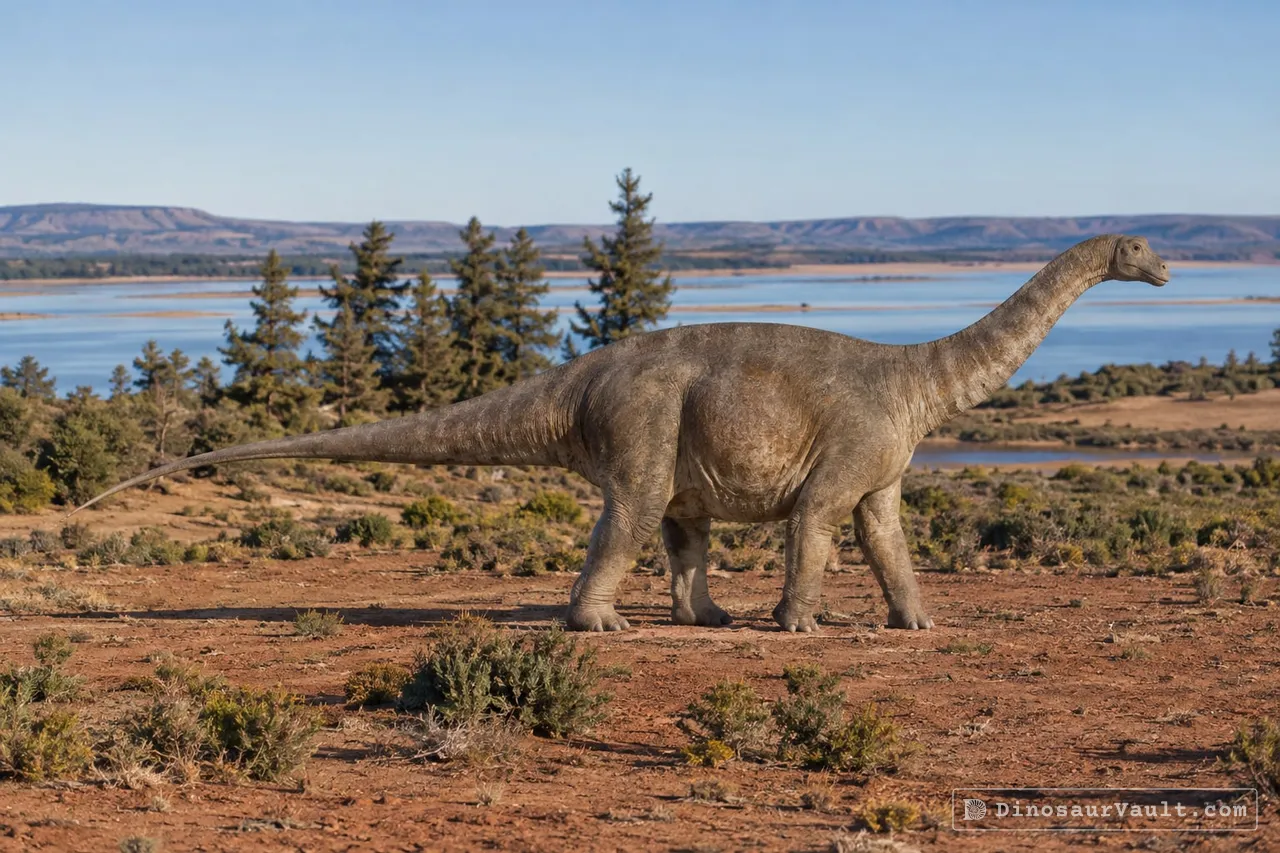
Titanomachya was a fairly small titanosaur, a long-necked, four-legged plant eater. It is known from part of the skeleton, including legs and backbones.
Its name comes from the war of the titans in Greek legend.
Its world
It lived about 72 to 66 million years ago, at the very end of the Late Cretaceous, in what is now Argentina. Its bones come from the La Colonia Formation, where it shared the land with the abelisaurs Carnotaurus and Koleken.
How it was found
Pérez-Moreno and colleagues named Titanomachya in 2024, from a single find. It is the first long-necked dinosaur named from this formation.
Field gallery
More views of Titanomachya
Scenes reconstructed from the available fossil evidence.
Lived alongside
Found in the same rock formations


A rock formation can hold fossils laid down millions of years apart, so not every animal here met Titanomachya.
The evidence
The science behind Titanomachya
Which parts of the picture come from its own bones, and which come from its relatives.
From its own fossils
- A partial skeleton preserves a tail vertebra and bones from the limbs.
- Its ankle bone has a distinctive shape that helps separate it from other titanosaurs.
Borrowed from relatives
- The missing skull, neck and much of the trunk are restored by comparison with other titanosaurs, including Saltasaurus and Rapetosaurus.
Still unknown
- The shape of its skull and the length of its neck.
- Its skin covering and color.
- How it grew and whether it cared for its young.
Discovery timeline
- 2014Its worldCúneo et al.
- 2024Named itPérez-Moreno et al.
- 2024Same rocksPol et al.
Key papers
The research behind what we know of Titanomachya
Its world
Reconstructed freshwater lagoons with water ferns, lotus plants and nearby palms and conifers in the rocks that also contain Titanomachya.
Late Cretaceous Aquatic Plant World in Patagonia, Argentina. PLoS ONE 9: e104749
Read the paper : Late Cretaceous Aquatic Plant World in Patagonia, Argentina (opens in a new tab)Named it
Named a small titanosaur from partial limb and tail remains, with a distinctive ankle bone.
A new titanosaur from the La Colonia Formation (Campanian-Maastrichtian), Chubut Province, Argentina. Historical Biology 37: 792-811
Read the paper : A new titanosaur from the La Colonia Formation (Campanian-Maastrichtian), Chubut Province, Argentina (opens in a new tab)Same rocks
Named Koleken, a meat eater from the same formation as Titanomachya, and described the region's coastal environments.
A new abelisaurid dinosaur from the end Cretaceous of Patagonia and evolutionary rates among the Ceratosauria. Cladistics 40: 307-356
Read the paper : A new abelisaurid dinosaur from the end Cretaceous of Patagonia and evolutionary rates among the Ceratosauria (opens in a new tab)
Close relatives
Other members of Saltasauroidea


Sources: Wikidata