Calvarius
"suffering"
Type species Calvarius rapidus
- Lived
- 72 to 66 million years ago, Late Cretaceous
- Diet
- Herbivore
- Group
- Ornithopods
- Found in
- Spain
- Named by
- Prieto-Márquez and Sellés 2023
Where its fossils were found
The evidence
Today

70 million years ago
Habitat
A winding river crossed its island home in what is now Spain. Pararhabdodon and Tamarro also lived in the region.
Field notes
About Calvarius
What it was like
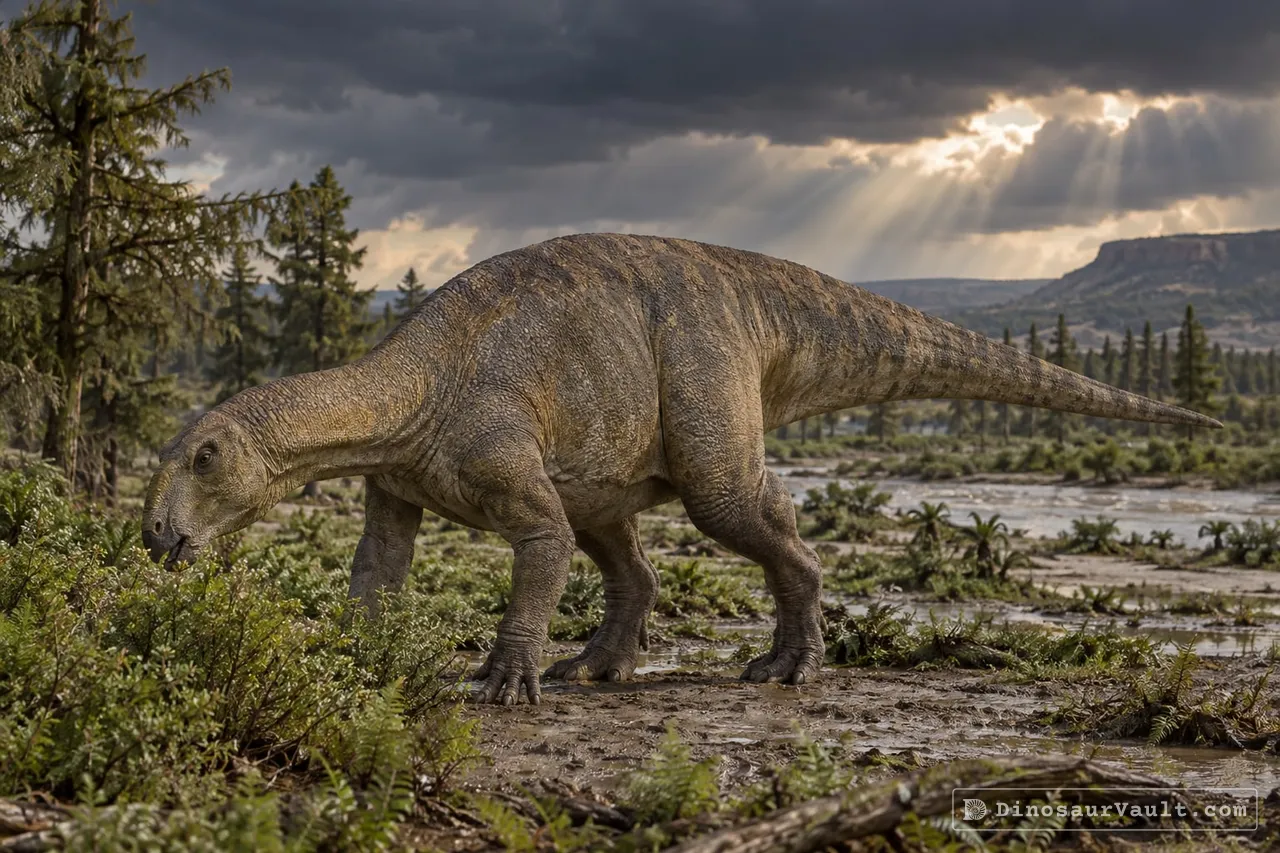
Calvarius was a plant eater related to Iguanodon, known from a single foot bone. The bone is slender, which suggests it was a fast runner.
Its world
It lived about 72 to 66 million years ago, at the very end of the Late Cretaceous, in what is now Spain. Europe was then a chain of islands. Its bone comes from the Talarn Formation, where the duckbill Pararhabdodon and the small troodontid Tamarro also lived.
How it was found
Prieto-Márquez and Sellés named it in 2023. The type species is Calvarius rapidus.
Field gallery
More views of Calvarius
Scenes reconstructed from the available fossil evidence.
1 of 3
Lived alongside
Found in the same rock formations


A rock formation can hold fossils laid down millions of years apart, so not every animal here met Calvarius.
The evidence
The science behind Calvarius
Which parts of the picture come from its own bones, and which come from its relatives.
From its own fossils
- A single long, slender bone from the outer part of the left foot.
- A projecting flange on the bone links it to the group of plant eaters that includes Iguanodon.
- Its unusually slender foot bone suggests that it could run quickly.
Borrowed from relatives
- The head, torso and limbs must be restored by comparison with better-known ornithopods such as Iguanodon.
Still unknown
- The shape of its skull and the proportions of most of its body.
- Its top running speed.
- Its skin covering and color.
Discovery timeline
- 2009Same rocksPrieto-Marquez & Wagner
- 2021Same rocksSellés et al.
- 2023Named itPrieto-Márquez & Sellés
Key papers
The research behind what we know of Calvarius
Same rocks
Linked the local duck-billed dinosaur Pararhabdodon to Tsintaosaurus through distinctive features of their jaws.
Pararhabdodon isonensis and Tsintaosaurus spinorhinus: a new clade of lambeosaurine hadrosaurids from Eurasia. Cretaceous Research 30: 1238-1246
Read the paper : Pararhabdodon isonensis and Tsintaosaurus spinorhinus: a new clade of lambeosaurine hadrosaurids from Eurasia (opens in a new tab)Same rocks
Described Tamarro, a small theropod from the same regional succession, whose bone structure records rapid early growth.
A fast-growing basal troodontid (Dinosauria: Theropoda) from the latest Cretaceous of Europe. Scientific Reports 11
Read the paper : A fast-growing basal troodontid (Dinosauria: Theropoda) from the latest Cretaceous of Europe (opens in a new tab)Named it
Named a plant eater from an unusually slender foot bone and proposed that it was adapted for running.
Evolutionary convergence in a small cursorial styracosternan ornithopod dinosaur from western Europe. Journal of Vertebrate Paleontology 42(5):e2210632:1-17.
No link available
Close relatives
Other members of Styracosterna


Sources: Wikidata