Tamarro
- Lived
- 72 to 66 million years ago, Late Cretaceous
- Diet
- Omnivore
- Group
- Theropods, Troodontidae
- Found in
- Spain
- Named by
- Sellés et al. 2021
Where its fossils were found
The evidence
Today

70 million years ago
Habitat
Rivers crossed an island landscape in what is now Spain. Pararhabdodon and Calvarius also lived in the region.
Field notes
About Tamarro
What it was like
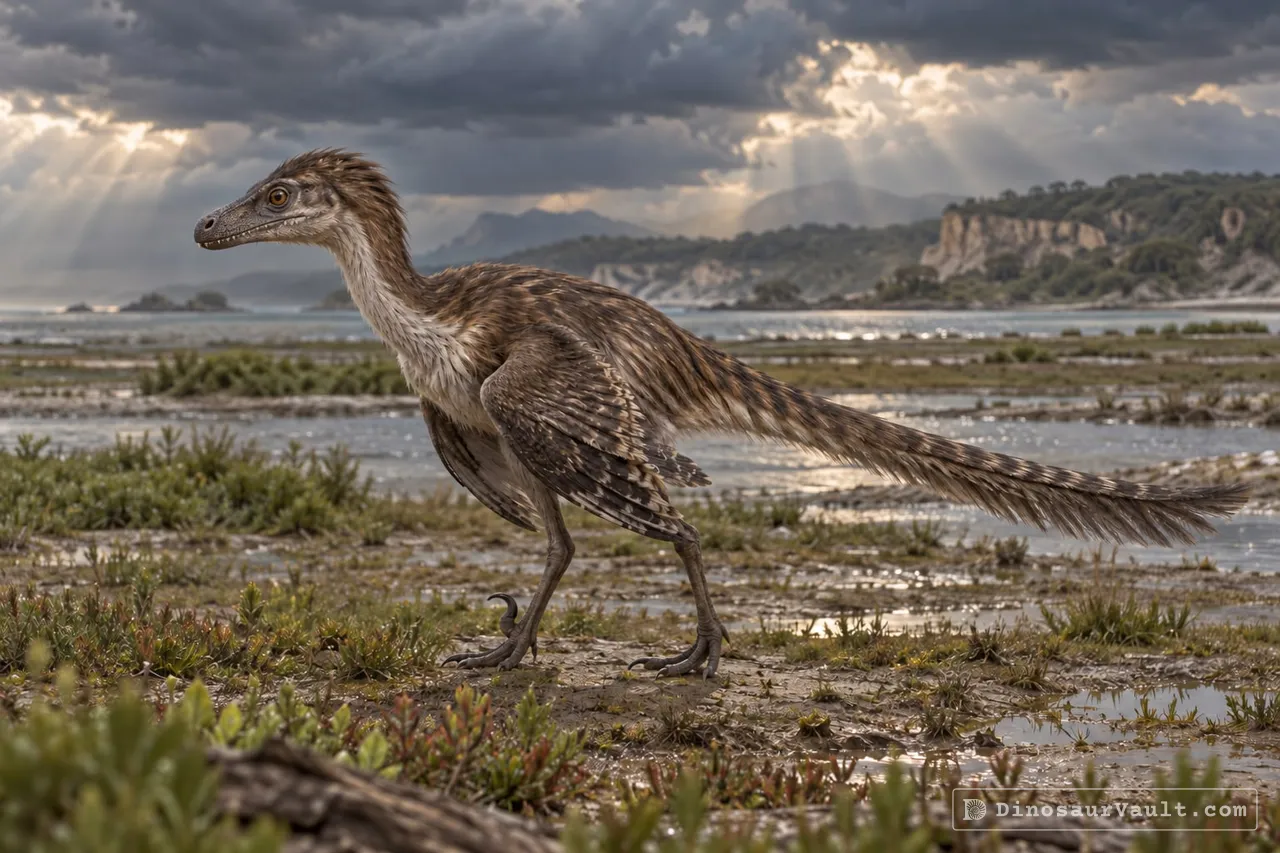
Tamarro was a small troodontid, a feathered, big-eyed theropod. It is known from a single foot bone. The bone shows the animal grew very fast.
Its world
It lived about 72 to 66 million years ago, at the very end of the Late Cretaceous, in what is now Spain. Europe was then a chain of islands. Its bone comes from the Talarn Formation, where the duckbill Pararhabdodon also lived.
How it was found
Sellés and colleagues named it in 2021. Its name comes from a small creature of local legend.
Field gallery
More views of Tamarro
Scenes reconstructed from the available fossil evidence.
Lived alongside
Found in the same rock formations


A rock formation can hold fossils laid down millions of years apart, so not every animal here met Tamarro.
The evidence
The science behind Tamarro
Which parts of the picture come from its own bones, and which come from its relatives.
From its own fossils
- A partial foot bone has a strong ridge and a small opening that distinguish Tamarro from other troodontids.
- The bone's internal tissue shows rapid growth in an animal approaching adulthood.
Borrowed from relatives
- The missing head, arms and tail are restored by comparison with other troodontids, including Jinfengopteryx.
- A feathered covering probably resembled that of troodontids such as Jianianhualong.
Still unknown
- The shape of its skull and the proportions of its body.
- Its feather colors and pattern.
- Exactly where it fits among the earliest branches of troodontids.
Discovery timeline
- 2012Family treeTurner, Makovicky & Norell
- 2017Close relativeXu et al.
- 2021Named itSellés et al.
Key papers
The research behind what we know of Tamarro
Family tree
Compared raptors, troodontids and early birds, establishing the family-tree framework later used to investigate Tamarro's relationships.
A Review of Dromaeosaurid Systematics and Paravian Phylogeny. Bulletin of the American Museum of Natural History 371: 1-206
Read the paper : A Review of Dromaeosaurid Systematics and Paravian Phylogeny (opens in a new tab)Close relative
Jianianhualong preserved long feathers on its arms, legs and tail, supporting a feathered restoration of troodontids such as Tamarro.
Mosaic evolution in an asymmetrically feathered troodontid dinosaur with transitional features. Nature Communications 8
Read the paper : Mosaic evolution in an asymmetrically feathered troodontid dinosaur with transitional features (opens in a new tab)Named it
Named Tamarro from a foot bone and found that the animal was a fast-growing subadult troodontid.
A fast-growing basal troodontid (Dinosauria: Theropoda) from the latest Cretaceous of Europe. Scientific Reports 11
Read the paper : A fast-growing basal troodontid (Dinosauria: Theropoda) from the latest Cretaceous of Europe (opens in a new tab)
Close relatives
Other members of Troodontidae


Sources: Wikidata