Batyrosaurus
- Lived
- 86 to 72 million years ago, Late Cretaceous
- Diet
- Herbivore
- Group
- Ornithopods
- Found in
- Kazakhstan
- Named by
- Godefroit et al. 2012
Where its fossils were found
The evidence
Today

80 million years ago
Habitat
Floodplains in what is now Kazakhstan, where sand and mud became the Bostobe Formation. Aralosaurus also lived in the region, along with sauropods and meat-eating dinosaurs.
Field notes
About Batyrosaurus
What it was like
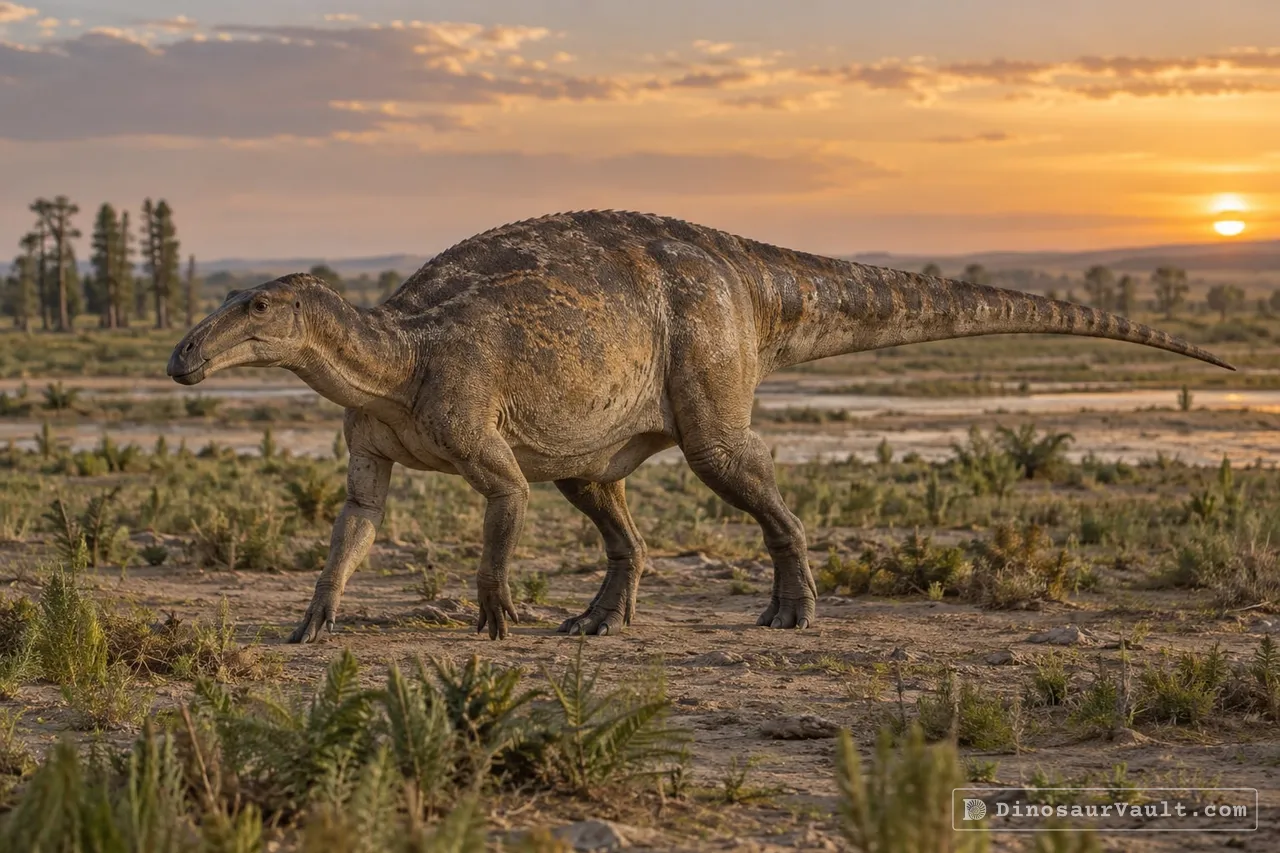
Batyrosaurus was a plant eater, an early relative of the duck-billed dinosaurs. It is known from parts of the skull, hands and backbone.
Its world
It lived in the Late Cretaceous in what is now Kazakhstan. Its bones come from the Bostobe Formation, where the duckbill Aralosaurus also lived.
How it was found
Godefroit and colleagues named it in 2012. Its name comes from a word for hero.
Field gallery
More views of Batyrosaurus
Scenes reconstructed from the available fossil evidence.
Lived alongside
Found in the same rock formations

A rock formation can hold fossils laid down millions of years apart, so not every animal here met Batyrosaurus.
The evidence
The science behind Batyrosaurus
Which parts of the picture come from its own bones, and which come from its relatives.
From its own fossils
- A partial skeleton includes skull and lower-jaw bones, many teeth, chest bones and parts of the arms and hands.
- The lower jaw is long, straight and robust, and its teeth sat in narrow, parallel grooves. A horseshoe-shaped bone capped the front of the jaw.
- A hand claw, probably from the second finger, is flattened from side to side and tapering. The forearm bone called the radius is slender and nearly straight.
Borrowed from relatives
- The missing snout, body, hind legs and tail are restored by comparison with Eolambia, an early duckbill relative known from much more of the skeleton.
Still unknown
- Its snout and hind legs are unknown.
- Whether it usually walked on two legs or four. The shape of its inner-ear canals tentatively suggested to its describers that it moved nimbly on its hind legs.
- Its skin texture and color.
Discovery timeline
- 2004Its worldDyke & Malakhov
- 2012Named itGodefroit
- 2012Close relativeMcDonald et al.
- 2022Family treePoole
Key papers
The research behind what we know of Batyrosaurus
Its world
Studied teeth and other small fossils from the same formation, identifying a floodplain fauna of duckbills, sauropods and meat-eating dinosaurs.
Abundance and taphonomy of dinosaur teeth and other vertebrate remains from the Bostobynskaya Formation, north-east Aral Sea region, Republic of Kazakhstan. Cretaceous Research 25: 669-674
Read the paper : Abundance and taphonomy of dinosaur teeth and other vertebrate remains from the Bostobynskaya Formation, north-east Aral Sea region, Republic of Kazakhstan (opens in a new tab)Named it
Described the partial skeleton and inner ear, identifying an early duckbill relative that may have been an agile two-legged walker.
Bernissart Dinosaurs and Early Cretaceous Terrestrial Ecosystems.
Read the paper : Bernissart Dinosaurs and Early Cretaceous Terrestrial Ecosystems (opens in a new tab)Close relative
Described the skull and skeleton of Eolambia, an early duckbill relative from scattered bones of adults and young animals.
Osteology of the Basal Hadrosauroid Eolambia caroljonesa (Dinosauria: Ornithopoda) from the Cedar Mountain Formation of Utah. PLoS ONE 7: e45712
Read the paper : Osteology of the Basal Hadrosauroid Eolambia caroljonesa (Dinosauria: Ornithopoda) from the Cedar Mountain Formation of Utah (opens in a new tab)Family tree
Compared skull and body features across plant-eating dinosaurs and recovered Batyrosaurus as an early member of the duckbill lineage.
Phylogeny of iguanodontian dinosaurs and the evolution of quadrupedality. Palaeontologia Electronica
Read the paper : Phylogeny of iguanodontian dinosaurs and the evolution of quadrupedality (opens in a new tab)
Close relatives
Other members of Hadrosauroidea


Sources: Wikidata