Aralosaurus
"Aral lizard"
- Lived
- 86 to 72 million years ago, Late Cretaceous
- Diet
- Herbivore
- Length
- about 8 m (26 ft)
- Group
- Ornithopods, Hadrosauridae
- Found in
- Kazakhstan
- Named by
- Rozhdestvensky 1968
Size comparison
To scale


Scale in metersOutline: typical ornithopod shape
Where its fossils were found
The evidence
Today

80 million years ago
Habitat
A coastal river plain in Kazakhstan supported flowering trees and shrubs, with ferns among the vegetation. Animals from the Bostobe Formation included Batyrosaurus, turtles and pterosaurs.
Field notes
About Aralosaurus
What it was like
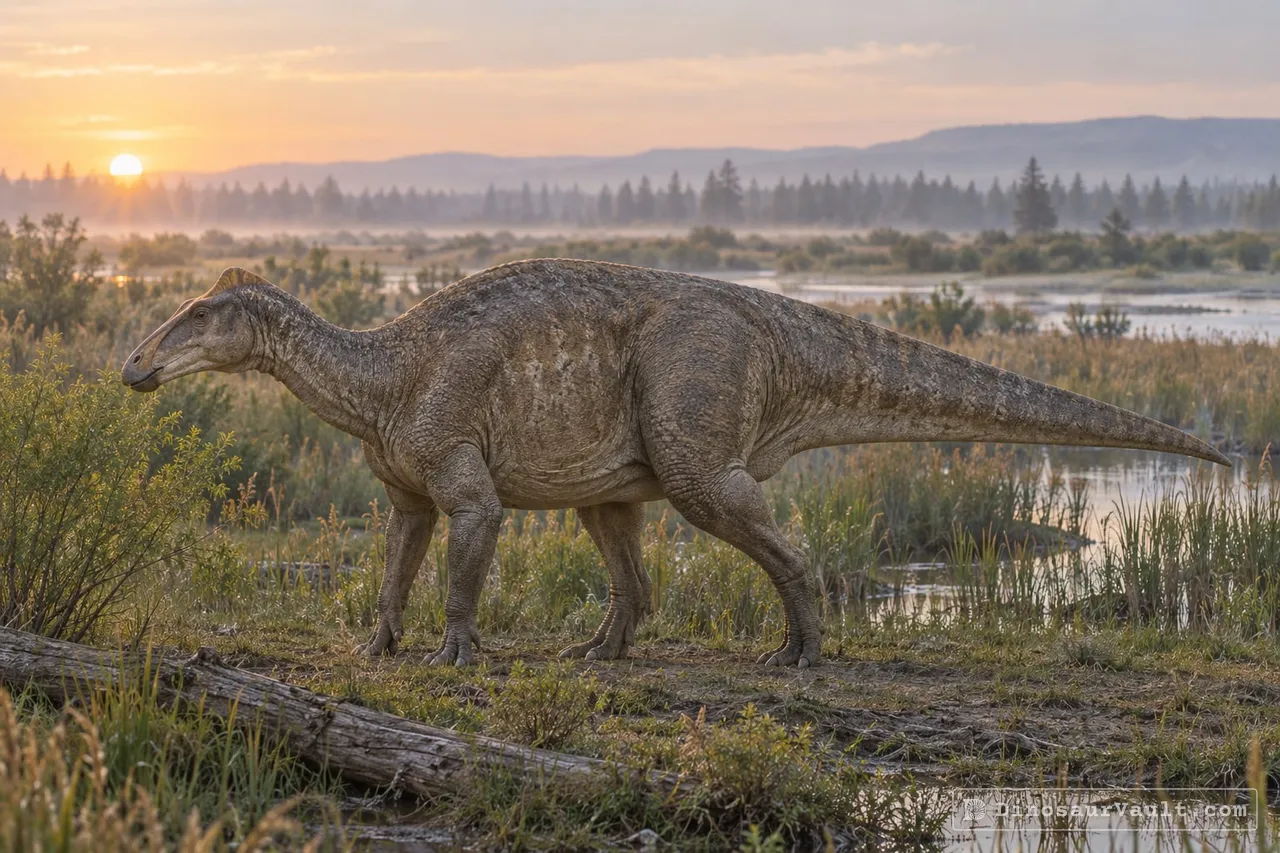
Aralosaurus was a duck-billed plant eater about 8 meters (26 feet) long. It is known from the back half of a skull and a few other bones. A bony bump rose on its snout, and later studies place it among the crested duckbills.
Its world
It lived in the Late Cretaceous in what is now Kazakhstan. Its bones come from the Bostobe Formation, where the plant eater Batyrosaurus also lived.
How it was found
Rozhdestvensky named Aralosaurus in 1968 from one find. It is named after a large inland lake near where it was found.
Field gallery
More views of Aralosaurus
Scenes reconstructed from the available fossil evidence.
Lived alongside
Found in the same rock formations

A rock formation can hold fossils laid down millions of years apart, so not every animal here met Aralosaurus.
The evidence
The science behind Aralosaurus
Which parts of the picture come from its own bones, and which come from its relatives.
From its own fossils
- The back of a skull and parts of the upper jaw preserve its braincase and the base of a crest.
- A hollow structure rose from the snout ahead of the eyes and enclosed part of the breathing passage.
Borrowed from relatives
- The missing body can be modeled on crested duckbills such as Corythosaurus and Lambeosaurus.
- Features of the upper jaw link it closely with Canardia.
Still unknown
- The full shape and size of its crest.
- Its skin color and markings.
- How its crest changed as it grew.
Discovery timeline
- 1968Named itRozhdestvensky
- 2013Family treePrieto-Márquez et al.
- 2015Its worldAverianov et al.
Key papers
The research behind what we know of Aralosaurus
Named it
Named Aralosaurus from a partial skull in Kazakhstan and compared it with other duck-billed dinosaurs.
Gadrozavry Kazakhstana [Hadrosaurs of Kazakhstan]. [Upper Paleozoic and Mesozoic Amphibians and Reptiles]. Akademia Naul SSSR, Moscow.
No link available
Family tree
Identified Canardia as a close relative of Aralosaurus, linking early crested duckbills from Asia with later ones in Europe.
Diversity, Relationships, and Biogeography of the Lambeosaurine Dinosaurs from the European Archipelago, with Description of the New Aralosaurin Canardia garonnensis. PLoS ONE 8: e69835
Read the paper : Diversity, Relationships, and Biogeography of the Lambeosaurine Dinosaurs from the European Archipelago, with Description of the New Aralosaurin Canardia garonnensis (opens in a new tab)Its world
Reconstructed coastal river plains from the Bostobe Formation's sediments, plants and animals, including pterosaurs.
The paleoenvironments of azhdarchid pterosaurs localities in the Late Cretaceous of Kazakhstan. ZooKeys 483: 59-80
Read the paper : The paleoenvironments of azhdarchid pterosaurs localities in the Late Cretaceous of Kazakhstan (opens in a new tab)
Close relatives
Other members of Hadrosauridae


Sources: Wikidata