Xinjiangovenator
"Xinjiang hunter"
- Lived
- Early Cretaceous
- Diet
- Carnivore
- Group
- Theropods
- Found in
- China
- Named by
- Rauhut and Xu 2005
Where its fossils were found
The evidence
Today

Habitat
An inland region of rivers and lakes in what is now northwestern China. The Lianmuqin Formation fauna included Psittacosaurus, Wuerhosaurus and Kelmayisaurus.
Field notes
About Xinjiangovenator
What it was like
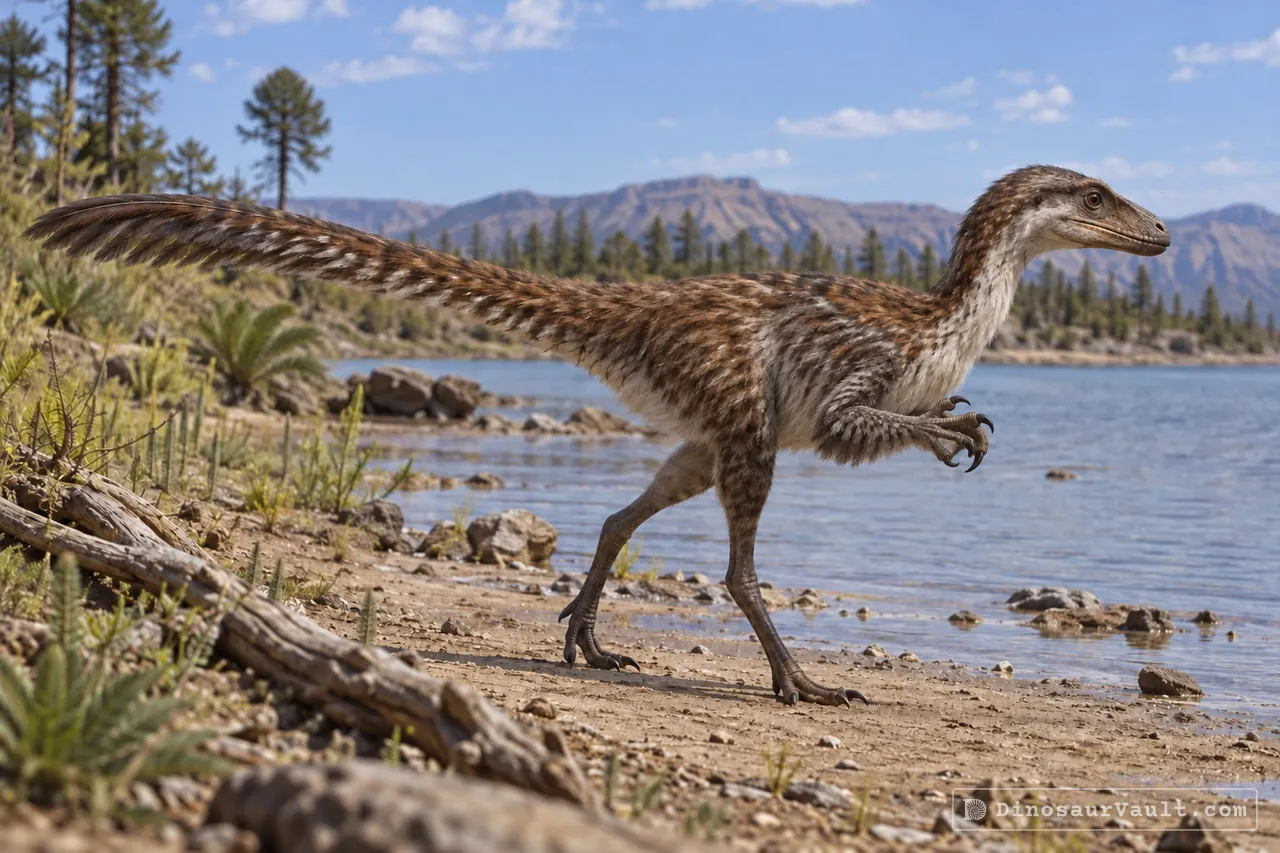
Xinjiangovenator was a small two-legged predator known from a partial leg. It was a coelurosaur, part of the group that includes tyrannosaurs and birds, but its exact place is uncertain.
Its world
It lived in the Early Cretaceous in what is now northwestern China. Its bones come from the Lianmuqin Formation, where the plated Wuerhosaurus and the small horned Psittacosaurus also lived.
How it was found
Rauhut and Xu named it in 2005.
Field gallery
More views of Xinjiangovenator
Scenes reconstructed from the available fossil evidence.
1 of 2
The evidence
The science behind Xinjiangovenator
Which parts of the picture come from its own bones, and which come from its relatives.
From its own fossils
- A partial right lower leg preserves the shinbone, the slender bone beside it and the ankle bones.
- The top of the shinbone has a backward-projecting joint surface, and the neighboring bone has a groove along its front.
- The shinbone, neighboring slender bone and ankle bones lie closely together without being fused.
Borrowed from relatives
- Zuolong offers comparisons for the missing upper face, trunk and forearms.
- Guanlong offers comparisons for the missing lower jaw, hands and feet.
Still unknown
- Its closest relatives within the coelurosaurs.
- The shape of its skull and hands.
- Its body covering and color.
Discovery timeline
- 2005Named itRauhut & Xu
- 2010Family treeChoiniere et al.
- 2012Same rocksBrusatte, Benson & Xu
- 2024Family treeSłowiak, Brusatte & Szczygielski
Key papers
The research behind what we know of Xinjiangovenator
Named it
Named Xinjiangovenator from a distinctive shin and fibula previously assigned to a genus based on an isolated tooth.
The small theropod dinosaursTugulusaurusandPhaedrolosaurusfrom the early Cretaceous of Xinjiang, China. Journal of Vertebrate Paleontology 25: 107-118
Read the paper : The small theropod dinosaursTugulusaurusandPhaedrolosaurusfrom the early Cretaceous of Xinjiang, China (opens in a new tab)Family tree
Included Xinjiangovenator in a broad theropod family tree, where its position varied among the possible trees.
A basal coelurosaur (Dinosauria: Theropoda) from the Late Jurassic (Oxfordian) of the Shishugou Formation in Wucaiwan, People's Republic of China. Journal of Vertebrate Paleontology 30: 1773-1796
Read the paper : A basal coelurosaur (Dinosauria: Theropoda) from the Late Jurassic (Oxfordian) of the Shishugou Formation in Wucaiwan, People's Republic of China (opens in a new tab)Same rocks
Identified Kelmayisaurus from the same formation as a large carcharodontosaurid predator.
A Reassessment ofKelmayisaurus petrolicus, a Large Theropod Dinosaur from the Early Cretaceous of China. Acta Palaeontologica Polonica 57: 65-72
Read the paper : A Reassessment ofKelmayisaurus petrolicus, a Large Theropod Dinosaur from the Early Cretaceous of China (opens in a new tab)Family tree
Showed the remains once called Bagaraatan combined two kinds of theropod, so that skeleton is a poor model for Xinjiangovenator.
Reassessment of the enigmatic Late Cretaceous theropod dinosaur, Bagaraatan ostromi. Zoological Journal of the Linnean Society 202
Read the paper : Reassessment of the enigmatic Late Cretaceous theropod dinosaur, Bagaraatan ostromi (opens in a new tab)
Close relatives
Other members of Coelurosauria


Sources: Wikidata