Juravenator
JOO-ra-ven-AY-tor
"Jura hunter"
- Lived
- 152 to 149 million years ago, Late Jurassic
- Diet
- Carnivore
- Length
- about 0.8 m (3 ft)
- Group
- Theropods
- Found in
- Germany
- Named by
- Göhlich and Chiappe 2006
Size comparison
To scale

Scale in metersOutline: typical theropod shape
Where its fossils were found
The evidence
Today

150 million years ago
Habitat
It lived on islands beside a shallow sea, where fine limestone formed in sheltered marine basins. Compsognathus comes from neighboring, slightly younger deposits in the same island region.
Field notes
About Juravenator
What it was like
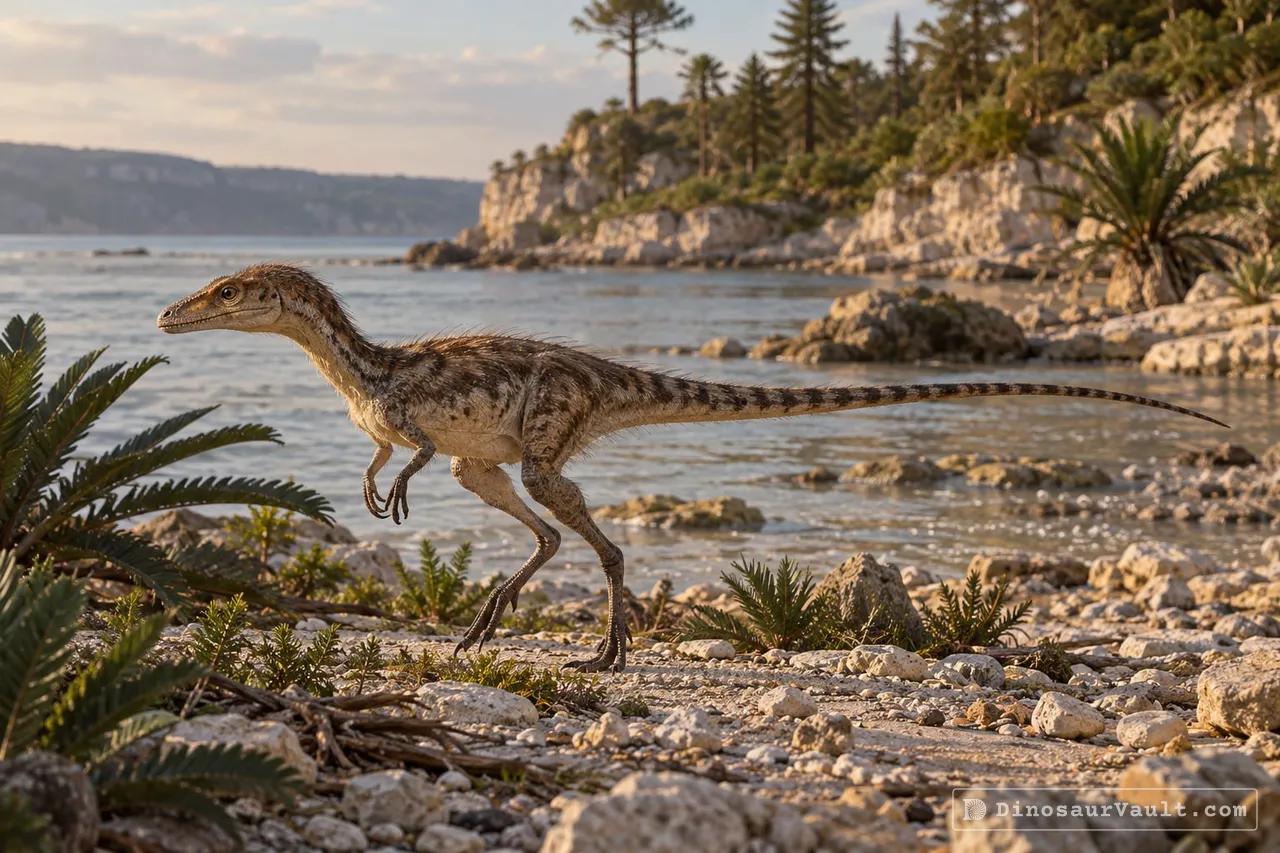
Juravenator was a small predator known from one nearly complete skeleton of a young animal, about 0.8 meters (3 feet) long. It had a long tail, big eyes and sharp teeth. Patches of scaly skin are preserved on its tail, along with signs of fine filaments.
Its world
It lived about 152 to 149 million years ago, in the Late Jurassic, in what is now Germany. Much of the region was then a chain of islands in a warm, shallow sea. The small hunter Compsognathus lived in the same region.
How it was found
Göhlich and Chiappe named Juravenator in 2006. Its skeleton is one of the best preserved small theropods from Europe.
Field gallery
More views of Juravenator
Scenes reconstructed from the available fossil evidence.
1 of 3
Lived alongside
Found in the same rock formations

A rock formation can hold fossils laid down millions of years apart, so not every animal here met Juravenator.
The evidence
The science behind Juravenator
Which parts of the picture come from its own bones, and which come from its relatives.
From its own fossils
- A nearly complete skeleton preserves the skull, short arms, sharp hand claws and long tail of a young animal.
- Skin along the tail preserves several kinds of scales and fine filaments.
Borrowed from relatives
- Almost the whole skeleton is known from its own bones, so little of its outline needs to be borrowed from relatives.
Still unknown
- Its adult size and proportions.
- How far the filaments extended over its body.
- Its color and exact place in the theropod family tree.
Discovery timeline
- 2006Named itGöhlich & Chiappe
- 2010Full descriptionChiappe & Göhlich
- 2020SkinBell & Hendrickx
Key papers
The research behind what we know of Juravenator
Named it
Named a small predator from a nearly complete young skeleton with preserved scaly skin.
A new carnivorous dinosaur from the Late Jurassic Solnhofen archipelago. Nature 440: 329-332
Read the paper : A new carnivorous dinosaur from the Late Jurassic Solnhofen archipelago (opens in a new tab)Full description
Described the skeleton in detail, confirmed its juvenile age and identified fine filaments alongside the preserved scales.
Anatomy of Juravenator starki (Theropoda: Coelurosauria) from the Late Jurassic of Germany. Neues Jahrbuch für Geologie und Paläontologie - Abhandlungen 258: 257-296
Read the paper : Anatomy of Juravenator starki (Theropoda: Coelurosauria) from the Late Jurassic of Germany (opens in a new tab)Skin
Found bands of different scale types along the tail, together with short filaments.
Epidermal complexity in the theropod dinosaur Juravenator from the Upper Jurassic of Germany. Palaeontology 64: 203-223
Read the paper : Epidermal complexity in the theropod dinosaur Juravenator from the Upper Jurassic of Germany (opens in a new tab)
Close relatives
Other members of Coelurosauria


Sources: Wikidata