Ligabuesaurus
Type species Ligabuesaurus leanzai
- Lived
- 113 to 110 million years ago, Early Cretaceous
- Diet
- Herbivore
- Length
- about 24 m (79 ft)
- Group
- Sauropods
- Found in
- Argentina
- Named by
- Bonaparte et al. 2006
Size comparison
To scale


Scale in metersOutline: typical sauropod shape
Where its fossils were found
The evidence
Today

110 million years ago
Habitat
A river floodplain in a fairly dry climate, in what is now Argentina. Agustinia and Comahuesaurus also lived in the Lohan Cura Formation.
Field notes
About Ligabuesaurus
What it was like
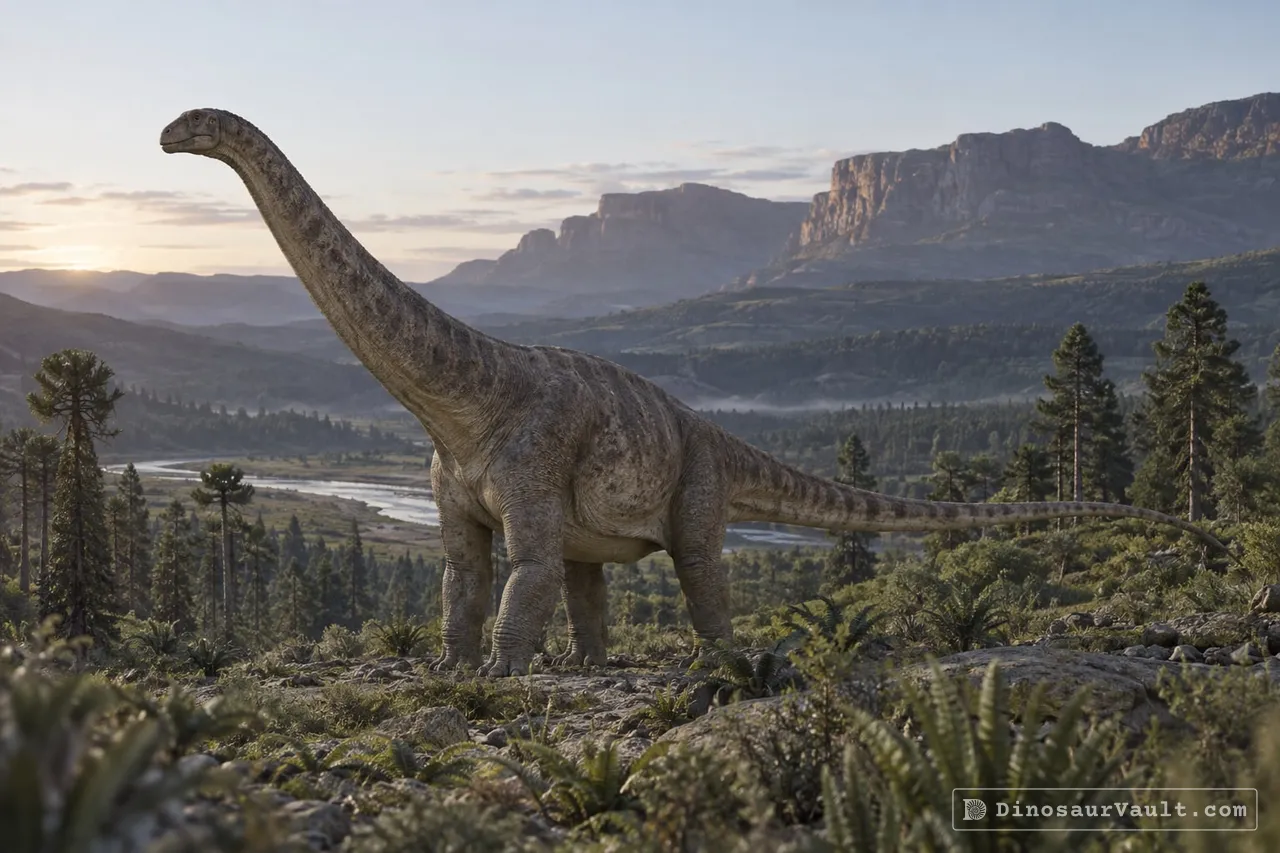
Ligabuesaurus was a large sauropod about 24 meters (79 feet) long, a long-necked plant eater related to the titanosaurs.
Its world
It lived in the Early Cretaceous, in what is now Argentina. It comes from the Lohan Cura Formation, where the sauropods Agustinia and Comahuesaurus also lived.
How it was found
Bonaparte and colleagues named Ligabuesaurus in 2006. The type species is Ligabuesaurus leanzai. Its name honors the man who funded the work.
Field gallery
More views of Ligabuesaurus
Scenes reconstructed from the available fossil evidence.
Lived alongside
Found in the same rock formations


A rock formation can hold fossils laid down millions of years apart, so not every animal here met Ligabuesaurus.
The evidence
The science behind Ligabuesaurus
Which parts of the picture come from its own bones, and which come from its relatives.
From its own fossils
- The type specimen includes part of the right upper jaw with ten teeth, neck and back vertebrae, both shoulder blades, long, slender upper arm bones, hand bones and a nearly complete right foot.
- Later study added bones from the neck, tail, shoulders and hips to the type skeleton and argued that they all come from one animal. Bones of a second animal, from another quarry, were also assigned to it.
- Its neck and back vertebrae contain many cavities separated by thin walls of bone, and the claw on its first toe is hooked and flattened from side to side.
Borrowed from relatives
- The missing parts of the head are restored by comparison with Euhelopus, the sauropod its describers compared it with for the low, backward-pointing prong at the rear of its upper jaw.
- The rest of the neck, the body and the tail follow Mnyamawamtuka, and the wrists and hands follow Camarasaurus and Apatosaurus.
Still unknown
- The full shape of its skull.
- The length of its neck. Only a few neck vertebrae are known.
- How its body proportions changed as it grew.
Discovery timeline
- 2006Named itBonaparte, González Riga & Apesteguía
- 2012Same rocksCarballido et al.
- 2022RedescriptionBellardini et al.
Key papers
The research behind what we know of Ligabuesaurus
Named it
Named a large sauropod from a partial jaw, vertebrae and associated limb bones, noting its relatively long forelimbs.
Ligabuesaurus leanzai gen. et sp. nov. (Dinosauria, Sauropoda), a new titanosaur from the Lohan Cura Formation (Aptian, Lower Cretaceous) of Neuquén, Patagonia, Argentina. Cretaceous Research 27: 364-376
Read the paper : Ligabuesaurus leanzai gen. et sp. nov. (Dinosauria, Sauropoda), a new titanosaur from the Lohan Cura Formation (Aptian, Lower Cretaceous) of Neuquén, Patagonia, Argentina (opens in a new tab)Same rocks
Named Comahuesaurus, another sauropod from the Lohan Cura Formation, from a different branch of the sauropod family tree.
A new basal rebbachisaurid (Sauropoda, Diplodocoidea) from the Early Cretaceous of the Neuquén Basin; evolution and biogeography of the group. Historical Biology 24: 631-654
Read the paper : A new basal rebbachisaurid (Sauropoda, Diplodocoidea) from the Early Cretaceous of the Neuquén Basin; evolution and biogeography of the group (opens in a new tab)Redescription
Added previously undescribed bones, listed the traits that set Ligabuesaurus apart, and placed it among the somphospondylans just outside the titanosaurs.
Osteology and phylogenetic relationships ofLigabuesaurus leanzai(Dinosauria: Sauropoda) from the Early Cretaceous of the Neuquén Basin, Patagonia, Argentina. Zoological Journal of the Linnean Society 196: 1333-1393
Read the paper : Osteology and phylogenetic relationships ofLigabuesaurus leanzai(Dinosauria: Sauropoda) from the Early Cretaceous of the Neuquén Basin, Patagonia, Argentina (opens in a new tab)
Close relatives
Other members of Somphospondyli


Sources: Wikidata