Afrovenator
AF-roh-veh-NAY-tor
"African hunter"
- Lived
- 175 to 162 million years ago, Middle Jurassic
- Diet
- Carnivore
- Length
- about 9 m (30 ft)
- Group
- Theropods, Megalosauridae
- Found in
- Niger
- Named by
- Sereno et al. 1994
Size comparison
To scale


Scale in metersOutline: typical theropod shape
Where its fossils were found
The evidence
Today

170 million years ago
Habitat
It probably lived on a river plain in what is now Niger. Jobaria and Spinophorosaurus were long-necked plant eaters of the region.
Field notes
About Afrovenator
What it was like
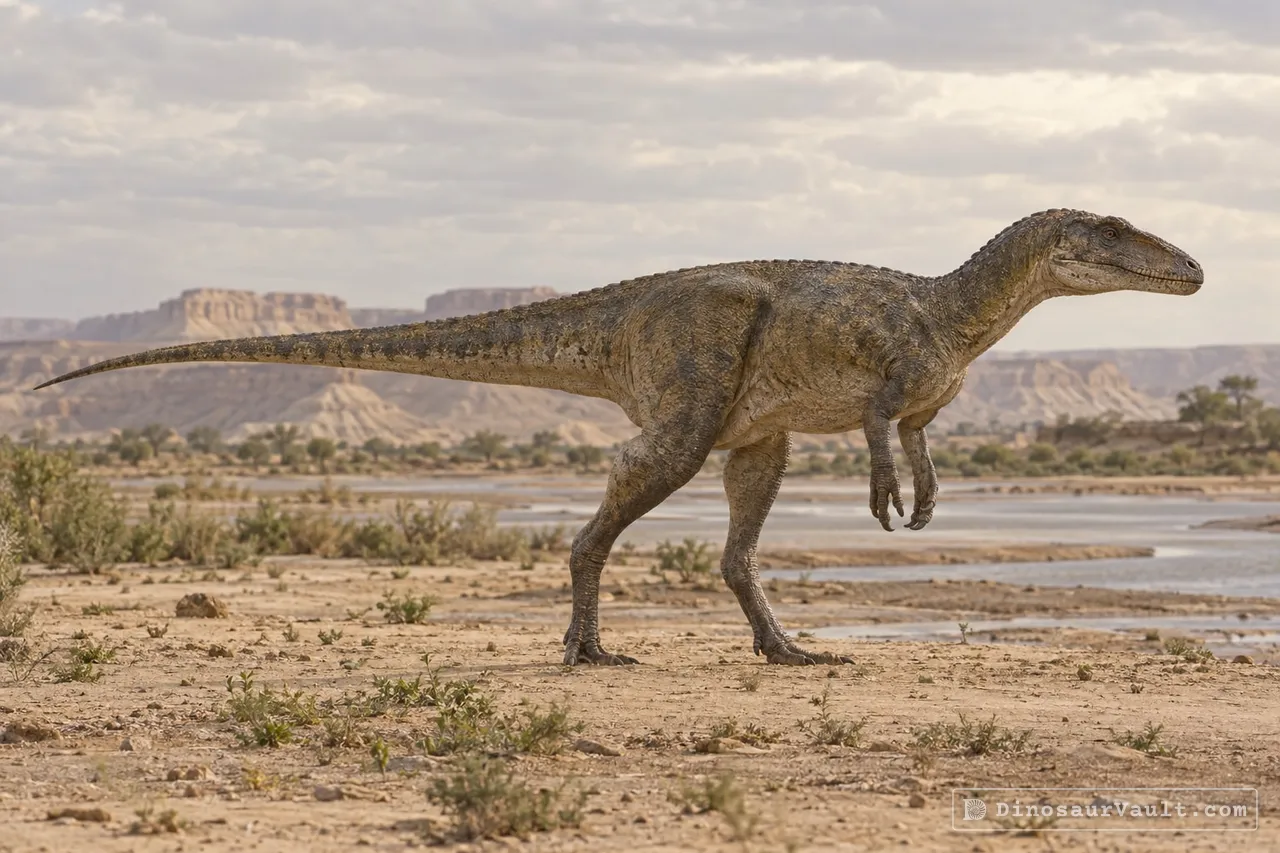
Afrovenator was a two-legged meat eater about 9 meters (30 feet) long, a member of the megalosaurid family along with Megalosaurus and Torvosaurus. It had a long, low skull with blade-like teeth, strong arms with three clawed fingers, and a long tail for balance.
It is one of the few megalosaurids known from Africa, and its skeleton is fairly complete for a meat eater of its age.
Its world
Its fossils come from Niger, in the Tiourarén and Irhazer II formations. These rocks are usually dated to the Middle Jurassic, though their exact age is still debated. It lived beside the long-necked plant eaters Jobaria and Spinophorosaurus, which may have been among its prey.
How it was found
Sereno and colleagues named Afrovenator in 1994 after fieldwork in the desert of Niger. Two finds are known.
Field gallery
More views of Afrovenator
Scenes reconstructed from the available fossil evidence.
1 of 3
Lived alongside
Found in the same rock formations


A rock formation can hold fossils laid down millions of years apart, so not every animal here met Afrovenator.
The evidence
The science behind Afrovenator
Which parts of the picture come from its own bones, and which come from its relatives.
From its own fossils
- A partial skeleton preserves a long, low skull, parts of the backbone and limb bones.
- Its jaws held blade-like teeth, and its hands had three clawed fingers.
Borrowed from relatives
- Missing portions of the skeleton are restored by comparison with other megalosaurids such as Megalosaurus and Dubreuillosaurus.
Still unknown
- The precise age of the rocks containing its skeleton.
- Its skin covering and color.
- Which animals it regularly hunted.
Discovery timeline
- 1994Named itSereno et al.
- 2009Fossil sitesRauhut & López-Arbarello
- 2012Family treeCarrano, Benson & Sampson
Key papers
The research behind what we know of Afrovenator
Named it
Named Afrovenator from a partial skeleton in Niger and compared it with other large predatory dinosaurs.
Early Cretaceous Dinosaurs from the Sahara. Science 266: 267-271
Read the paper : Early Cretaceous Dinosaurs from the Sahara (opens in a new tab)Fossil sites
Argued that the rocks containing Afrovenator and Jobaria probably date to the Jurassic rather than the Early Cretaceous.
Considerations on the age of the Tiouaren Formation (Iullemmeden Basin, Niger, Africa): Implications for Gondwanan Mesozoic terrestrial vertebrate faunas. Palaeogeography, Palaeoclimatology, Palaeoecology 271: 259-267
Read the paper : Considerations on the age of the Tiouaren Formation (Iullemmeden Basin, Niger, Africa): Implications for Gondwanan Mesozoic terrestrial vertebrate faunas (opens in a new tab)Family tree
Placed Afrovenator within the megalosaurid family and recognized a branch of that family named after it.
The phylogeny of Tetanurae (Dinosauria: Theropoda). Journal of Systematic Palaeontology 10: 211-300
Read the paper : The phylogeny of Tetanurae (Dinosauria: Theropoda) (opens in a new tab)
Close relatives
Other members of Megalosauridae


Sources: Wikidata