Spinophorosaurus
"spine-bearing lizard"
Type species Spinophorosaurus nigerensis
- Lived
- 171 to 165 million years ago, Middle Jurassic
- Diet
- Herbivore
- Group
- Sauropods
- Found in
- Niger
- Named by
- Remes et al. 2009
Where its fossils were found
The evidence
Today

170 million years ago
Habitat
A broad river valley with lakes and muddy banks occupied what is now Niger. Afrovenator is another dinosaur reported from the region's Jurassic rocks.
Field notes
About Spinophorosaurus
What it was like
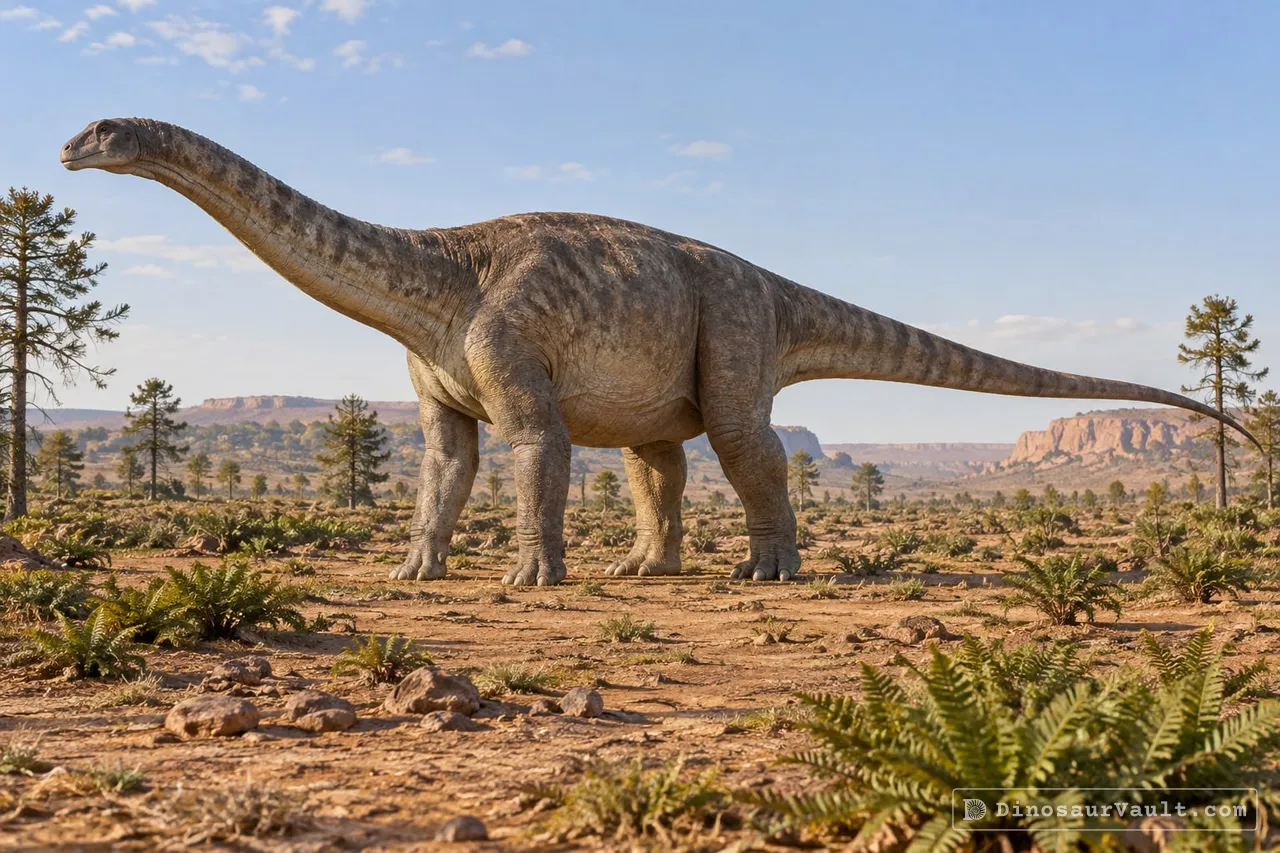
Spinophorosaurus was an early sauropod, a long-necked plant eater known from nearly complete skeletons. It was one of the first sauropods to have its skeleton scanned into a computer and printed as a physical copy. Its name comes from bony spikes first thought to sit on its tail, but later work suggested those bones may belong elsewhere in the body.
Its world
It lived about 171 to 165 million years ago, in the Middle Jurassic, in what is now Niger. Its bones come from the Irhazer II group of rocks. Few sauropods of this age are known from Africa, so it helps show how the giants spread.
How it was found
Remes and colleagues named it in 2009. The type species is Spinophorosaurus nigerensis.
Field gallery
More views of Spinophorosaurus
Scenes reconstructed from the available fossil evidence.
Lived alongside
Found in the same rock formations

A rock formation can hold fossils laid down millions of years apart, so not every animal here met Spinophorosaurus.
The evidence
The science behind Spinophorosaurus
Which parts of the picture come from its own bones, and which come from its relatives.
From its own fossils
- The type skeleton preserves the back of the skull and most of the body, including a nearly complete neck and much of the tail, but not the forearms, hands or feet. Over the brain, the frontal bones are fused and the skull roof is mostly flat.
- A second skeleton referred to it adds broken pieces of the snout and lower jaw, an upper arm bone and a toe bone.
- Its spoon-shaped teeth have widely spaced serrations near their tips. Long, overlapping bones beneath the rear tail helped stiffen it.
Borrowed from relatives
- Most of the skeleton comes from its own fossils. The missing front of the snout and jaws is restored by comparison with Shunosaurus.
- The missing forearms and hands follow Vulcanodon and Tazoudasaurus, and the feet follow Rhoetosaurus.
Still unknown
- The shape of the front of its face.
- What the bones first described as tail spikes really were. One study found that they look like clavicles, a pair of chest bones.
- Which plants it preferred to eat.
Often drawn wrong
- Older reconstructions gave it a level back and low neck; its wedge-shaped hip vertebrae tilted the trunk upward toward tall shoulders.
Discovery timeline
- 2009Named itRemes et al.
- 2012SkullKnoll et al.
- 2012RedescriptionTschopp & Mateus
- 2020PostureVidal et al.
- 2020Growing upVidal et al.
Key papers
The research behind what we know of Spinophorosaurus
Named it
Described complementary sauropod skeletons with distinctive teeth, neck vertebrae and stiffening bones beneath the tail.
A New Basal Sauropod Dinosaur from the Middle Jurassic of Niger and the Early Evolution of Sauropoda. PLoS ONE 4: e6924
Read the paper : A New Basal Sauropod Dinosaur from the Middle Jurassic of Niger and the Early Evolution of Sauropoda (opens in a new tab)Skull
Described the braincase of Spinophorosaurus, including its fused frontal bones and short parietals on the skull roof.
The Braincase of the Basal Sauropod Dinosaur Spinophorosaurus and 3D Reconstructions of the Cranial Endocast and Inner Ear. PLoS ONE 7: e30060
Read the paper : The Braincase of the Basal Sauropod Dinosaur Spinophorosaurus and 3D Reconstructions of the Cranial Endocast and Inner Ear (opens in a new tab)Redescription
Argued that the bones first described as tail spikes of Spinophorosaurus resemble clavicles and need to be reexamined.
Clavicles, interclavicles, gastralia, and sternal ribs in sauropod dinosaurs: new reports from Diplodocidae and their morphological, functional and evolutionary implications. Journal of Anatomy 222: 321-340
Read the paper : Clavicles, interclavicles, gastralia, and sternal ribs in sauropod dinosaurs: new reports from Diplodocidae and their morphological, functional and evolutionary implications (opens in a new tab)Posture
A digital skeleton showed that tilted hip vertebrae, tall shoulders and a mobile neck allowed Spinophorosaurus to reach high vegetation.
High browsing skeletal adaptations in Spinophorosaurus reveal an evolutionary innovation in sauropod dinosaurs. Scientific Reports 10
Read the paper : High browsing skeletal adaptations in Spinophorosaurus reveal an evolutionary innovation in sauropod dinosaurs (opens in a new tab)Growing up
Compared small and large neck skeletons and found that the neck's bony range of movement increased as Spinophorosaurus grew.
Ontogenetic similarities between giraffe and sauropod neck osteological mobility. PLOS ONE 15: e0227537
Read the paper : Ontogenetic similarities between giraffe and sauropod neck osteological mobility (opens in a new tab)
Close relatives
Other members of Gravisauria


Sources: Wikidata