Magnosaurus
"large lizard"
- Lived
- 171 to 169 million years ago, Middle Jurassic
- Diet
- Carnivore
- Group
- Theropods, Megalosauridae
- Found in
- United Kingdom
- Named by
- Huene 1932
Where its fossils were found
The evidence
Today

170 million years ago
Habitat
It lived on land beside a shallow sea in what is now England. Its bones come from the Middle Inferior Oolite.
Field notes
About Magnosaurus
What it was like
Magnosaurus was a mid-sized, two-legged meat eater related to Megalosaurus. It is known from a few pieces of jaw, backbone and legs, so its size and shape are uncertain.
Its world
It lived in the Middle Jurassic, in what is now England. It comes from the Middle Inferior Oolite, rocks laid down in and near a shallow sea.
How it was found
Huene named Magnosaurus in 1932, for bones first thought to belong to Megalosaurus. It has been moved back and forth between the two names since.
Field gallery
More views of Magnosaurus
Scenes reconstructed from the available fossil evidence.
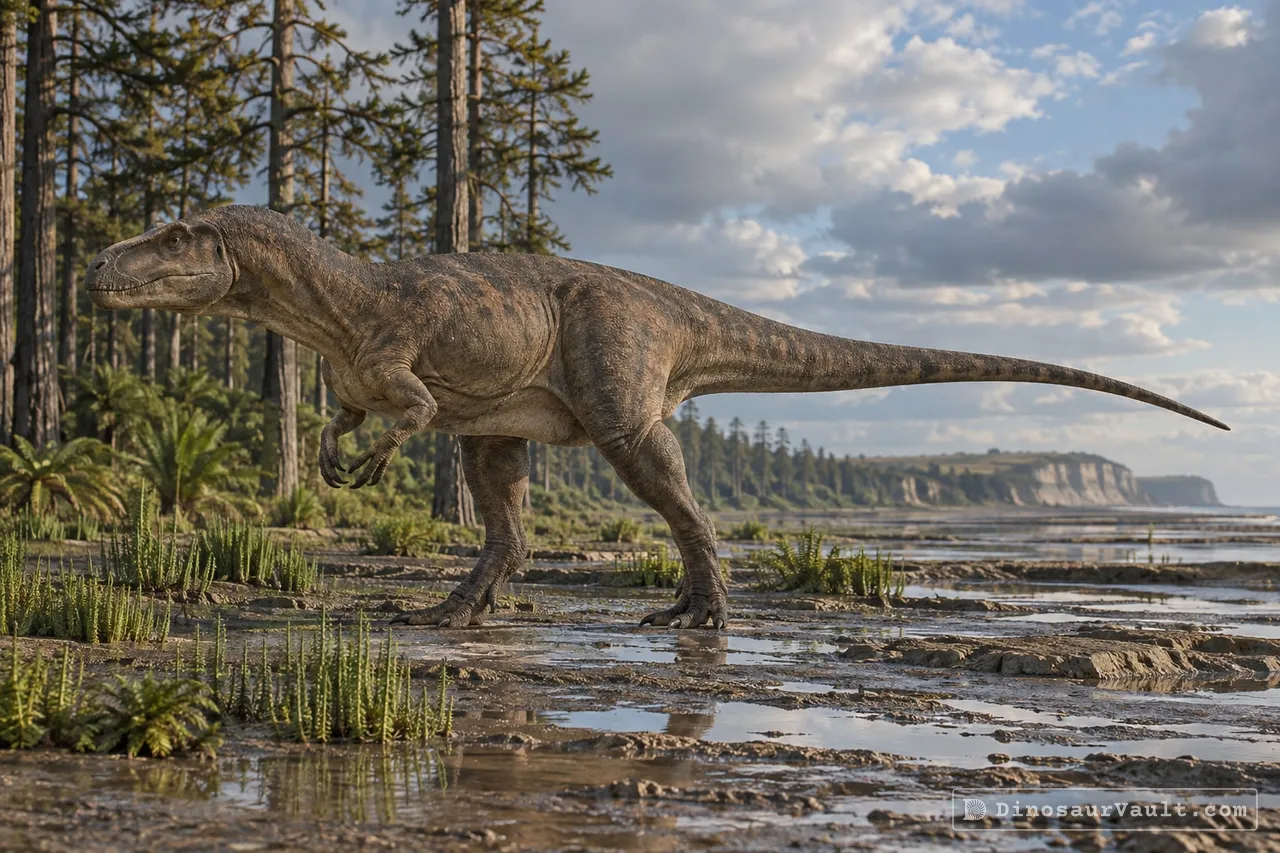
1 of 2
The evidence
The science behind Magnosaurus
Which parts of the picture come from its own bones, and which come from its relatives.
From its own fossils
- Parts of the lower jaws, backbone, hips and hind legs belong to a single skeleton.
- Long, slanting openings low on the outside of the lower jaw distinguish it from other meat eaters.
- The thigh bone has a deep groove for the muscles that straightened the knee.
Borrowed from relatives
- Much of the missing head, arms and tail is restored by comparison with megalosaurids such as Eustreptospondylus and Dubreuillosaurus.
Still unknown
- Its complete skull shape and body proportions.
- Its skin covering and color.
- How its appearance changed as it grew.
Discovery timeline
- 1932Named itHuene
- 2010Full descriptionBenson
- 2012Family treeCarrano, Benson & Sampson
Key papers
The research behind what we know of Magnosaurus
Named it
Gave a separate genus name to a meat eater previously placed in Megalosaurus.
Die fossile Reptil-Ordnung Saurischia, ihre Entwicklung und Geschichte [The fossil reptile order Saurischia, their development and history]. Monographien zur Geologie und Palaeontologie, serie 1 4: 1-361
No link available
Full description
Described the surviving bones in detail and identified distinctive openings in the lower jaw that support Magnosaurus as a separate genus.
The osteology ofMagnosaurus nethercombensis(Dinosauria, Theropoda) from the Bajocian (Middle Jurassic) of the United Kingdom and a re-examination of the oldest records of tetanurans. Journal of Systematic Palaeontology 8: 131-146
Read the paper : The osteology ofMagnosaurus nethercombensis(Dinosauria, Theropoda) from the Bajocian (Middle Jurassic) of the United Kingdom and a re-examination of the oldest records of tetanurans (opens in a new tab)Family tree
Compared the skeletons of early members of the branch that includes birds and large meat eaters, clarifying the relationships of megalosaurids.
The phylogeny of Tetanurae (Dinosauria: Theropoda). Journal of Systematic Palaeontology 10: 211-300
Read the paper : The phylogeny of Tetanurae (Dinosauria: Theropoda) (opens in a new tab)
Close relatives
Other members of Megalosauridae


Sources: Wikidata