Wiehenvenator
"Wiehen hunter"
Type species Wiehenvenator albati
- Lived
- 165 to 162 million years ago, Middle Jurassic
- Diet
- Carnivore
- Group
- Theropods, Megalosauridae
- Found in
- Germany
- Named by
- Rauhut et al. 2016
Where its fossils were found
The evidence
Today

165 million years ago
Habitat
It probably lived on land near the shallow seas that divided Europe into islands. Its bones were buried with ammonites, oysters and other sea animals in the Ornatenton Formation.
Field notes
About Wiehenvenator
What it was like
Wiehenvenator was a large megalosaur, a meat eater related to Megalosaurus and Torvosaurus. It was one of the largest predators of the Middle Jurassic. It is known from part of the skull, backbone and limbs.
Its world
It lived in the Middle Jurassic, in what is now Germany. It comes from the Ornatenton Formation, which formed in a shallow sea, so its body was probably washed out from land.
How it was found
Rauhut and colleagues named Wiehenvenator in 2016. The type species is Wiehenvenator albati.
Field gallery
More views of Wiehenvenator
Scenes reconstructed from the available fossil evidence.
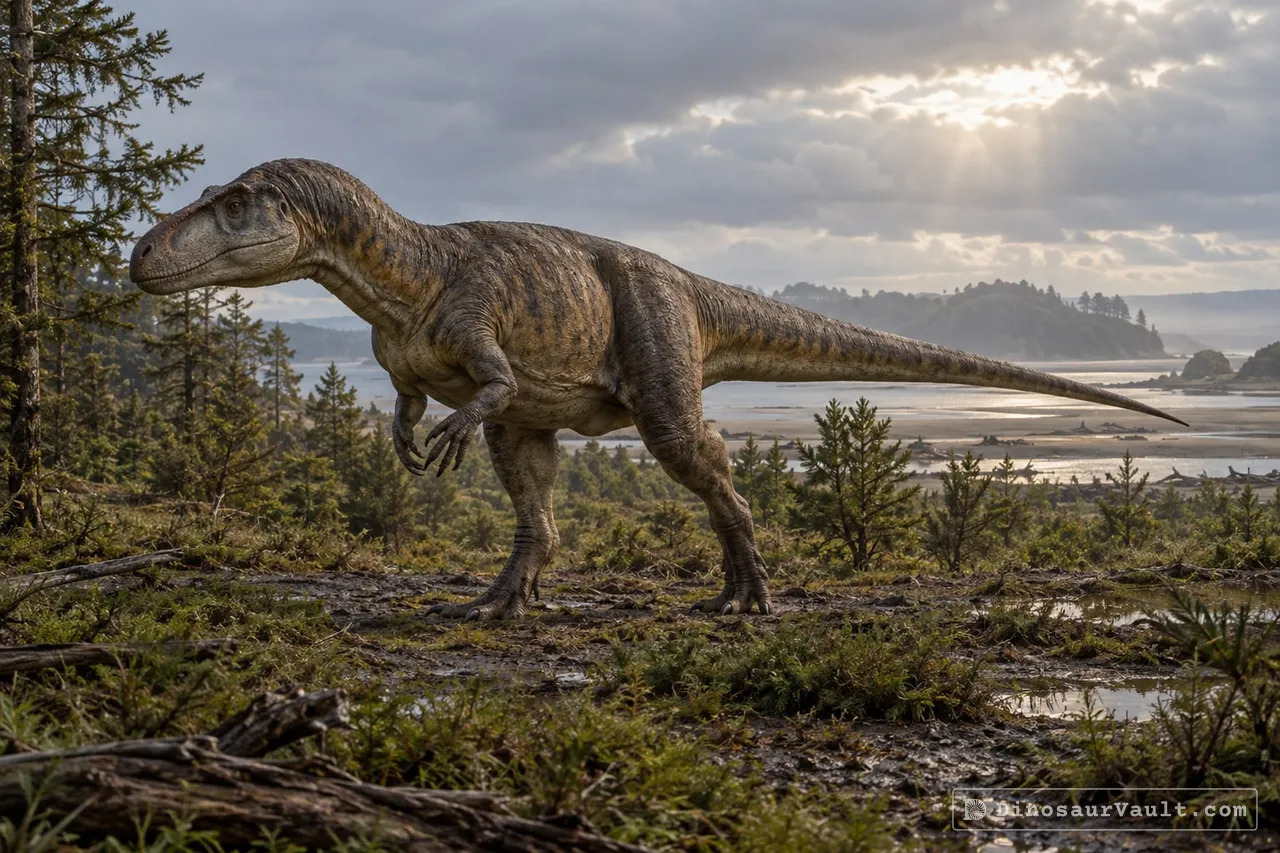
1 of 3
Lived alongside
Found in the same rock formations

A rock formation can hold fossils laid down millions of years apart, so not every animal here met Wiehenvenator.
The evidence
The science behind Wiehenvenator
Which parts of the picture come from its own bones, and which come from its relatives.
From its own fossils
- The partial skeleton includes skull and jaw bones, tail vertebrae, ribs, a finger bone, shin bones and ankle bones.
- The preserved skull bones suggest a low, long head with a modest brow above the eye.
- The surviving finger bone is short and stout, and the lower leg and ankle bones are robust.
Borrowed from relatives
- Torvosaurus guides the restoration of the missing arms, hands and feet.
- Comparisons with other large theropods suggest lips that covered the teeth when the mouth was closed.
Still unknown
- The complete outline of its skull and jaws.
- Its full body proportions and finger and toe arrangement.
- Its skin covering and color.
Often drawn wrong
- A large horn above the eye exaggerates the small rounded bump and modest brow on the preserved skull.
Discovery timeline
- 2013Close relativeHanson & Makovicky
- 2016Named itRauhut, Hübner & Lanser
- 2023SkullCullen et al.
Key papers
The research behind what we know of Wiehenvenator
Close relative
Described stout finger and foot bones of Torvosaurus, providing a model for missing parts of its relative Wiehenvenator.
A new specimen ofTorvosaurus tannerioriginally collected by Elmer Riggs. Historical Biology 26: 775-784
Read the paper : A new specimen ofTorvosaurus tannerioriginally collected by Elmer Riggs (opens in a new tab)Named it
Named a large megalosaurid from a partial skeleton buried in marine rocks and compared it with other Jurassic predators.
A new megalosaurid theropod dinosaur from the late Middle Jurassic (Callovian) of north-western Germany: Implications for theropod evolution and faunal turnover in the Jurassic. Palaeontologia Electronica
Read the paper : A new megalosaurid theropod dinosaur from the late Middle Jurassic (Callovian) of north-western Germany: Implications for theropod evolution and faunal turnover in the Jurassic (opens in a new tab)Skull
Compared tooth wear and skull proportions in reptiles, supporting lips that covered the teeth of large theropods when their mouths were closed.
Theropod dinosaur facial reconstruction and the importance of soft tissues in paleobiology. Science 379: 1348-1352
Read the paper : Theropod dinosaur facial reconstruction and the importance of soft tissues in paleobiology (opens in a new tab)
Close relatives
Other members of Megalosauridae


Sources: Wikidata