Duriavenator
"Dorset hunter"
- Lived
- 169 to 168 million years ago, Middle Jurassic
- Diet
- Carnivore
- Group
- Theropods, Megalosauridae
- Found in
- United Kingdom
- Named by
- Benson 2008
Where its fossils were found
The evidence
Today

170 million years ago
Habitat
It lived on land in what is now southern England, close to the shallow seas that deposited the Upper Inferior Oolite limestone.
Field notes
About Duriavenator
What it was like
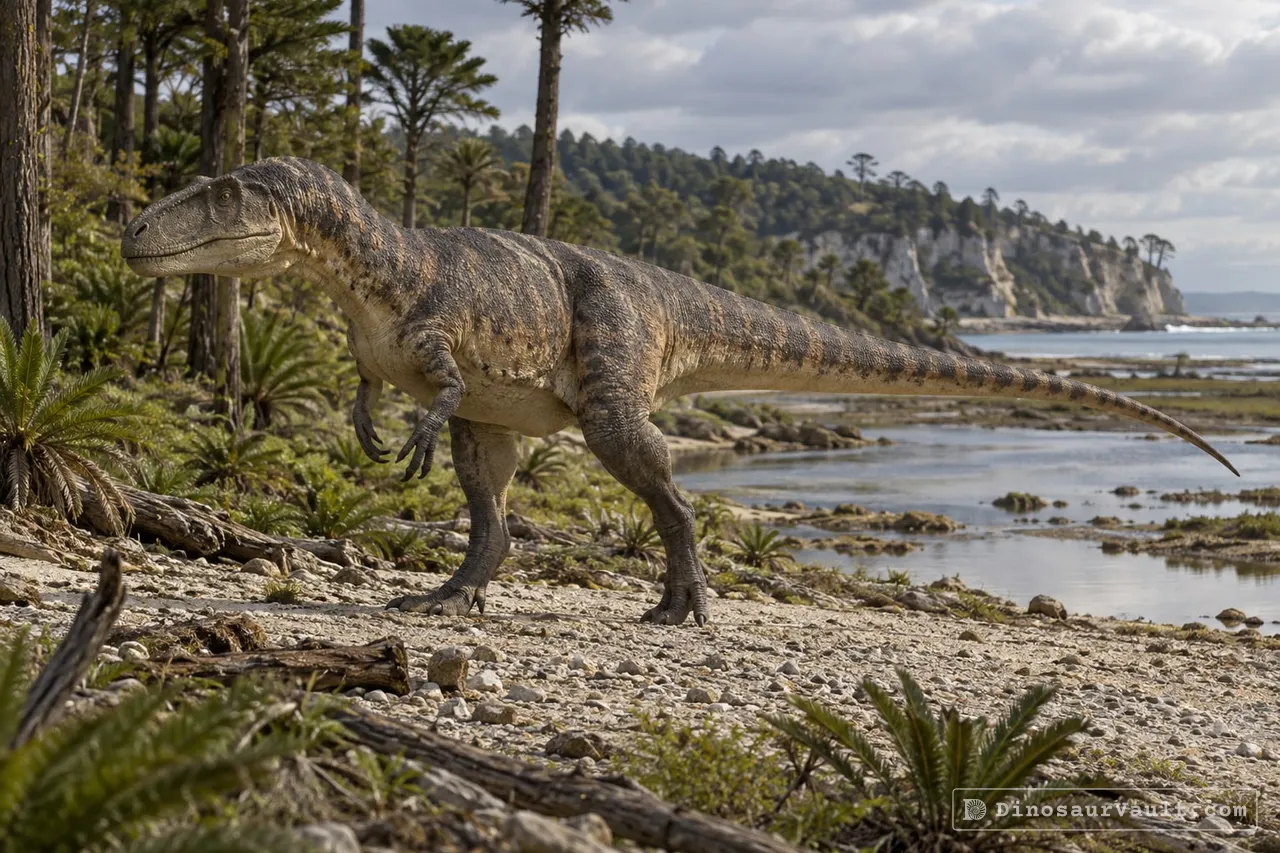
Duriavenator was a large meat eater known only from its upper and lower jaws, with sharp, blade-like teeth. It was a close relative of Megalosaurus, and for over a century its jaws were thought to belong to that genus.
Its world
It lived about 169 to 168 million years ago, in the Middle Jurassic, in what is now southern England.
How it was found
Benson named Duriavenator in 2008, from a single find. The jaws had been collected long before and placed in Megalosaurus until a closer look showed they came from a different animal.
Field gallery
More views of Duriavenator
Scenes reconstructed from the available fossil evidence.
1 of 3
The evidence
The science behind Duriavenator
Which parts of the picture come from its own bones, and which come from its relatives.
From its own fossils
- Parts of the upper and lower jaws preserve the front of the mouth and its teeth.
- The front lower teeth lean forward, and an enlarged tooth socket widens the jaw locally.
- Grooves and small air openings in the upper jaw help distinguish it from other meat eaters.
Borrowed from relatives
- Dubreuillosaurus guides the missing roof and rear of the skull.
- Torvosaurus provides a guide to the missing body, arms and feet.
- Lips covering the teeth follow comparisons with other theropods.
Still unknown
- Its complete skull shape, including any ornament above the eyes.
- Its body size and proportions.
- Its skin covering and color.
Discovery timeline
- 2008Named itBENSON
- 2012Family treeCarrano, Benson & Sampson
- 2023Close relativeCullen et al.
Key papers
The research behind what we know of Duriavenator
Named it
Restudied jaws formerly assigned to Megalosaurus and named Duriavenator from distinctive features of the upper and lower jaws.
A redescription of 'Megalosaurus' hesperis (Dinosauria, Theropoda) from the Inferior Oolite (Bajocian, Middle Jurassic) of Dorset, United Kingdom. Zootaxa 1931
Read the paper : A redescription of 'Megalosaurus' hesperis (Dinosauria, Theropoda) from the Inferior Oolite (Bajocian, Middle Jurassic) of Dorset, United Kingdom (opens in a new tab)Family tree
Placed Duriavenator in the megalosaurid family alongside Megalosaurus and Torvosaurus.
The phylogeny of Tetanurae (Dinosauria: Theropoda). Journal of Systematic Palaeontology 10: 211-300
Read the paper : The phylogeny of Tetanurae (Dinosauria: Theropoda) (opens in a new tab)Close relative
Compared teeth and jaws across reptiles and supported lips covering the teeth in theropods, a useful model for the face of Duriavenator.
Theropod dinosaur facial reconstruction and the importance of soft tissues in paleobiology. Science 379: 1348-1352
Read the paper : Theropod dinosaur facial reconstruction and the importance of soft tissues in paleobiology (opens in a new tab)
Close relatives
Other members of Megalosauridae


Sources: Wikidata