Adynomosaurus
Type species Adynomosaurus arcanus
- Lived
- 72 to 66 million years ago, Late Cretaceous
- Diet
- Herbivore
- Group
- Ornithopods, Hadrosauridae
- Found in
- Spain
- Named by
- Prieto-Márquez et al. 2019
Where its fossils were found
The evidence
Today

70 million years ago
Habitat
It lived in what is now Spain, on an island in the Late Cretaceous European archipelago. The Conques Formation also preserves Abditosaurus, Pararhabdodon and Pareisactus.
Field notes
About Adynomosaurus
What it was like
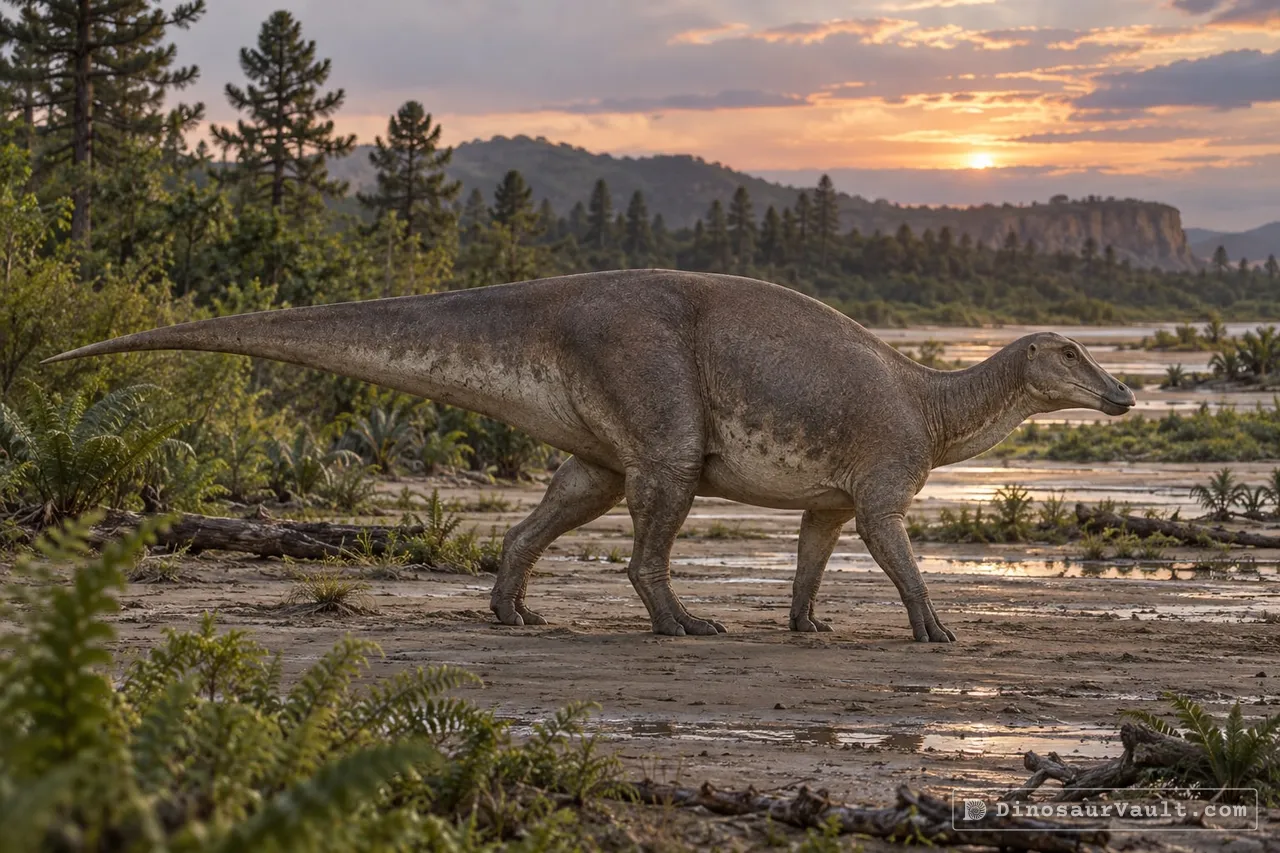
Adynomosaurus was a lambeosaurine duckbill, a plant eater that probably had a hollow crest. It is known from a few bones, including a small, weak shoulder blade, which gave it its name.
Its world
It lived about 72 to 66 million years ago, near the end of the Cretaceous, in what is now Spain. It comes from the Conques Formation, where it shared the land with the titanosaur Abditosaurus.
How it was found
Prieto-Márquez and colleagues named Adynomosaurus in 2019. The type species is Adynomosaurus arcanus.
Field gallery
More views of Adynomosaurus
Scenes reconstructed from the available fossil evidence.
Lived alongside
Found in the same rock formations


A rock formation can hold fossils laid down millions of years apart, so not every animal here met Adynomosaurus.
The evidence
The science behind Adynomosaurus
Which parts of the picture come from its own bones, and which come from its relatives.
From its own fossils
- Its shoulder blade has an unusually narrow, shallow blade compared with other duck-billed dinosaurs.
Borrowed from relatives
- Its overall body shape is restored from more complete duckbills such as Corythosaurus and Lambeosaurus.
- A hollow head crest is inferred from its membership in the same group as Pararhabdodon.
Still unknown
- The shape of its head crest.
- How much its narrow shoulder blade affected movement.
- Its skin color and pattern.
Discovery timeline
- 2019Named itPrieto-Márquez et al.
- 2021Family treeLongrich et al.
- 2022Same rocksVila et al.
Key papers
The research behind what we know of Adynomosaurus
Named it
Named a duckbill with an unusually narrow shoulder blade and suggested that some shoulder muscles were weaker than in other duckbills.
Adynomosaurus arcanus, a new lambeosaurine dinosaur from the Late Cretaceous Ibero-Armorican Island of the European archipelago. Cretaceous Research 96: 19-37
Read the paper : Adynomosaurus arcanus, a new lambeosaurine dinosaur from the Late Cretaceous Ibero-Armorican Island of the European archipelago (opens in a new tab)Family tree
Named Ajnabia and grouped it with European duckbills, tracing connections between dinosaur faunas separated by seas.
The first duckbill dinosaur (Hadrosauridae: Lambeosaurinae) from Africa and the role of oceanic dispersal in dinosaur biogeography. Cretaceous Research 120: 104678
Read the paper : The first duckbill dinosaur (Hadrosauridae: Lambeosaurinae) from Africa and the role of oceanic dispersal in dinosaur biogeography (opens in a new tab)Same rocks
Described Abditosaurus, a large titanosaur from Spain with relatives on the southern continents.
A titanosaurian sauropod with Gondwanan affinities in the latest Cretaceous of Europe. Nature Ecology & Evolution 6: 288-296
Read the paper : A titanosaurian sauropod with Gondwanan affinities in the latest Cretaceous of Europe (opens in a new tab)
Close relatives
Other members of Hadrosauridae


Sources: Wikidata