Abditosaurus
"forgotten lizard"
Type species Abditosaurus kuehnei
- Lived
- 72 to 66 million years ago, Late Cretaceous
- Diet
- Herbivore
- Group
- Sauropods, Saltasauridae
- Found in
- Spain
- Named by
- Vila et al. 2022
Where its fossils were found
The evidence
Today

70 million years ago
Habitat
It lived on an island in what is now southwestern Europe. Dinosaurs from the Conques Formation include Adynomosaurus, Pararhabdodon and Pareisactus.
Field notes
About Abditosaurus
What it was like
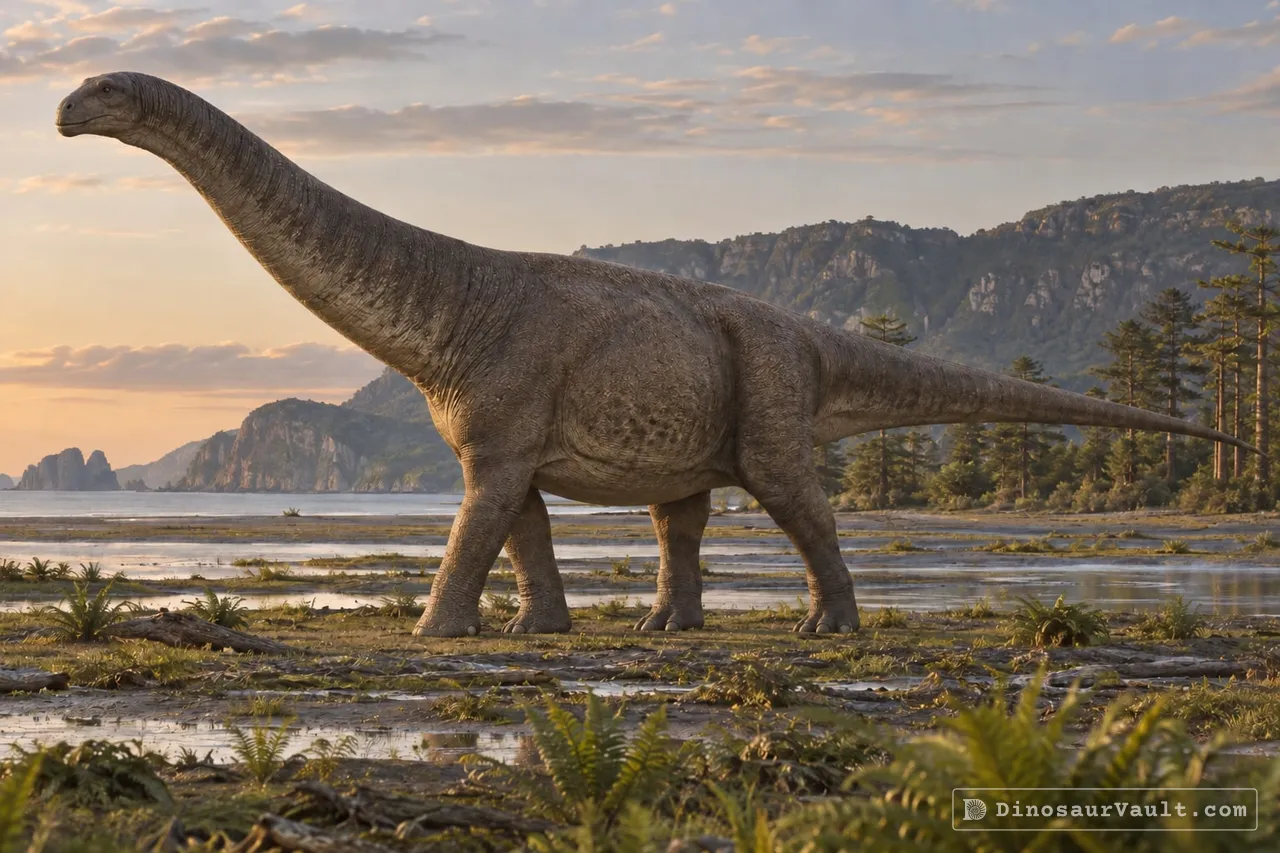
Abditosaurus was a titanosaur, a long-necked plant eater. It was large for a European titanosaur of its time. Other titanosaurs there were small island dwarfs, so it may have come from elsewhere.
Its world
It lived about 72 to 66 million years ago, near the end of the Cretaceous, in what is now Spain. It comes from the Conques Formation.
How it was found
Vila and colleagues named Abditosaurus in 2022. The type species is Abditosaurus kuehnei. The skeleton was dug up decades earlier and then left unstudied, which is why it is called forgotten.
Field gallery
More views of Abditosaurus
Scenes reconstructed from the available fossil evidence.
Lived alongside
Found in the same rock formations


A rock formation can hold fossils laid down millions of years apart, so not every animal here met Abditosaurus.
The evidence
The science behind Abditosaurus
Which parts of the picture come from its own bones, and which come from its relatives.
From its own fossils
- The type skeleton was found partly connected. It includes joined neck and front back vertebrae, ribs, a chevron from the tail, shoulder and hip bones, pieces of the upper arm, a forearm bone, and a shin bone, calf bone and ankle bone.
- The upper arm bone is robust with an expanded crest, a forearm bone carries a distinctive ridge, and the shin bone is relatively slender.
- Its large bones and bone tissue distinguish it from the small island titanosaurs of its time.
Borrowed from relatives
- The missing head is restored after the preserved skull of Tapuiasaurus, and the gaps in the neck after Futalognkosaurus.
- The rest of the tail and the feet are restored by comparison with Mnyamawamtuka, and the hands follow the general sauropod hand known from Camarasaurus and Apatosaurus.
Still unknown
- The exact shape of its head and the length of its complete tail.
- Its color and whether it carried skin armor.
- When its ancestors reached Europe, and which titanosaurs are its closest relatives. Family-tree studies place it in different spots.
Discovery timeline
- 2022Named itVila et al.
- 2022Fossil sitesVila
- 2024Family treeMocho et al.
- 2025Family treeDíaz et al.
Key papers
The research behind what we know of Abditosaurus
Named it
Named a large titanosaur and proposed that its ancestors arrived in Europe from southern continents.
A titanosaurian sauropod with Gondwanan affinities in the latest Cretaceous of Europe. Nature Ecology & Evolution 6: 288-296
Read the paper : A titanosaurian sauropod with Gondwanan affinities in the latest Cretaceous of Europe (opens in a new tab)Fossil sites
Traced the interrupted excavation history and showed that parts of the skeleton were already recognized as connected during the earliest digs.
Walter Georg Kühne (1911-1991) and the discovery of the first semi-articulated titanosaurian sauropod from Europe. Historical Biology 35: 1536-1550
Read the paper : Walter Georg Kühne (1911-1991) and the discovery of the first semi-articulated titanosaurian sauropod from Europe (opens in a new tab)Family tree
Named a new titanosaur from Spain and kept Abditosaurus as a separate genus in its family-tree analysis of European titanosaurs.
A Spanish saltasauroid titanosaur reveals Europe as a melting pot of endemic and immigrant sauropods in the Late Cretaceous. Communications Biology 7
Read the paper : A Spanish saltasauroid titanosaur reveals Europe as a melting pot of endemic and immigrant sauropods in the Late Cretaceous (opens in a new tab)Family tree
Reanalyzed European titanosaurs and challenged the idea that Abditosaurus descended from a recent immigrant from Africa.
Revision of Romanian sauropod dinosaurs reveals high titanosaur diversity and body-size disparity on the latest Cretaceous Haţeg Island, with implications for titanosaurian biogeography. Journal of Systematic Palaeontology 23
Read the paper : Revision of Romanian sauropod dinosaurs reveals high titanosaur diversity and body-size disparity on the latest Cretaceous Haţeg Island, with implications for titanosaurian biogeography (opens in a new tab)
Close relatives
Other members of Saltasauridae


Sources: Wikidata