Sinocephale
"Chinese head"
- Lived
- 84 to 66 million years ago, Late Cretaceous
- Diet
- Herbivore
- Group
- Pachycephalosaurs, Pachycephalosauridae
- Found in
- China
- Named by
- Evans et al. 2021
Where its fossils were found
The evidence
Today

75 million years ago
Habitat
The Ulansuhai Formation records rivers and lakes in a landscape that became increasingly dry. Chilantaisaurus and Sinornithomimus also lived in this region of China.
Field notes
About Sinocephale
What it was like
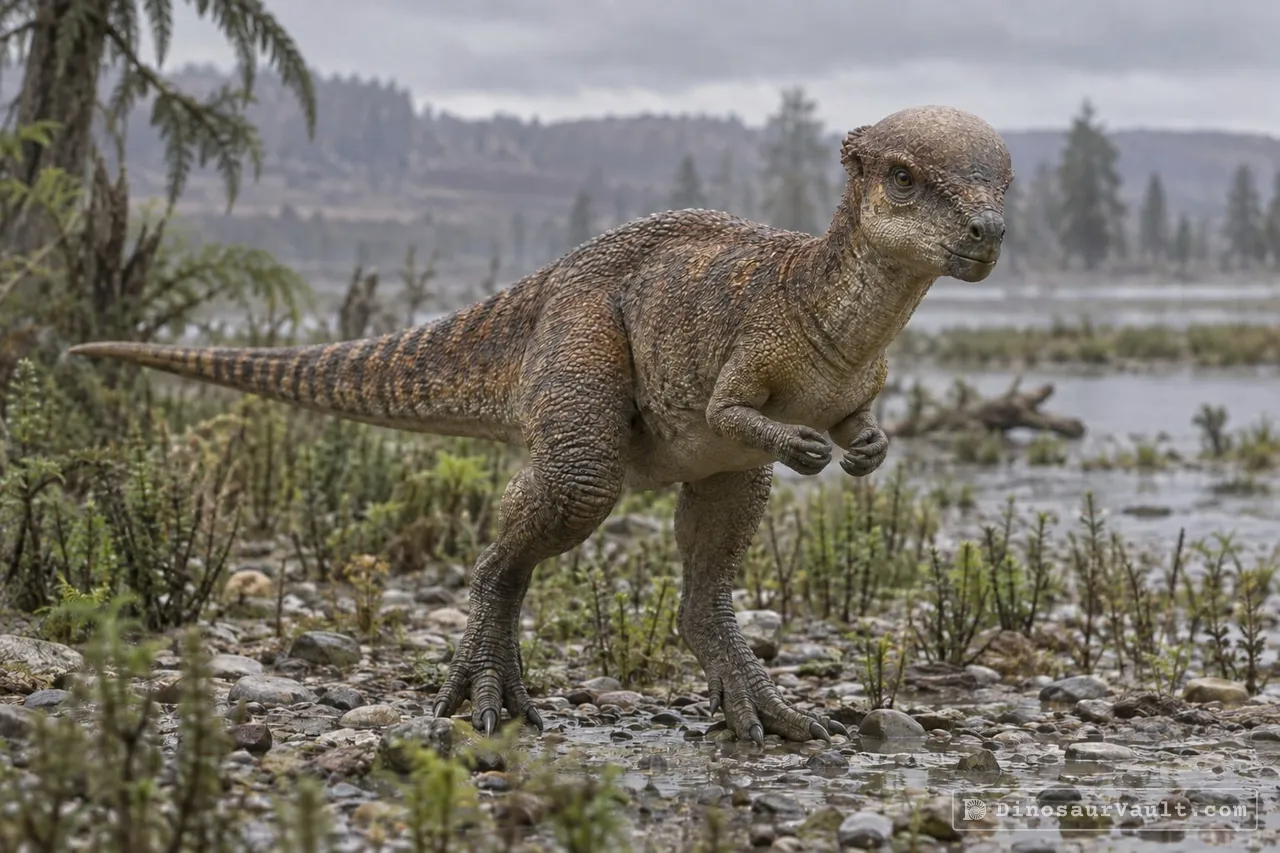
Sinocephale was a bone-headed dinosaur, a two-legged plant eater with a thick, domed skull roof. It is known from the dome of a skull.
Its world
It lived in the Late Cretaceous in what is now northern China. Its fossil comes from the Ulansuhai Formation, where the predator Chilantaisaurus and the ostrich-like Sinornithomimus also lived.
How it was found
It was first named as a species of Troodon and later moved to Stegoceras. Evans and colleagues gave it its own genus in 2021.
Field gallery
More views of Sinocephale
Scenes reconstructed from the available fossil evidence.
Lived alongside
Found in the same rock formations

A rock formation can hold fossils laid down millions of years apart, so not every animal here met Sinocephale.
The evidence
The science behind Sinocephale
Which parts of the picture come from its own bones, and which come from its relatives.
From its own fossils
- It is known from part of a thick skull dome, studied through plaster casts after the original fossil was lost.
- A broad, deep notch cuts into the back edge of the dome.
- The preserved parietal, a skull-roof bone, has no enlarged primary nodes.
Borrowed from relatives
- Its missing face is restored by comparison with Prenocephale, and its missing body, limbs and tail with Goyocephale.
Still unknown
- Its body size, proportions and precise place among pachycephalosaurs.
- Its skin color and markings.
- How it used its thick skull dome.
Discovery timeline
- 2008Same rocksVarricchio et al.
- 2013SkullsEvans et al.
- 2021Named itEvans et al.
Key papers
The research behind what we know of Sinocephale
Same rocks
Described a group of young Sinornithomimus trapped in a drying lake or pond in the Ulansuhai Formation.
Mud-Trapped Herd Captures Evidence of Distinctive Dinosaur Sociality. Acta Palaeontologica Polonica 53: 567-578
Read the paper : Mud-Trapped Herd Captures Evidence of Distinctive Dinosaur Sociality (opens in a new tab)Skulls
Described Acrotholus and showed how tough skull domes preserve more readily than the rest of small pachycephalosaur skeletons.
The oldest North American pachycephalosaurid and the hidden diversity of small-bodied ornithischian dinosaurs. Nature Communications 4
Read the paper : The oldest North American pachycephalosaurid and the hidden diversity of small-bodied ornithischian dinosaurs (opens in a new tab)Named it
Used casts of the lost skull dome to show that Sinocephale was distinct from Stegoceras and deserved its own genus.
Description and revised diagnosis of Asia’s first recorded pachycephalosaurid, Sinocephale bexelli gen. nov., from the Upper Cretaceous of Inner Mongolia, China. Canadian Journal of Earth Sciences 58: 981-992
Read the paper : Description and revised diagnosis of Asia’s first recorded pachycephalosaurid, Sinocephale bexelli gen. nov., from the Upper Cretaceous of Inner Mongolia, China (opens in a new tab)
Close relatives
Other members of Pachycephalosauridae


Sources: Wikidata