Sasayamagnomus
"gnome of Sasayama"
Type species Sasayamagnomus saegusai
- Lived
- 113 to 110 million years ago, Early Cretaceous
- Diet
- Herbivore
- Group
- Ceratopsians
- Found in
- Japan
- Named by
- Tanaka et al. 2024
Where its fossils were found
The evidence
Today

110 million years ago
Habitat
A landscape crossed by rivers in what is now Japan. Hypnovenator and Tambatitanis also lived in the Ohyamashimo Formation.
Field notes
About Sasayamagnomus
What it was like
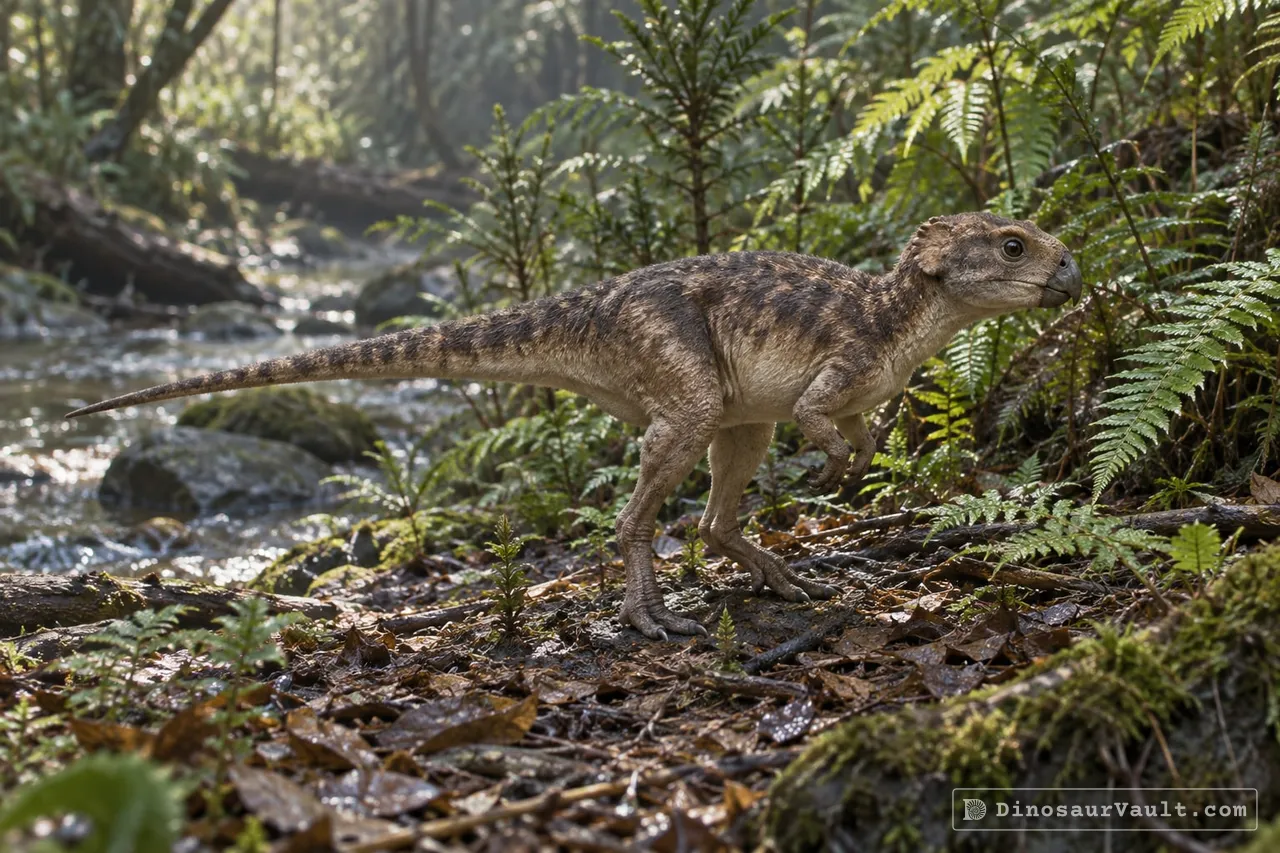
Sasayamagnomus was a small, early horned dinosaur, a plant eater with a beak. It is known from part of a skull and skeleton.
Its world
It lived in the Early Cretaceous, in what is now Japan. It comes from the Ohyamashimo Formation, where it shared the land with the small troodontid Hypnovenator and the sauropod Tambatitanis.
How it was found
Tanaka and colleagues named Sasayamagnomus in 2024. The type species is Sasayamagnomus saegusai.
Field gallery
More views of Sasayamagnomus
Scenes reconstructed from the available fossil evidence.
Lived alongside
Found in the same rock formations


A rock formation can hold fossils laid down millions of years apart, so not every animal here met Sasayamagnomus.
The evidence
The science behind Sasayamagnomus
Which parts of the picture come from its own bones, and which come from its relatives.
From its own fossils
- Parts of the skull and skeleton show a small, early horned dinosaur.
- Distinctive shapes in its cheek, rear skull and shoulder bones distinguish it from other early horned dinosaurs.
Borrowed from relatives
- Aquilops and Auroraceratops help fill in missing parts of its head and body.
Still unknown
- How large it grew as an adult.
- Its skin covering and color.
- Whether it lived in groups.
Discovery timeline
- 2014Close relativeFarke et al.
- 2024Named itTanaka et al.
- 2024Same rocksKubota, Kobayashi & Ikeda
Key papers
The research behind what we know of Sasayamagnomus
Close relative
Described the skull of Aquilops, a close relative useful for comparing the heads of early horned dinosaurs.
A Ceratopsian Dinosaur from the Lower Cretaceous of Western North America, and the Biogeography of Neoceratopsia. PLoS ONE 9: e112055
Read the paper : A Ceratopsian Dinosaur from the Lower Cretaceous of Western North America, and the Biogeography of Neoceratopsia (opens in a new tab)Named it
Named a small early horned dinosaur and found that Aquilops and Auroraceratops were among its closest relatives.
A new neoceratopsian (Ornithischia, Ceratopsia) from the Lower Cretaceous Ohyamashimo Formation (Albian), southwestern Japan. Papers in Palaeontology 10
Read the paper : A new neoceratopsian (Ornithischia, Ceratopsia) from the Lower Cretaceous Ohyamashimo Formation (Albian), southwestern Japan (opens in a new tab)Same rocks
Described Hypnovenator from river deposits in the same formation, preserved in a curled resting posture.
Early Cretaceous troodontine troodontid (Dinosauria: Theropoda) from the Ohyamashimo Formation of Japan reveals the early evolution of Troodontinae. Scientific Reports 14
Read the paper : Early Cretaceous troodontine troodontid (Dinosauria: Theropoda) from the Ohyamashimo Formation of Japan reveals the early evolution of Troodontinae (opens in a new tab)
Close relatives
Other members of Neoceratopsia


Sources: Wikidata