Tietasaura
"Tieta lizard"
Type species Tietasaura derbyiana
- Lived
- 137 to 126 million years ago, Early Cretaceous
- Diet
- Herbivore
- Group
- Ornithopods
- Found in
- Brazil
- Named by
- Bandeira et al. 2024
Where its fossils were found
The evidence
Today

130 million years ago
Habitat
Its bone comes from the Marfim Formation in Brazil, where sediments record lakes and river deltas. The wider region also supported sauropods and meat-eating dinosaurs.
Field notes
About Tietasaura
What it was like
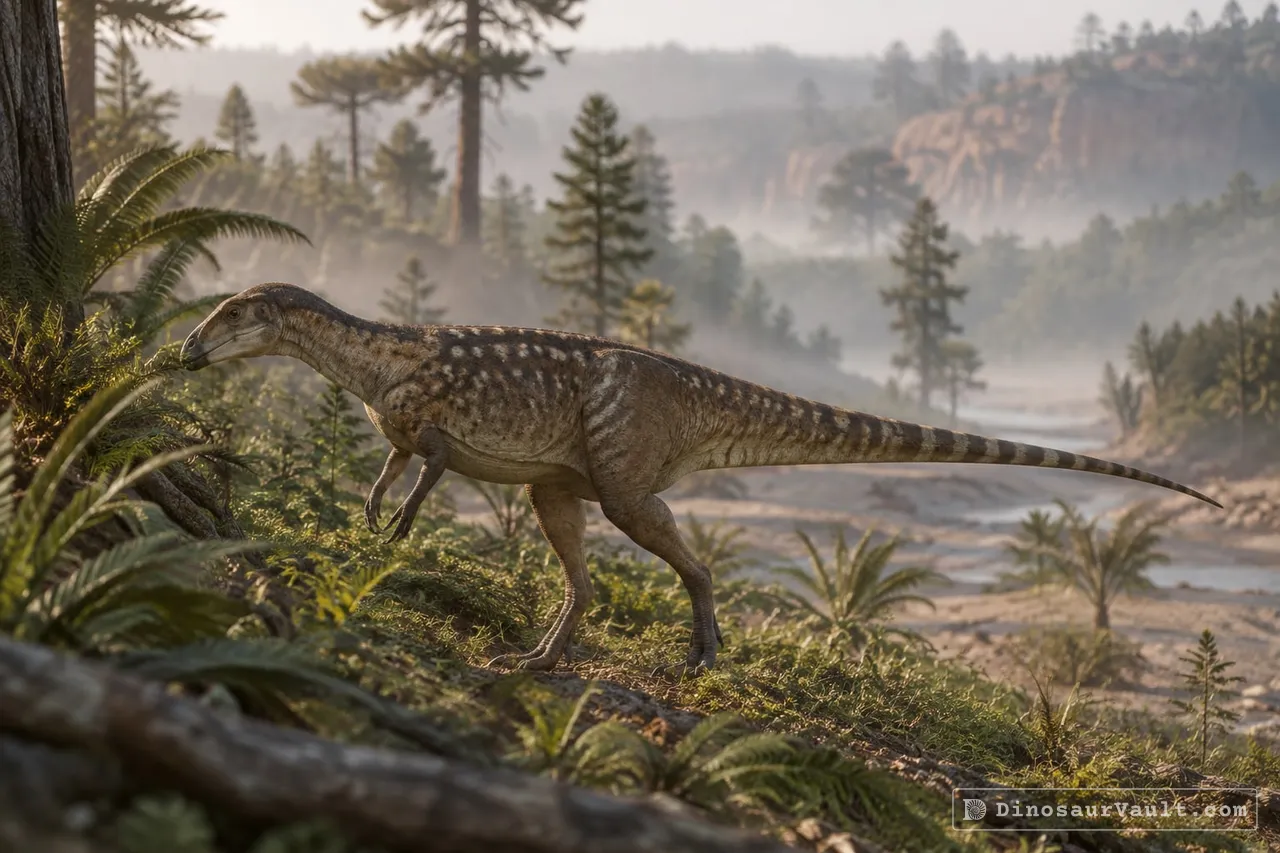
Tietasaura was a small, two-legged plant eater from the elasmarians, a group of southern ornithopods. It is known from a single thigh bone.
Its world
It lived in the Early Cretaceous in what is now Brazil. Its bone comes from the Marfim Formation.
How it was found
Bandeira and colleagues named it in 2024. The type species is Tietasaura derbyiana. The bone had been found long before. Its name comes from a character in a Brazilian novel.
Field gallery
More views of Tietasaura
Scenes reconstructed from the available fossil evidence.
1 of 3
The evidence
The science behind Tietasaura
Which parts of the picture come from its own bones, and which come from its relatives.
From its own fossils
- The only known bone is the lower half of a left thigh bone.
- The naming study linked the thigh bone to elasmarian ornithopods.
- The preserved shaft curves backward near the knee, where the inner joint surface is larger than the outer one.
Borrowed from relatives
- Lesothosaurus offers comparisons for the missing face and jaws, and Fona for the missing neck, body, limbs and tail.
Still unknown
- Its full size, body proportions, skin covering and color.
- The shape of its skull and teeth.
- A later review urges caution about placing the fragmentary bone among elasmarians.
Discovery timeline
- 2014Family treeIBIRICU et al.
- 2019Family treeRozadilla, Agnolín & Novas
- 2024Named itBandeira et al.
Key papers
The research behind what we know of Tietasaura
Family tree
Restudied Notohypsilophodon, confirming distinctive skeletal features in another small southern ornithopod used for comparison.
<strong>A reappraisal of <em>Notohypshilophodon</em> <em>comodorensis</em> (Ornithischia: Ornithopoda) from the Late Cretaceous of Patagonia, Argentina</strong>. Zootaxa 3786: 401
Read the paper : <strong>A reappraisal of <em>Notohypshilophodon</em> <em>comodorensis</em> (Ornithischia: Ornithopoda) from the Late Cretaceous of Patagonia, Argentina</strong> (opens in a new tab)Family tree
Described the nearly complete Talenkauen skeleton and the relatively long neck found in elasmarians.
Osteology of the Patagonian ornithopod Talenkauen santacrucensis (Dinosauria, Ornithischia). Journal of Systematic Palaeontology 17: 2043-2089
Read the paper : Osteology of the Patagonian ornithopod Talenkauen santacrucensis (Dinosauria, Ornithischia) (opens in a new tab)Named it
Reexamined long-stored bones from Brazil and named Tietasaura from a thigh bone it linked to the elasmarians.
A reassessment of the historical fossil findings from Bahia State (Northeast Brazil) reveals a diversified dinosaur fauna in the Lower Cretaceous of South America. Historical Biology 37: 548-589
Read the paper : A reassessment of the historical fossil findings from Bahia State (Northeast Brazil) reveals a diversified dinosaur fauna in the Lower Cretaceous of South America (opens in a new tab)
Close relatives
Other members of Elasmaria


Sources: Wikidata