Thanos
Type species Thanos simonattoi
- Lived
- 86 to 72 million years ago, Late Cretaceous
- Diet
- Carnivore
- Group
- Theropods, Abelisauridae
- Found in
- Brazil
- Named by
- Delcourt and Iori 2020
Where its fossils were found
The evidence
Today

80 million years ago
Habitat
It lived in the Late Cretaceous of Brazil, in a region crossed by rivers that split into shallow channels. The small long-necked plant eater Ibirania also comes from these rocks.
Field notes
About Thanos
What it was like
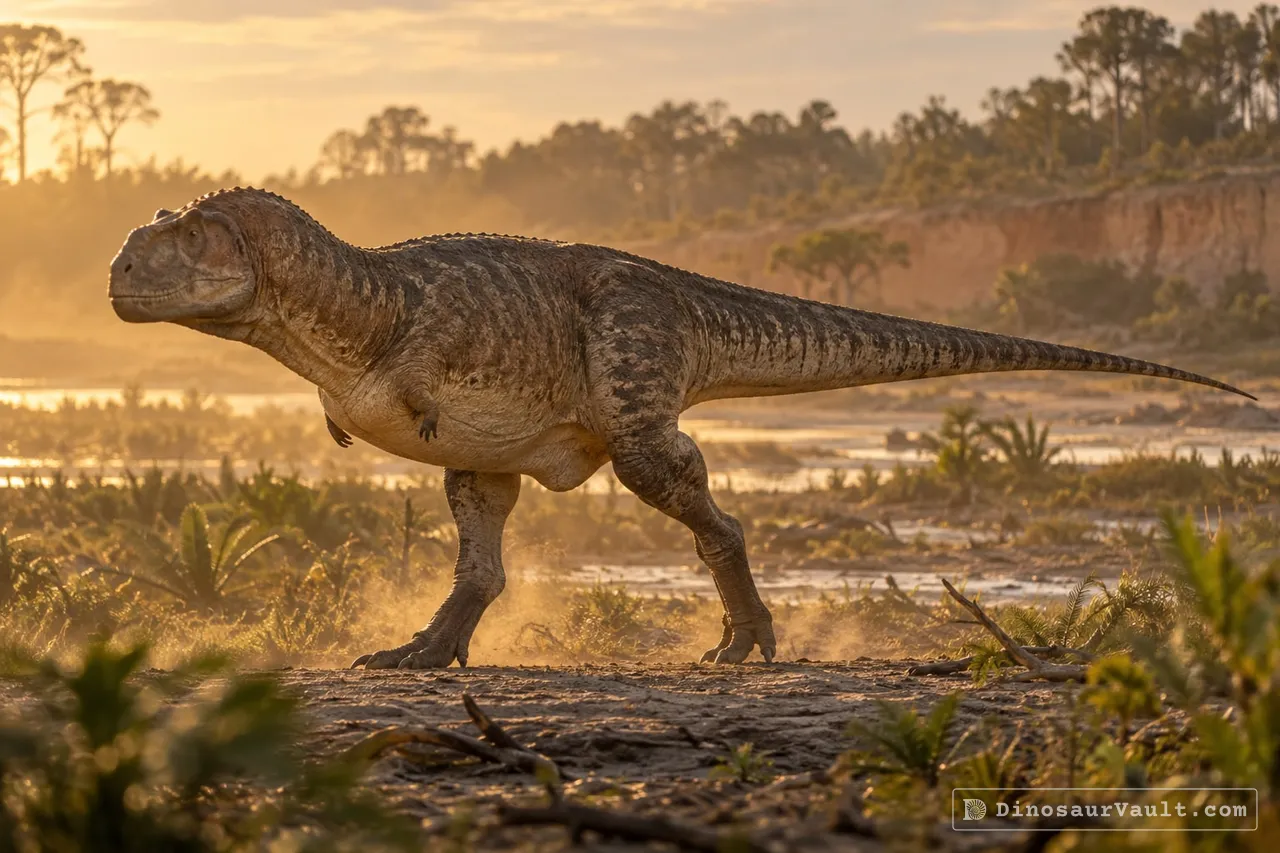
Thanos was an abelisaurid known from a single neck bone. Its head and arms are unknown, but relatives suggest it may have had a short, deep head and tiny arms.
Its world
It lived in the Late Cretaceous in what is now Brazil. Its bone comes from the São José do Rio Preto Formation, where the small titanosaur Ibirania also lived.
How it was found
Delcourt and Iori named it in 2020. The type species is Thanos simonattoi. Its name comes from a Greek word for death.
Field gallery
More views of Thanos
Scenes reconstructed from the available fossil evidence.
Lived alongside
Found in the same rock formations

A rock formation can hold fossils laid down millions of years apart, so not every animal here met Thanos.
The evidence
The science behind Thanos
Which parts of the picture come from its own bones, and which come from its relatives.
From its own fossils
- The only known fossil of Thanos is its axis, the neck bone just behind the skull, fused to a small bone beneath its front. Its front and back parts were collected separately.
- The bone has a strong keel underneath that deepens toward the back, two small openings on its side separated by a wide wall, and deep hollows beside its upper projections.
- Jaws, teeth and tail bones found nearby are treated as separate finds, not as parts of Thanos.
Borrowed from relatives
- The short, deep head and tiny arms in restorations follow better-known abelisaurids such as Carnotaurus and Majungasaurus.
- Its neck and chest are restored by comparison with Majungasaurus.
Still unknown
- The shape of its skull and limbs.
- Its exact place among abelisaurids. In at least one family-tree study its position was too unstable to settle.
- Its exact adult size.
Discovery timeline
- 2018Close relativesDelcourt
- 2020Named itDelcourt & Iori
- 2022Same rocksNavarro et al.
- 2023Family treeBaiano et al.
Key papers
The research behind what we know of Thanos
Close relatives
Reviewed the anatomy and ecology of ceratosaurs, including the deep skulls and reduced arms used to restore fragmentary abelisaurids.
Ceratosaur palaeobiology: new insights on evolution and ecology of the southern rulers. Scientific Reports 8
Read the paper : Ceratosaur palaeobiology: new insights on evolution and ecology of the southern rulers (opens in a new tab)Named it
Named Thanos from a distinctive neck vertebra and placed it among the short-snouted abelisaurids.
A new Abelisauridae (Dinosauria: Theropoda) from São José do Rio Preto Formation, Upper Cretaceous of Brazil and comments on the Bauru Group fauna. Historical Biology 32: 917-924
No link available
Same rocks
Named Ibirania from the same formation and showed that its small skeletons belonged to mature animals.
A New Nanoid Titanosaur (Dinosauria: Sauropoda) from the Upper Cretaceous of Brazil. Ameghiniana 59
Read the paper : A New Nanoid Titanosaur (Dinosauria: Sauropoda) from the Upper Cretaceous of Brazil (opens in a new tab)Family tree
Described the backbone of Aucasaurus, compared its axis with that of Thanos, and found Thanos among abelisaurids whose places in the family tree are unstable.
Osteology of the axial skeleton of Aucasaurus garridoi: phylogenetic and paleobiological inferences. PeerJ 11: e16236
Read the paper : Osteology of the axial skeleton of Aucasaurus garridoi: phylogenetic and paleobiological inferences (opens in a new tab)
Close relatives
Other members of Abelisauridae


Sources: Wikidata