Ibirania
"tree wanderer"
Type species Ibirania parva
- Lived
- 86 to 72 million years ago, Late Cretaceous
- Diet
- Herbivore
- Group
- Sauropods, Saltasauridae
- Found in
- Brazil
- Named by
- Navarro et al. 2022
Where its fossils were found
The evidence
Today

80 million years ago
Habitat
It lived in a hot landscape with dry seasons in what is now Brazil. The same formation also held Thanos and a larger meat eater that may have belonged to the megaraptor group.
Field notes
About Ibirania
What it was like
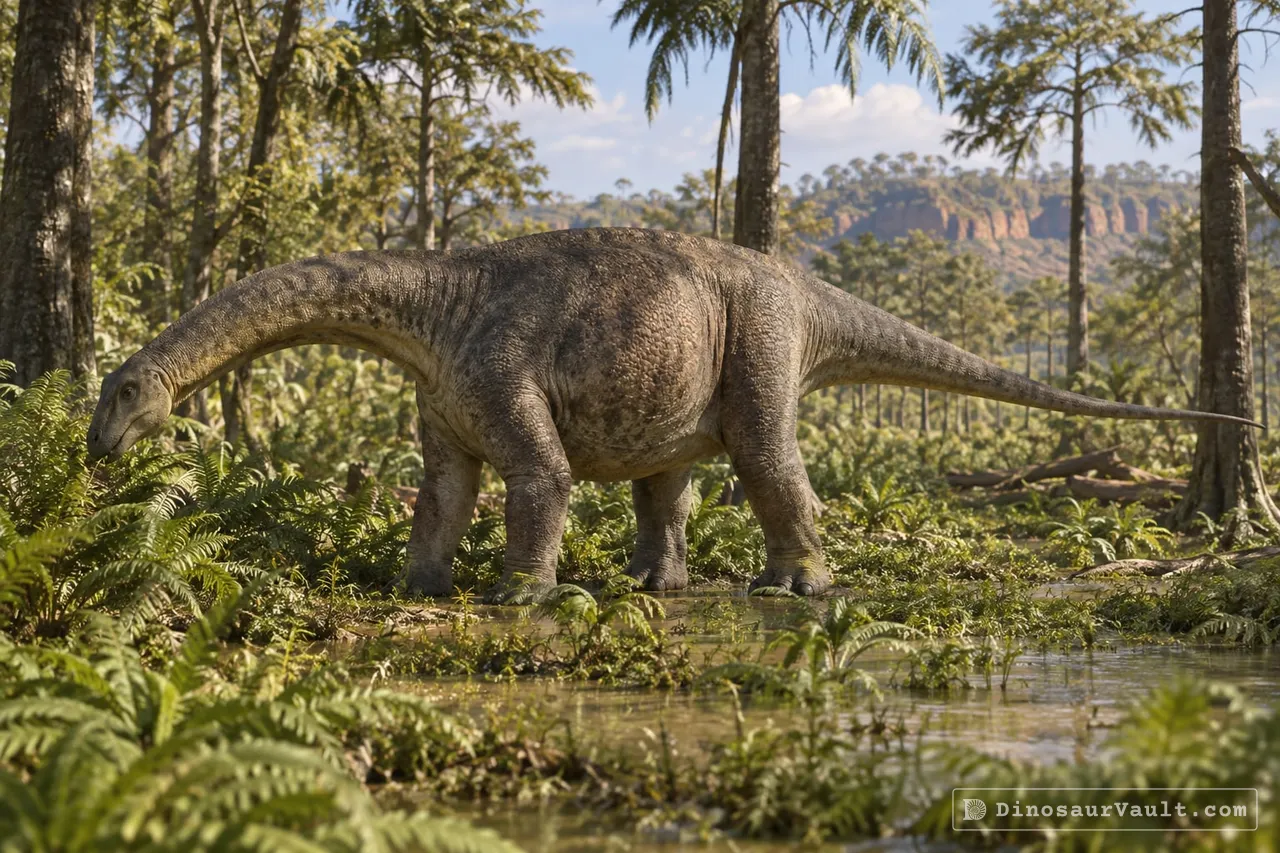
Ibirania was a dwarf titanosaur, one of the smallest long-necked dinosaurs known, only a few meters long. Its bones show it was fully grown, so its small size was not because it was young.
Its world
It lived in the Late Cretaceous in what is now southeastern Brazil. Its bones come from the São José do Rio Preto Formation, where it shared the land with the abelisaur Thanos. It lived in a hot, dry land, which may have favored small bodies.
How it was found
Navarro and colleagues named Ibirania in 2022. Three finds are known.
Field gallery
More views of Ibirania
Scenes reconstructed from the available fossil evidence.
Lived alongside
Found in the same rock formations

A rock formation can hold fossils laid down millions of years apart, so not every animal here met Ibirania.
The evidence
The science behind Ibirania
Which parts of the picture come from its own bones, and which come from its relatives.
From its own fossils
- Microscopic bone structure shows that the small individuals had finished growing, making Ibirania a dwarf sauropod.
- Its vertebrae contain many small air spaces and microscopic traces of an air sac system.
- A lower-leg bone has swelling and altered tissue from an aggressive bone infection.
Borrowed from relatives
- The missing head, neck and much of the tail are restored from related titanosaurs such as Saltasaurus and Neuquensaurus.
Still unknown
- The shape of its skull and full neck.
- Whether its skin carried bony armor.
- Why its ancestors became so small.
Discovery timeline
- 2021Full descriptionAureliano et al.
- 2021Full descriptionAureliano et al.
- 2022Named itNavarro et al.
Key papers
The research behind what we know of Ibirania
Full description
Found microscopic traces of air sacs and a complex network of air spaces inside the vertebrae of the dwarf titanosaur.
Exquisite air sac histological traces in a hyperpneumatized nanoid sauropod dinosaur from South America. Scientific Reports 11
Read the paper : Exquisite air sac histological traces in a hyperpneumatized nanoid sauropod dinosaur from South America (opens in a new tab)Full description
Traced a severe bone infection and reported microscopic remains interpreted as parasites inside the affected bone.
Blood parasites and acute osteomyelitis in a non-avian dinosaur (Sauropoda, Titanosauria) from the Upper Cretaceous Adamantina Formation, Bauru Basin, Southeast Brazil. Cretaceous Research 118: 104672
Read the paper : Blood parasites and acute osteomyelitis in a non-avian dinosaur (Sauropoda, Titanosauria) from the Upper Cretaceous Adamantina Formation, Bauru Basin, Southeast Brazil (opens in a new tab)Named it
Named a dwarf titanosaur from Brazil and showed that its small bones belonged to fully grown individuals.
A New Nanoid Titanosaur (Dinosauria: Sauropoda) from the Upper Cretaceous of Brazil. Ameghiniana 59
Read the paper : A New Nanoid Titanosaur (Dinosauria: Sauropoda) from the Upper Cretaceous of Brazil (opens in a new tab)
Close relatives
Other members of Saltasauridae


Sources: Wikidata