Hypnovenator
"sleep hunter"
Type species Hypnovenator matsubaraetoheorum
- Lived
- 113 to 106 million years ago, Early Cretaceous
- Diet
- Omnivore
- Group
- Theropods, Troodontidae
- Found in
- Japan
- Named by
- Kubota et al. 2024
Where its fossils were found
The evidence
Today

110 million years ago
Habitat
Rivers crossed the landscape of what is now Japan. Sasayamagnomus and Tambatitanis are also known from the Ohyamashimo Formation.
Field notes
About Hypnovenator
What it was like
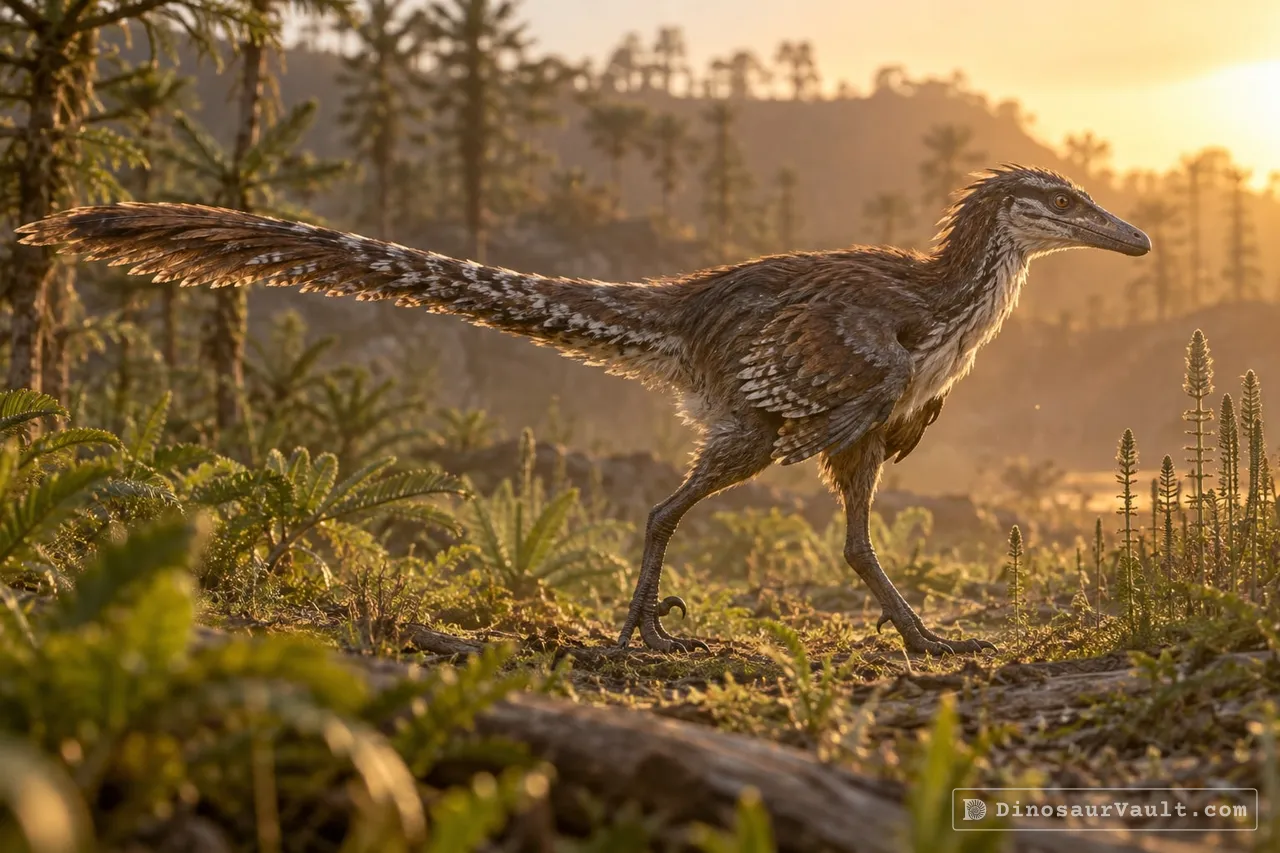
Hypnovenator was a small troodontid, a feathered theropod. Its skeleton was found curled up, head tucked in, in the same sleeping pose seen in some birds.
Its world
It lived in the Early Cretaceous, in what is now Japan. It comes from the Ohyamashimo Formation, where it shared the land with the small horned dinosaur Sasayamagnomus and the sauropod Tambatitanis.
How it was found
Kubota and colleagues named Hypnovenator in 2024. The type species is Hypnovenator matsubaraetoheorum.
Field gallery
More views of Hypnovenator
Scenes reconstructed from the available fossil evidence.
1 of 3
Lived alongside
Found in the same rock formations


A rock formation can hold fossils laid down millions of years apart, so not every animal here met Hypnovenator.
The evidence
The science behind Hypnovenator
Which parts of the picture come from its own bones, and which come from its relatives.
From its own fossils
- A partial skeleton preserves arm and leg bones, fingers, toes, ribs and a few tail bones.
- The forelimb and ankles were folded, with the toes tucked beneath the belly, in a birdlike sleeping posture.
Borrowed from relatives
- Feathers are restored by comparison with feathered relatives such as Anchiornis.
- Its missing head is modeled on better-known troodontids such as Mei and Sinornithoides.
Still unknown
- The shape of its skull.
- The color and exact arrangement of its feathers.
- What it ate.
Discovery timeline
- 2004Close relativeXu & Norell
- 2009Close relativeHu et al.
- 2024Named itKubota, Kobayashi & Ikeda
Key papers
The research behind what we know of Hypnovenator
Close relative
Described Mei curled up like a sleeping bird, a comparison for the folded limbs of Hypnovenator.
A new troodontid dinosaur from China with avian-like sleeping posture. Nature 431: 838-841
Read the paper : A new troodontid dinosaur from China with avian-like sleeping posture (opens in a new tab)Close relative
Described extensive feathers in Anchiornis, supporting feathered restorations of related dinosaurs such as Hypnovenator.
A pre-Archaeopteryx troodontid theropod from China with long feathers on the metatarsus. Nature 461: 640-643
Read the paper : A pre-Archaeopteryx troodontid theropod from China with long feathers on the metatarsus (opens in a new tab)Named it
Described a troodontid skeleton preserved in a sleeping posture and placed Hypnovenator near the early branches of Troodontinae.
Early Cretaceous troodontine troodontid (Dinosauria: Theropoda) from the Ohyamashimo Formation of Japan reveals the early evolution of Troodontinae. Scientific Reports 14
Read the paper : Early Cretaceous troodontine troodontid (Dinosauria: Theropoda) from the Ohyamashimo Formation of Japan reveals the early evolution of Troodontinae (opens in a new tab)
Close relatives
Other members of Troodontidae


Sources: Wikidata