Spectrovenator
"ghost hunter"
Type species Spectrovenator ragei
- Lived
- 121 to 113 million years ago, Early Cretaceous
- Diet
- Carnivore
- Group
- Theropods, Abelisauridae
- Found in
- Brazil
- Named by
- Zaher et al. 2020
Where its fossils were found
The evidence
Today

115 million years ago
Habitat
A lake basin in what is now Brazil. The long-necked plant eater Tapuiasaurus lived in the same region.
Field notes
About Spectrovenator
What it was like
Spectrovenator was a small, early abelisaur. It is known from a nearly complete skull and part of the skeleton, which help show how the short-snouted abelisaurs began.
Its world
It lived in the Early Cretaceous, in what is now Brazil. It comes from the Quiricó Formation, where it was found close to the titanosaur Tapuiasaurus.
How it was found
Zaher and colleagues named Spectrovenator in 2020. The type species is Spectrovenator ragei.
Field gallery
More views of Spectrovenator
Scenes reconstructed from the available fossil evidence.
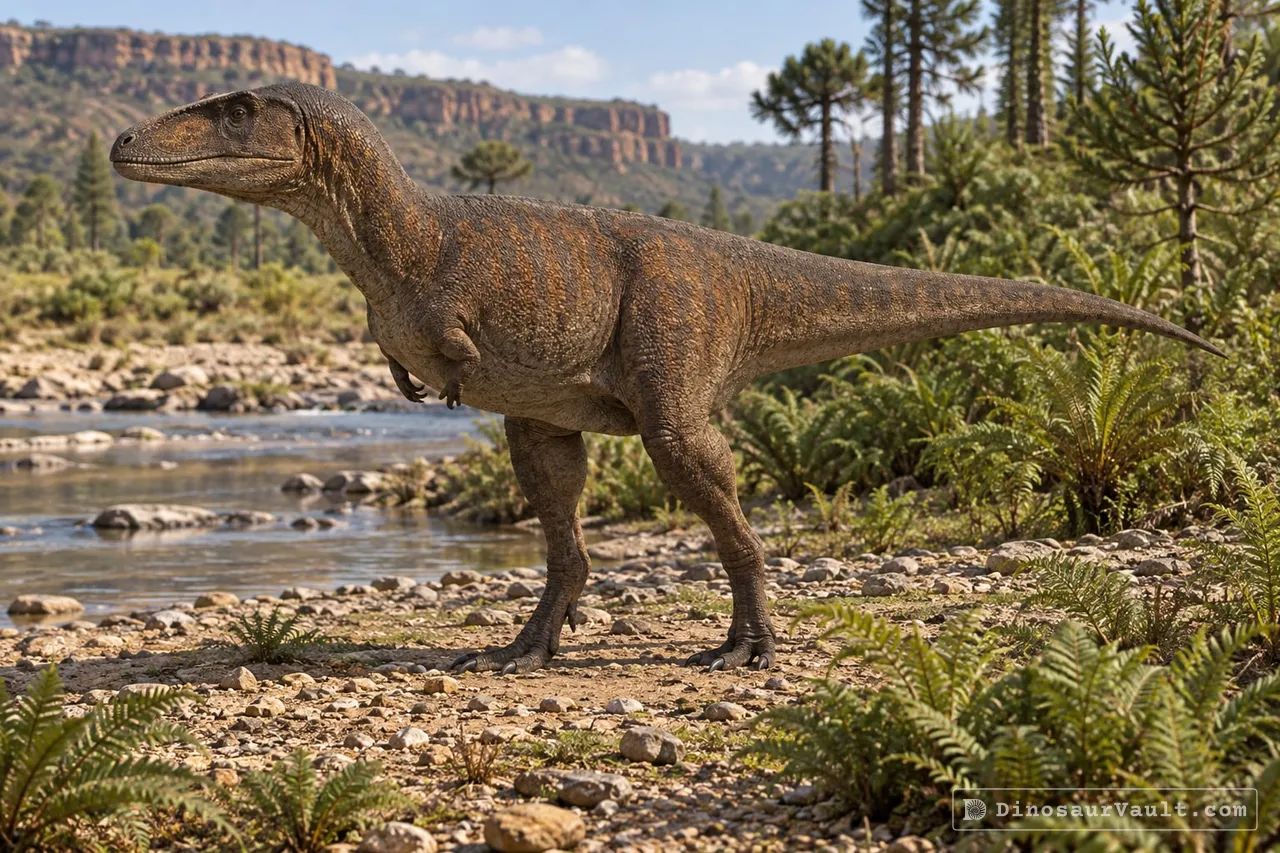
1 of 3
Lived alongside
Found in the same rock formations

A rock formation can hold fossils laid down millions of years apart, so not every animal here met Spectrovenator.
The evidence
The science behind Spectrovenator
Which parts of the picture come from its own bones, and which come from its relatives.
From its own fossils
- A nearly complete skull and lower jaws preserve grooved snout bones and a broad, relatively flat skull roof.
- The skeleton includes the pelvis and hindlimbs, along with parts of the neck, back and tail.
Borrowed from relatives
- Missing arms must be restored by comparison with other abelisaurs, such as Majungasaurus and Carnotaurus.
Still unknown
- The size and shape of its arms.
- Its skin color and pattern.
- Which animals it hunted.
Discovery timeline
- 2011Same rocksZaher et al.
- 2020Named itZAHER et al.
- 2025How it fedPereyra et al.
Key papers
The research behind what we know of Spectrovenator
Same rocks
Described Tapuiasaurus, the long-necked plant eater from the same lake deposits as Spectrovenator.
A Complete Skull of an Early Cretaceous Sauropod and the Evolution of Advanced Titanosaurians. PLoS ONE 6: e16663
Read the paper : A Complete Skull of an Early Cretaceous Sauropod and the Evolution of Advanced Titanosaurians (opens in a new tab)Named it
Named an early abelisaur whose skull shows an earlier stage of the feeding anatomy seen in later members of the family.
An Early Cretaceous theropod dinosaur from Brazil sheds light on the cranial evolution of the Abelisauridae. Comptes Rendus Palevol
Read the paper : An Early Cretaceous theropod dinosaur from Brazil sheds light on the cranial evolution of the Abelisauridae (opens in a new tab)How it fed
Compared upper jaw shapes and suggested that Spectrovenator already shared a specialized hunting strategy with later abelisaurs.
Morphology of the maxilla informs about the type of predation strategy in the evolution of Abelisauridae (Dinosauria: Theropoda). Scientific Reports 15
Read the paper : Morphology of the maxilla informs about the type of predation strategy in the evolution of Abelisauridae (Dinosauria: Theropoda) (opens in a new tab)
Close relatives
Other members of Abelisauridae


Sources: Wikidata